Build Your US Startup Advisory Board: 6-Month Guide 2025

Building a strong US startup advisory board in 2025 is crucial for navigating market complexities and accelerating growth, providing invaluable expertise and strategic guidance for nascent ventures.
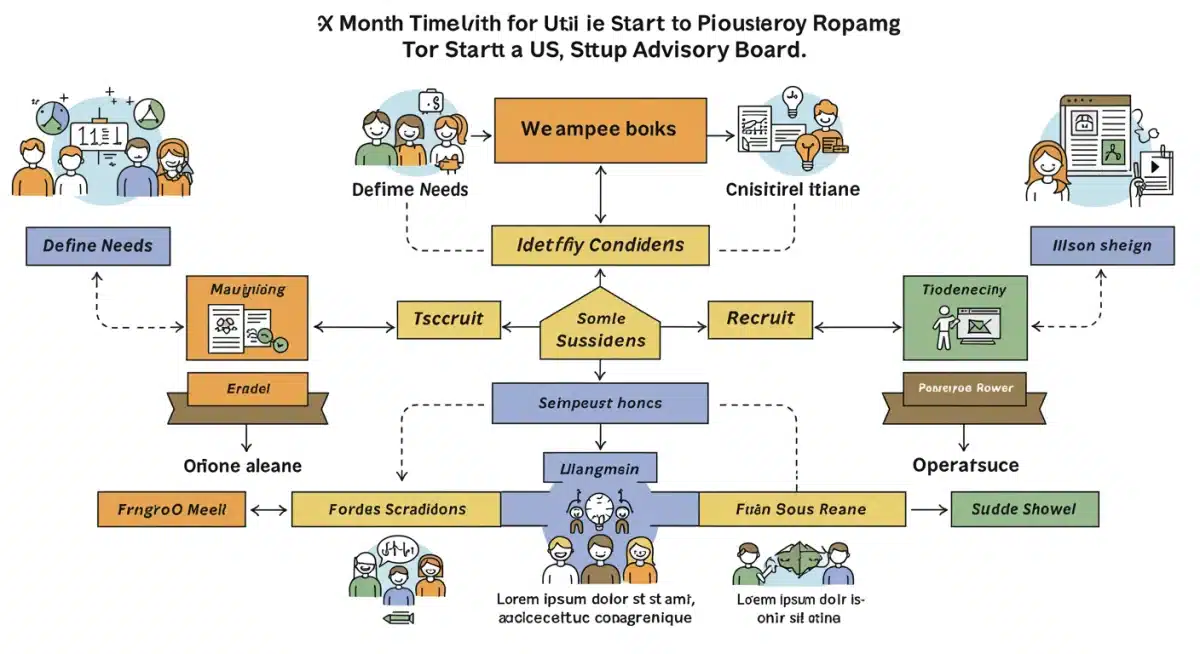
Embarking on the journey of a startup in the United States is both exhilarating and challenging. To significantly enhance your chances of success, establishing a robust advisory board is not just an option but a strategic imperative. This guide provides a comprehensive, six-month roadmap for implementing practical solutions: building your first US startup advisory board: a 6-month guide for 2025, ensuring you harness the collective wisdom needed to thrive.
Understanding the strategic imperative of an advisory board
Before diving into the ‘how,’ it is crucial to grasp the ‘why.’ An advisory board, distinct from a board of directors, offers non-binding strategic counsel. For US startups, this counsel can be transformative, providing insights into market trends, regulatory landscapes, and critical operational challenges. They act as mentors, sounding boards, and connectors, helping founders avoid common pitfalls and seize emerging opportunities.
In the dynamic US market of 2025, having external perspectives grounded in experience is more valuable than ever. Advisors bring diverse backgrounds, from seasoned entrepreneurs to industry veterans, offering a panoramic view that internal teams often lack. This external validation and guidance are especially critical during early growth stages when resources are limited and decisions carry significant weight.
The difference between an advisory board and a board of directors
Many founders confuse these two entities, but their roles are fundamentally different. A board of directors has fiduciary duties and legal obligations to the company and its shareholders, making binding decisions. An advisory board, however, provides guidance and expertise without legal or fiduciary responsibilities. This distinction allows for more candid, informal, and flexible advice, which can be incredibly beneficial for a startup still finding its footing.
- Board of Directors: Legal oversight, fiduciary duty, binding decisions, shareholder representation.
- Advisory Board: Strategic counsel, non-binding advice, industry expertise, mentorship, networking.
- Flexibility: Advisory boards are easier to form and dissolve, adapting to evolving startup needs.
Understanding this distinction is the first step in effective board building. It clarifies expectations for potential advisors and ensures that their role aligns with the startup’s strategic needs. The advisory board is a resource for growth and problem-solving, not governance.
The strategic imperative of an advisory board lies in its ability to augment a startup’s internal capabilities without adding the complexities of formal governance. It’s a powerful tool for navigating the intricate US business landscape, providing a competitive edge through informed decision-making and robust networking.
Month 1: Defining your needs and ideal advisor profile
The first month of building your US startup advisory board is dedicated to introspection and strategic alignment. Before you can identify the right people, you must precisely define what expertise and perspectives your startup needs most. This involves a thorough assessment of your current team’s strengths and weaknesses, your market challenges, and your growth objectives for 2025.
Consider the gaps in your knowledge, your network, and your strategic planning. Are you struggling with market entry, product-market fit, fundraising, or scaling operations? Each of these areas requires specific types of expertise. A clear understanding of these needs will form the foundation of your ideal advisor profile, ensuring that every board member brings targeted value.
Identifying critical knowledge gaps
Start by honestly evaluating your team. Where do you lack experience? Do you need guidance on specific technologies, regulatory compliance in the US, or perhaps sales and marketing strategies for a niche market? Document these gaps comprehensively. This exercise can often reveal blind spots that could hinder your startup’s progress if left unaddressed.
- Market expertise: Understanding specific US market segments, customer behaviors, and competitive landscapes.
- Technical proficiency: Guidance on emerging technologies, product development, or intellectual property.
- Financial acumen: Expertise in fundraising, financial modeling, or investor relations.
- Operational scaling: Advice on growing infrastructure, human resources, or supply chains.
Once you have a clear picture of your needs, you can begin to sketch out the ideal advisor profile. This profile should include not only professional experience and skills but also personal attributes. Look for individuals who are passionate about your mission, possess strong ethical values, and are genuinely interested in contributing to your success.
Defining your needs and ideal advisor profile in month one sets a clear direction for the entire board-building process. It ensures that your search is focused and purposeful, maximizing the likelihood of attracting advisors who will truly add value to your US startup.
Month 2-3: Researching and identifying potential candidates
With a clear understanding of your needs and ideal advisor profile, months two and three are dedicated to proactive research and identification of potential candidates. This phase is about casting a wide yet discerning net, leveraging your existing network, and exploring new avenues to find individuals who align with your strategic requirements. Remember, quality over quantity is paramount when building an advisory board.
Begin by tapping into your immediate and extended professional network. Who do you know that embodies the expertise you seek? Who do your mentors or investors know? Personal referrals often yield the most engaged and suitable candidates. Beyond direct connections, explore industry events, professional organizations, and even LinkedIn to identify thought leaders and experienced professionals in your target areas.
Leveraging your network and beyond
Your network is your most valuable asset during this stage. Reach out to mentors, investors, past colleagues, and even friends who might have connections to suitable candidates. Be clear about the specific skills and experience you are looking for, and articulate the value proposition of advising your startup. Networking events, both in-person and virtual, can also be fertile ground for discovering potential advisors.
Consider individuals who have successfully navigated challenges similar to those your startup faces. Look for those with a proven track record of contributing meaningfully to other ventures. Don’t shy away from reaching out to individuals who might seem out of your league; a compelling vision and a clear ask can often open doors.
- LinkedIn: Search for professionals with specific titles, industries, and experience relevant to your needs.
- Industry associations: Many sectors have professional bodies where leaders congregate and share insights.
- Startup accelerators/incubators: These often have networks of experienced mentors and advisors.
- Conferences and webinars: Identify speakers and panelists who demonstrate thought leadership in your target areas.
Once you’ve identified a list of potential candidates, conduct thorough background research. Review their professional history, publications, public speaking engagements, and any other indicators of their expertise and character. This due diligence is crucial to ensure that potential advisors not only possess the right skills but also align with your startup’s culture and values.
The research phase is iterative; you may refine your ideal profile as you learn more about available talent. By the end of month three, you should have a solid shortlist of highly qualified and genuinely interested individuals, ready for initial engagement.
Month 4: Initial outreach and recruitment strategies
Month four shifts the focus from identification to active engagement and recruitment. This is where you begin to formally approach your shortlisted candidates, articulating your vision, the value proposition of your startup, and the specific role you envision for them on your advisory board. Your approach must be professional, compelling, and respectful of their time and expertise.
Craft personalized outreach messages that highlight why you specifically chose them, referencing their unique contributions and how their expertise directly addresses your startup’s needs. Avoid generic templates. Emphasize the opportunity to shape an innovative venture and the potential for impact, rather than solely focusing on monetary compensation, which for advisory roles is often minimal or equity-based.

Crafting your value proposition for advisors
Advisors are often busy and successful individuals. To attract top talent, you need to present a clear and attractive value proposition. This goes beyond financial incentives and includes the intellectual challenge, the opportunity to contribute to a groundbreaking idea, and the potential for personal and professional growth. Clearly define the time commitment expected, the types of advice you seek, and how their contributions will be recognized.
Prepare a concise pitch deck or summary document that clearly outlines your startup’s mission, market opportunity, team, progress to date, and the specific challenges an advisor would help address. This demonstrates your professionalism and preparedness, making it easier for potential advisors to assess the fit.
- Clear expectations: Define meeting frequency, communication channels, and specific areas of focus.
- Impact: Highlight how their advice will directly influence key strategic decisions and growth milestones.
- Networking: Offer opportunities to connect with other high-caliber advisors and industry leaders.
- Recognition: Consider public acknowledgment, such as listing them on your website or in press releases.
During initial conversations, be an active listener. Understand their motivations for considering an advisory role and address any concerns they might have. This two-way dialogue is crucial for building rapport and ensuring mutual alignment. Be prepared to discuss compensation, which typically involves equity options or a small retainer, structured to reflect the expected time commitment and value provided.
Successful recruitment in month four hinges on a well-defined approach, personalized communication, and a compelling value proposition that resonates with the aspirations of experienced professionals. This sets the stage for formalizing relationships in the subsequent month.
Month 5: Formalizing agreements and onboarding
By month five, you should have identified and gained verbal commitments from your chosen advisors. This phase is about formalizing those relationships through clear agreements and initiating a structured onboarding process. A well-defined agreement protects both parties, setting clear expectations regarding roles, responsibilities, compensation, confidentiality, and terms of engagement. It’s a critical step to ensure a professional and productive advisory relationship.
Work with legal counsel to draft an advisory agreement. This document should be tailored to your specific needs and comply with US legal standards. It typically outlines the scope of services, meeting schedules, intellectual property clauses, and the term of the agreement. Clarity in these documents prevents misunderstandings down the line and establishes a strong foundation for collaboration.
Key components of an advisory agreement
The advisory agreement is more than just a formality; it’s a blueprint for your working relationship. It should be comprehensive yet easy to understand. Discuss each clause with your advisors to ensure full transparency and mutual agreement. This collaborative approach builds trust and demonstrates your commitment to a fair and professional partnership.
- Scope of services: Clearly define the types of advice and support expected.
- Compensation: Detail equity grants (vesting schedule), cash retainers, or expense reimbursements.
- Confidentiality: Standard non-disclosure clauses to protect sensitive company information.
- Term and termination: Outline the duration of the agreement and conditions for termination by either party.
- Intellectual property: Clarify ownership of any ideas or contributions made by the advisor.
Once agreements are signed, initiate the onboarding process. This involves providing advisors with all necessary information to effectively contribute. Share your business plan, pitch deck, market research, and any relevant financial documents. Introduce them to key team members and ensure they understand your current challenges and strategic priorities. A smooth onboarding experience allows advisors to quickly integrate and begin adding value.
Formalizing agreements and executing a thorough onboarding process in month five transforms verbal commitments into actionable partnerships. This meticulous approach ensures that your US startup advisory board is well-equipped and legally sound, ready to contribute meaningfully to your growth.
Month 6: Integrating and maximizing advisory board value
The final month of this guide focuses on actively integrating your newly formed advisory board into your startup’s operations and establishing mechanisms to maximize their value. Forming the board is only the first step; sustained engagement and effective utilization of their expertise are crucial for long-term success. This involves setting up regular communication, structured meetings, and clear channels for feedback and collaboration.
Schedule regular advisory board meetings, perhaps quarterly or bi-monthly, depending on your needs and their availability. These meetings should have clear agendas, distributed in advance, focusing on strategic discussions rather than operational minutiae. Encourage open dialogue, critical questioning, and diverse perspectives. Between meetings, maintain informal communication channels, such as email updates or quick calls, to keep them informed and engaged.
Effective meeting structures and engagement strategies
To maximize the value of your advisory board, meetings must be productive and focused. Treat their time as a precious resource. Encourage them to prepare by providing pre-reading materials and specific questions you need their input on. During meetings, facilitate discussions that tap into their unique experiences and insights, and ensure that action items are clearly assigned and followed up on.
- Structured agendas: Clearly defined topics, allocated time, and desired outcomes for each discussion point.
- Pre-reading materials: Distribute relevant documents well in advance to allow for thoughtful preparation.
- Actionable feedback: Encourage advisors to provide specific, constructive advice rather than general observations.
- Follow-up: Communicate how their advice was utilized and the impact it had, reinforcing their value.
Beyond formal meetings, consider creating opportunities for advisors to interact with your team members individually or in small groups. This can provide deeper insights into specific challenges and foster stronger relationships. Seek their input on investor pitches, product roadmaps, or market expansion strategies. Regularly solicit feedback on the advisory board’s effectiveness and adapt your approach as needed.
Maximizing advisory board value in month six and beyond is an ongoing process that requires active management and a commitment to leveraging their expertise. By fostering a culture of open communication and strategic collaboration, your US startup advisory board can become an indispensable asset, guiding you towards sustained growth and success in 2025 and beyond.
| Key Phase | Brief Description |
|---|---|
| Define Needs | Assess startup gaps and outline ideal advisor profiles. |
| Research Candidates | Leverage networks to identify and vet potential advisors. |
| Formalize Agreements | Draft and sign legal agreements, then onboard new advisors. |
| Maximize Value | Integrate advisors, schedule meetings, and ensure ongoing engagement. |
Frequently asked questions about US startup advisory boards
An advisory board provides non-binding strategic guidance and expertise, while a board of directors holds fiduciary duties and makes legally binding decisions for the company. Advisors offer flexible counsel without governance responsibilities.
For a first-time US startup, an advisory board of three to five members is ideal. This size allows for diverse perspectives without becoming unwieldy, ensuring each advisor can contribute meaningfully and effectively.
Compensation for US startup advisors commonly involves equity options, typically ranging from 0.1% to 1.0% of the company, often with a vesting schedule. Some high-profile advisors might also receive a small cash retainer, especially for significant time commitments.
The frequency of meetings can vary, but quarterly meetings are a common and effective cadence for US startup advisory boards. This allows sufficient time for progress between sessions while maintaining consistent engagement and strategic oversight.
Clear communication and defined expectations are paramount. Both the startup and its advisors must understand their roles, the scope of advice, time commitments, and how contributions will be recognized to ensure a productive and mutually beneficial relationship.
Conclusion
Building your first US startup advisory board is an investment that yields significant dividends in strategic guidance, market insight, and accelerated growth. By meticulously following this six-month guide, from defining your needs to actively integrating your advisors, you can assemble a powerful team of mentors and experts. This strategic asset will not only help navigate the complexities of the 2025 US market but also provide the crucial support needed to transform your innovative vision into a thriving reality. Embrace this journey, and empower your startup with the wisdom it deserves.
Related Posts: