Predictive Analytics AI: Boost E-commerce Sales 20% by 2025
AI-driven predictive analytics is set to revolutionize US e-commerce, offering practical solutions to boost sales forecast accuracy by 20% by 2025, enabling smarter inventory, marketing, and customer engagement strategies.
By: Eduarda Moura on August 6, 2025
Last updated on: November 28, 2025
AI-driven predictive analytics is rapidly transforming the US e-commerce landscape, offering robust solutions to significantly enhance sales forecast accuracy and drive substantial growth by 2025.
The competitive landscape of US e-commerce demands precision and foresight. Businesses that can accurately predict future sales gain a monumental advantage. This is where predictive analytics AI e-commerce steps in, offering a transformative approach to forecasting that promises to boost sales forecast accuracy by a remarkable 20% by 2025. It’s no longer just about reacting to market shifts; it’s about anticipating them with intelligent, data-driven strategies.
Understanding the Power of Predictive Analytics in E-commerce
In the dynamic world of e-commerce, anticipating customer demand and market trends is paramount. Predictive analytics, powered by artificial intelligence, offers a sophisticated solution by analyzing vast historical datasets to identify patterns and predict future outcomes. This capability moves businesses beyond traditional forecasting methods, which often rely on simple averages or linear trends, towards a more nuanced and accurate understanding of future sales.
For US e-commerce businesses, this means the ability to make more informed decisions across various operational facets. From inventory management to targeted marketing campaigns, the insights derived from AI-driven predictive models can significantly reduce waste, optimize resource allocation, and ultimately, enhance profitability. The goal is not just to predict what might happen, but to understand why and how to influence it positively.
What is Predictive Analytics?
Predictive analytics leverages statistical algorithms and machine learning techniques to identify the likelihood of future outcomes based on historical data. It’s about using data to make educated guesses about what will happen next. In e-commerce, this translates to forecasting demand for specific products, identifying potential customer churn, or predicting market shifts before they fully materialize.
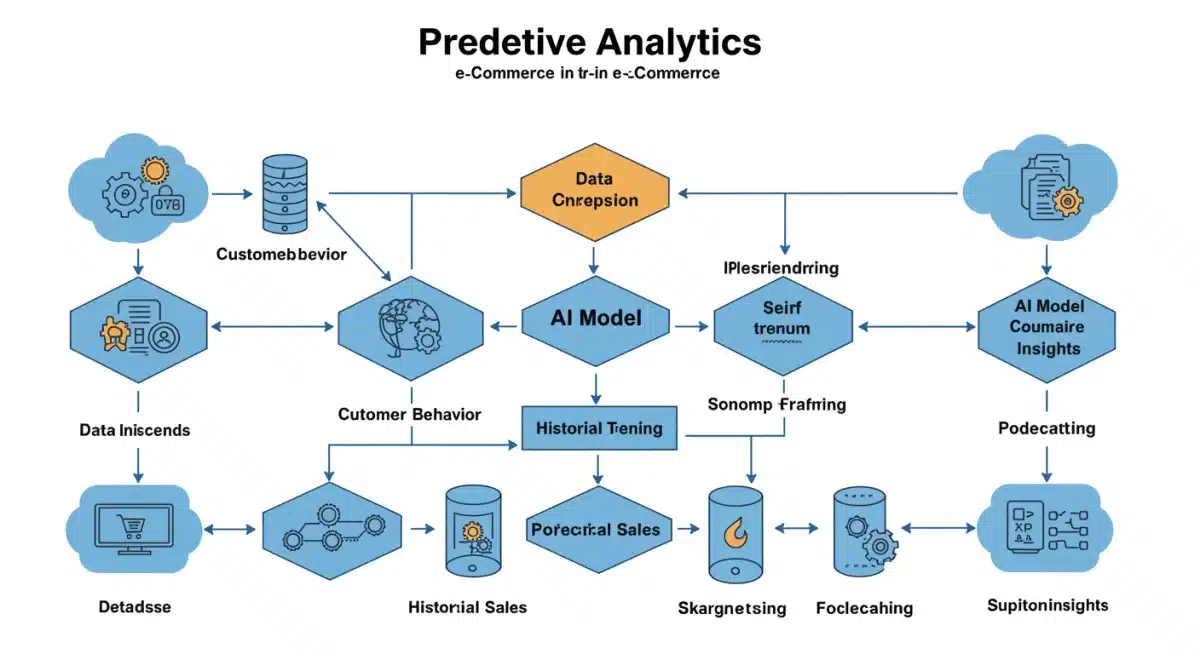
Data Collection: Gathers historical sales, customer behavior, website traffic, and external market data.
Model Building: Utilizes machine learning algorithms to detect complex patterns and relationships within the data.
Forecasting: Generates future projections for sales, demand, or customer actions based on trained models.
Actionable Insights: Translates predictions into practical strategies for inventory, marketing, and operations.
The evolution of AI has propelled predictive analytics from a niche data science tool into a mainstream business imperative, making it accessible and powerful for e-commerce platforms of all sizes. The ability to process and interpret massive datasets in real-time gives businesses an unprecedented edge.
In conclusion, predictive analytics powered by AI is not just an incremental improvement over traditional methods; it’s a paradigm shift. It empowers e-commerce businesses to transform uncertainty into actionable intelligence, laying the groundwork for significant growth and efficiency gains.
Key AI Technologies Driving Enhanced Sales Forecasting
The significant boost in sales forecast accuracy promised by predictive analytics is largely attributable to advancements in specific AI technologies. These technologies enable e-commerce platforms to move beyond simple trend analysis, delving into the intricate factors that influence consumer behavior and market dynamics. Understanding these core AI components is crucial for any business looking to implement robust forecasting solutions.
Modern AI models can process diverse data types, including structured sales data, unstructured customer reviews, and even external economic indicators, to paint a comprehensive picture of future demand. This multi-faceted approach is what differentiates AI-driven forecasting from its predecessors, offering a level of accuracy and granularity previously unattainable.
Machine Learning Algorithms for Prediction
At the heart of AI-driven predictive analytics are sophisticated machine learning algorithms. These algorithms learn from historical data, identifying complex, non-linear relationships that human analysts might miss. Regression models, decision trees, neural networks, and ensemble methods are commonly employed to build predictive models.
Time Series Analysis: Models like ARIMA and Prophet are excellent for predicting future values based on past observations over time, crucial for seasonal sales.
Deep Learning: Neural networks, especially Recurrent Neural Networks (RNNs) and Long Short-Term Memory (LSTM) networks, excel at processing sequential data, like customer journey paths or website clickstreams, to predict conversions.
Ensemble Methods: Techniques such as Random Forests and Gradient Boosting combine multiple models to improve overall prediction accuracy and robustness, reducing overfitting.
These algorithms are continuously refined and optimized, allowing for more precise predictions as more data becomes available and as computational power increases. The ability to adapt and learn is a hallmark of effective AI forecasting systems.
Beyond core algorithms, natural language processing (NLP) and computer vision are also playing increasingly important roles. NLP can analyze customer reviews, social media sentiment, and search queries to gauge demand and identify emerging trends. Computer vision, while less direct, can analyze product images to understand visual appeal or even monitor competitor inventory levels through publicly available images. These complementary AI technologies provide a richer context for sales predictions, enhancing overall accuracy.
In summary, the synergy of advanced machine learning algorithms with other AI capabilities like NLP is what truly empowers predictive analytics to deliver exceptionally accurate sales forecasts for US e-commerce businesses.
Practical Solutions: Implementing AI for Sales Forecasting
Implementing AI for sales forecasting in an e-commerce environment requires a structured approach, moving from data preparation to model deployment and continuous refinement. It’s not a one-time project but an ongoing process of learning and adaptation. The key is to start with clear objectives and gradually integrate more sophisticated AI capabilities as the business matures.
Many US e-commerce businesses might feel overwhelmed by the prospect of integrating AI, but modern platforms and tools have made it more accessible than ever. The focus should be on practical, actionable steps that deliver measurable results, starting with foundational data strategies.
Data Integration and Preparation
The success of any AI model hinges on the quality and quantity of its input data. E-commerce businesses typically have a wealth of data scattered across various systems: CRM, ERP, website analytics, marketing platforms, and external sources like weather data or economic indicators. Consolidating and cleaning this data is the foundational step.
Centralized Data Warehouse: Establish a single source of truth for all e-commerce data to ensure consistency and accessibility.
Data Cleaning and Transformation: Address missing values, outliers, and inconsistencies. Standardize data formats for AI model consumption.
Feature Engineering: Create new variables from existing data that can help the AI model identify patterns more effectively (e.g., ‘days since last purchase’, ‘average order value’).
This phase is often the most time-consuming but is critical for preventing the ‘garbage in, garbage out’ scenario. Robust data preparation ensures that the AI models learn from meaningful and reliable information.
Once data is prepared, selecting the right AI tools and platforms becomes the next crucial step. Many cloud providers like AWS, Google Cloud, and Microsoft Azure offer managed AI/ML services that democratize access to powerful predictive capabilities. These platforms often provide pre-built models or easy-to-use interfaces for building custom solutions, reducing the need for extensive in-house data science expertise. The goal is to choose a solution that aligns with the business’s technical capabilities and budget while offering scalability for future growth.
In essence, practical implementation revolves around a robust data strategy combined with leveraging accessible AI tools. This dual approach allows US e-commerce businesses to effectively harness predictive power without necessarily building everything from scratch.
Optimizing Inventory and Supply Chain with AI Forecasts
One of the most tangible benefits of accurate sales forecasting in e-commerce is its profound impact on inventory management and supply chain optimization. Overstocking leads to capital tied up in slow-moving goods and increased storage costs, while understocking results in lost sales and frustrated customers. AI-driven predictive analytics provides the foresight needed to strike the perfect balance.
By accurately predicting demand for specific products at various locations and times, e-commerce businesses can significantly reduce carrying costs and improve order fulfillment rates. This efficiency translates directly to improved profitability and customer satisfaction, crucial competitive advantages in the US market.
Dynamic Inventory Adjustment
AI models can analyze not only historical sales but also external factors like seasonal trends, promotional impacts, competitor activities, and even social media buzz to refine demand predictions. This allows for dynamic adjustments to inventory levels, ensuring products are available when and where customers want them.
Reduced Stockouts: AI predicts surges in demand, allowing businesses to proactively order and stock popular items, minimizing missed sales opportunities.
Minimized Overstock: By accurately forecasting slower periods or declining product interest, AI helps prevent excessive inventory buildup, reducing storage costs and potential markdowns.
The ability to respond quickly and intelligently to predicted changes in demand is a game-changer for supply chain resilience. It allows businesses to be agile and responsive, a critical trait in today’s fast-paced e-commerce environment.
Furthermore, AI-powered forecasts extend beyond simply ordering the right quantity. They can also inform optimal supplier relationships, negotiate better terms based on predictable order volumes, and even anticipate potential supply chain disruptions. By integrating predictive insights throughout the entire supply chain, from raw material sourcing to last-mile delivery, e-commerce businesses can build a more robust, cost-effective, and customer-centric operation.
Ultimately, optimizing inventory and the supply chain through AI forecasts is about creating a lean, responsive system that can adapt to market fluctuations while consistently meeting customer expectations, driving both efficiency and growth.
Personalized Marketing and Customer Engagement Through Predictions
Beyond operational efficiencies, AI-driven predictive analytics offers unparalleled opportunities for personalizing marketing efforts and enhancing customer engagement. Understanding what a customer is likely to buy next, when they might churn, or which marketing message they will respond to most effectively allows for highly targeted and impactful campaigns. This shift from mass marketing to hyper-personalization is a key driver of increased sales and stronger customer relationships in US e-commerce.
By anticipating individual customer needs and behaviors, businesses can deliver relevant content, product recommendations, and offers that resonate deeply. This not only boosts conversion rates but also fosters brand loyalty, transforming transient shoppers into long-term advocates.
Anticipating Customer Needs and Behavior
AI models analyze past purchase history, browsing patterns, demographic data, and even external social signals to create detailed customer profiles and predict future actions. This predictive capability allows marketers to be proactive rather than reactive.
Next Best Offer: Predict which products a customer is most likely to purchase next, enabling highly relevant product recommendations on websites, emails, or ads.
Churn Prediction: Identify customers at risk of leaving before they do, allowing for targeted retention campaigns with personalized incentives or support.
Optimal Send Times: Determine the best time to send emails or push notifications for individual customers, maximizing open and click-through rates.
The ability to anticipate these behaviors means marketing efforts are not wasted on irrelevant messaging, leading to higher ROI and a more positive customer experience.
Predictive analytics also empowers dynamic pricing strategies. By forecasting demand elasticity for different products and customer segments, businesses can optimize pricing in real-time to maximize revenue and profit margins. Combined with personalized promotions, this creates a powerful synergy that drives both sales volume and value. Furthermore, AI can predict which marketing channels will be most effective for specific customer segments, allowing for optimized budget allocation across digital advertising, social media, and email marketing.
In conclusion, leveraging predictive analytics for personalized marketing and customer engagement transforms the customer journey into a highly relevant and rewarding experience, directly contributing to increased sales and enduring brand loyalty.
Measuring Success: KPIs and ROI for AI Forecasting Initiatives
Implementing AI-driven predictive analytics for sales forecasting is a significant investment, and like any strategic initiative, its success must be rigorously measured. Establishing clear Key Performance Indicators (KPIs) and understanding the Return on Investment (ROI) are essential for justifying the effort and demonstrating the value to stakeholders. For US e-commerce businesses, demonstrating tangible improvements in sales forecast accuracy and its downstream effects is crucial.
Simply deploying an AI model isn’t enough; continuous monitoring and evaluation are necessary to ensure the solution is performing as expected and delivering the promised benefits. This involves both quantitative metrics and qualitative assessments of operational improvements.
Key Performance Indicators for Forecasting Accuracy
The primary KPI for any sales forecasting initiative is accuracy. However, accuracy can be measured in several ways, and using a combination of metrics provides a more comprehensive view of performance.
Mean Absolute Percentage Error (MAPE): A commonly used metric that expresses accuracy as a percentage, indicating the average absolute difference between predicted and actual values.
Root Mean Squared Error (RMSE): Measures the average magnitude of the errors, giving more weight to larger errors, which can be critical for high-value items.
Forecast Bias: Indicates whether the forecast consistently overestimates or underestimates actual sales, providing insight into systematic errors.
Inventory Turnaround: Directly impacted by forecast accuracy, this shows how quickly inventory is sold and replaced, indicating efficient stock management.
Tracking these metrics over time allows businesses to assess the AI model’s performance, identify areas for improvement, and quantify the gains achieved.
Beyond direct accuracy metrics, the ROI of AI forecasting is often seen in indirect benefits. Reduced stockouts lead to fewer lost sales, while optimized inventory means lower carrying costs and less capital tied up. Improved marketing personalization results in higher conversion rates and customer lifetime value. Quantifying these benefits requires careful tracking of related business metrics before and after AI implementation. For instance, comparing the cost of expedited shipping due to unexpected demand versus the cost savings from better planning provides a clear financial picture.
Ultimately, a robust measurement framework ensures that AI forecasting initiatives are not just technologically advanced but also demonstrably profitable, reinforcing their value to the e-commerce business.
Challenges and Future Trends in AI-Driven E-commerce Forecasting
While the promise of AI-driven predictive analytics for US e-commerce is immense, its implementation is not without challenges. Data quality, model complexity, and the need for skilled talent are significant hurdles. However, as the technology matures, new trends are emerging that promise to further refine forecasting capabilities, making it even more powerful and accessible.
Navigating these challenges and embracing future innovations will be key for e-commerce businesses aiming to maintain a competitive edge and achieve the ambitious target of boosting sales forecast accuracy by 20% by 2025.
Overcoming Implementation Obstacles
The journey to fully leverage AI for sales forecasting often encounters several common roadblocks.
Data Silos and Quality: Disparate data sources and inconsistent data quality can impede model development and accuracy. Investing in data integration and governance is crucial.
Talent Gap: Building and maintaining sophisticated AI models requires data scientists and machine learning engineers, a talent pool that is often scarce and expensive.
Model Explainability: ‘Black box’ AI models can be challenging to interpret, making it difficult for business users to trust or act on their predictions. Focus on explainable AI (XAI) techniques.
Bias and Fairness: Ensuring AI models are free from biases present in historical data is critical to avoid discriminatory outcomes in pricing or recommendations.
Addressing these challenges requires a strategic approach, often involving partnerships with AI solution providers or investment in internal training and infrastructure.
Looking ahead, several trends are poised to shape the future of AI-driven e-commerce forecasting. The rise of real-time analytics, fueled by edge computing and faster data processing, will enable instantaneous adjustments to forecasts and strategies. Furthermore, the integration of generative AI could create synthetic data to train models, especially in scenarios with limited historical data, or even generate personalized marketing content based on predicted customer responses. Federated learning, which allows models to be trained on decentralized datasets without sharing raw data, will address privacy concerns and enhance collaborative forecasting efforts across different entities.
Ultimately, while challenges persist, the continuous evolution of AI technologies and methodologies promises an even brighter future for sales forecasting, empowering US e-commerce businesses with unprecedented foresight and strategic agility.
Key Aspect
Brief Description
Enhanced Accuracy
AI-driven models significantly improve sales forecast precision by analyzing complex historical and real-time data.
Operational Efficiency
Optimizes inventory, supply chain, and resource allocation, reducing costs and preventing stockouts/overstock.
Personalized Engagement
Enables highly targeted marketing and customer experiences based on predicted individual behaviors.
Strategic Growth
Provides actionable insights for strategic decision-making, driving revenue growth and competitive advantage.
Frequently Asked Questions About AI in E-commerce Forecasting
What is predictive analytics in e-commerce?▼
Predictive analytics in e-commerce uses AI and machine learning to analyze historical data and predict future sales, customer behavior, and market trends. It helps businesses make data-driven decisions for inventory, marketing, and operational planning to optimize outcomes.
How can AI improve sales forecast accuracy?▼
AI improves accuracy by identifying complex patterns in vast datasets that traditional methods miss. It considers multiple variables like seasonality, promotions, external factors, and customer behavior to provide more precise and dynamic sales predictions, reducing errors significantly.
What data is crucial for AI sales forecasting?▼
Crucial data includes historical sales records, website traffic, customer demographics, browsing behavior, marketing campaign performance, and external factors like economic indicators or weather. The more comprehensive and clean the data, the better the AI model’s performance.
What are the main benefits of using AI for inventory management?▼
AI for inventory management leads to reduced stockouts, minimized overstocking, and optimized warehouse operations. By accurately predicting demand, businesses can ensure product availability, lower carrying costs, and improve overall supply chain efficiency and customer satisfaction.
Is AI forecasting accessible for small to medium-sized e-commerce businesses?▼
Yes, AI forecasting is increasingly accessible. Cloud-based platforms and managed AI/ML services from providers like AWS, Google Cloud, and Microsoft Azure offer user-friendly tools and pre-built models, lowering the barrier to entry for businesses of all sizes to leverage predictive power.
Conclusion
The journey towards achieving a 20% boost in sales forecast accuracy for US e-commerce by 2025 through predictive analytics with AI is not merely an aspiration but a tangible, achievable goal. By embracing advanced AI technologies, implementing practical data strategies, and continuously measuring performance against clear KPIs, businesses can transform their operational efficiencies and customer engagement. While challenges exist, the evolving landscape of AI tools and expertise makes this transformative power more accessible than ever. E-commerce platforms that proactively integrate AI into their forecasting models will not only gain a significant competitive edge but also build more resilient, responsive, and profitable operations for the future.
Eduarda Moura has a degree in Journalism and a postgraduate degree in Digital Media. With experience as a copywriter, Eduarda strives to research and produce informative content, bringing clear and precise information to the reader.