Personalized AI Experiences: 10% Higher Engagement for US E-commerce in 2025
Personalized AI experiences are poised to drive a significant 10% increase in customer engagement for US e-commerce platforms by 2025, leveraging advanced data analysis to create tailored shopping journeys and foster deeper customer connections.
By: Eduarda Moura on October 22, 2025
Last updated on: November 28, 2025
Personalized AI experiences are set to elevate customer engagement by a projected 10% for US e-commerce platforms in 2025, by meticulously tailoring interactions and offerings to individual consumer preferences.
The landscape of online retail is constantly evolving, and at its forefront, personalized AI experiences are emerging as a pivotal force. By 2025, these intelligent systems are projected to drive a remarkable 10% higher engagement for US e-commerce platforms, fundamentally reshaping how consumers interact with their favorite brands. This isn’t just about showing relevant products; it’s about crafting an entirely unique and intuitive shopping journey for every individual, fostering loyalty and significantly impacting conversion rates.
The foundation of personalized AI in e-commerce
At its core, personalized AI in e-commerce leverages vast amounts of data to understand individual customer behaviors, preferences, and needs. This understanding allows platforms to deliver highly relevant content, product recommendations, and tailored interactions, moving beyond generic marketing to a truly one-to-one experience.
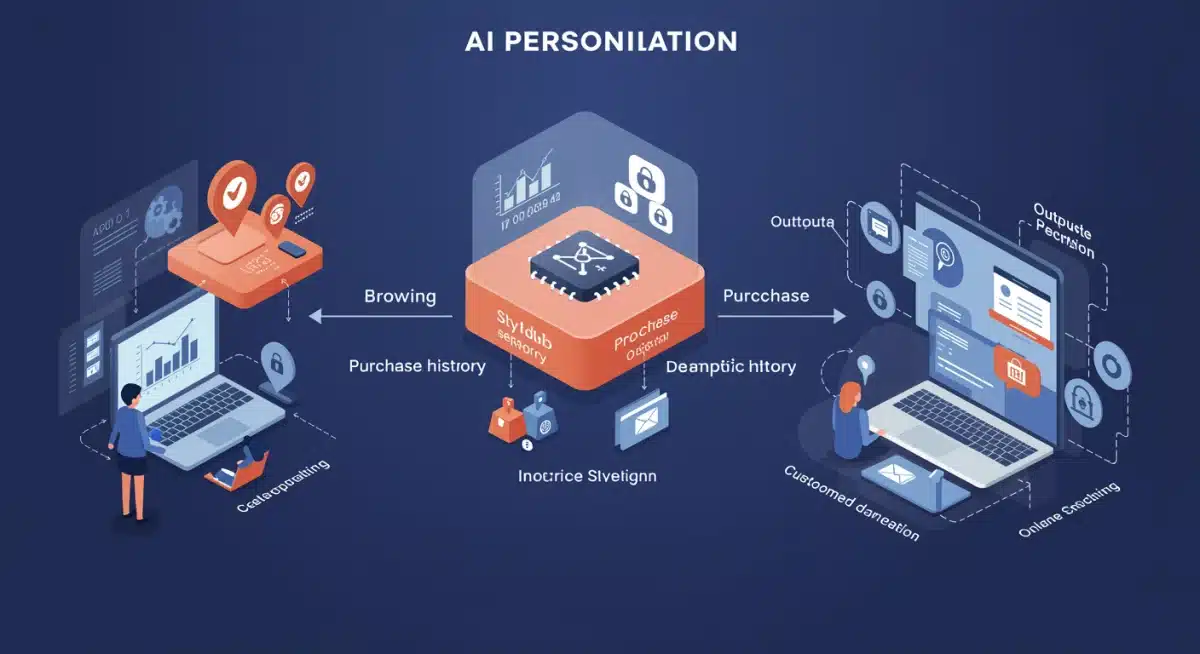
The sophistication of AI algorithms has grown exponentially, enabling real-time analysis of browsing patterns, purchase history, demographic information, and even emotional cues. This data confluence empowers e-commerce sites to predict future customer needs and proactively offer solutions, creating a seamless and often delightful shopping experience.
Understanding customer data for AI personalization
Effective AI personalization begins with robust data collection and intelligent interpretation. E-commerce platforms gather information from various touchpoints, both explicit and implicit, to build a comprehensive profile of each shopper.
Browsing History: Pages visited, products viewed, time spent on site.
Purchase History: Items bought, frequency, average order value.
Demographic Information: Age, location, gender (where available and relevant).
By synthesizing these diverse data points, AI systems can identify subtle patterns and correlations that human analysis might miss, leading to more accurate and impactful personalization strategies. The goal is to move from simple segmentation to true individualization, where each customer feels uniquely understood and valued.
The foundation of personalized AI is not just about collecting data, but also about the ethical and secure management of that data. Trust is paramount, and platforms must ensure transparency and provide customers with control over their personal information to maintain positive engagement.
Enhanced customer journeys through AI recommendations
One of the most visible applications of personalized AI is in product recommendations. Gone are the days of generic ‘customers also bought’ sections. Modern AI-driven systems provide recommendations that are highly specific, timely, and often anticipate customer desires before they are explicitly expressed.
These sophisticated recommendation engines analyze not only individual past behavior but also the behavior of similar customer segments, seasonal trends, and even external factors like news and social media sentiment. This multi-faceted approach ensures that suggestions are not just relevant, but also surprising and inspiring, leading to increased exploration and conversion.
Dynamic content and personalized search results
Beyond product recommendations, AI extends to dynamically adjusting website content and optimizing search results. A customer visiting an e-commerce site might see a different homepage layout, promotional banners, or even pricing based on their personalized profile.
Homepage Customization: Displaying categories and products most relevant to the individual.
Dynamic Pricing: Offering personalized discounts or bundles based on purchasing habits.
Search Optimization: Ranking search results according to individual preferences and past interactions.
This level of dynamic adaptation creates an immersive and highly efficient shopping environment. Customers spend less time searching and more time discovering items they genuinely want or need, reducing friction and enhancing satisfaction. The continuous learning nature of AI means these experiences only get better over time, refining their understanding with each interaction.
The ability of AI to learn and adapt in real-time is crucial for maintaining relevance. As customer preferences shift or new products emerge, the AI system can quickly adjust its recommendations and content delivery, ensuring the personalized experience remains fresh and compelling.
Boosting engagement: the 10% projection for 2025
The projection of a 10% increase in engagement for US e-commerce platforms by 2025 is not an arbitrary figure; it’s rooted in the compounding benefits of personalized AI. When customers feel understood and valued, they are more likely to spend more time on a platform, explore more products, and return for future purchases.
This enhanced engagement translates directly into measurable business outcomes. Higher engagement often leads to increased conversion rates, larger average order values, and improved customer lifetime value. The seamless and intuitive nature of AI-driven personalization reduces bounce rates and cultivates a sense of loyalty that is difficult to achieve through traditional marketing.
Measuring the impact of AI on customer loyalty
Engagement isn’t just about clicks and views; it’s about fostering a deeper connection with the brand. Personalized AI plays a critical role in building this loyalty by creating experiences that are consistently relevant and satisfying.
Repeat Purchases: Customers return to platforms that consistently meet their needs.
Reduced Churn: Personalized communication and offers keep customers from straying to competitors.
Brand Advocacy: Highly satisfied customers are more likely to recommend a brand to others.
The 10% engagement increase signifies a significant shift in customer behavior, driven by platforms that successfully implement and refine their AI personalization strategies. This isn’t a one-time boost but a sustained improvement in how customers interact with and perceive online retailers.
The continuous feedback loop inherent in AI systems allows platforms to constantly refine their personalization efforts. Each customer interaction provides new data, which the AI uses to further optimize future experiences, leading to a virtuous cycle of improved engagement and satisfaction.
Challenges and ethical considerations in AI personalization
While the benefits of personalized AI are undeniable, its implementation comes with its own set of challenges and ethical considerations. Data privacy, algorithmic bias, and the potential for a ‘filter bubble’ are all factors that e-commerce platforms must carefully navigate to maintain customer trust and ensure responsible AI deployment.
Striking the right balance between personalization and privacy is crucial. Customers appreciate tailored experiences, but they also expect their personal data to be handled securely and transparently. Platforms must adhere to regulations like GDPR and CCPA, and go beyond compliance to build genuine trust with their user base.
Navigating data privacy and algorithmic bias
The collection and use of personal data for AI personalization raise important questions about privacy. Customers need assurances that their information is protected and not misused. Transparency about data practices is not just good policy; it’s a foundation for trust.
Data Anonymization: Techniques to protect individual identities while still leveraging data insights.
Consent Management: Clear and easy-to-manage options for customers to control their data sharing.
Algorithmic Audits: Regularly checking AI systems for biases that could lead to unfair or discriminatory outcomes.
Another significant challenge is algorithmic bias. If the data used to train AI models contains inherent biases, the personalized recommendations or content generated by the AI can perpetuate or even amplify those biases. This can lead to exclusionary experiences for certain customer groups, undermining the very goal of inclusive engagement.
Addressing these challenges requires a proactive approach, including investing in ethical AI development, implementing robust data governance frameworks, and fostering a culture of responsibility within organizations. It’s about ensuring that technology serves humanity, not the other way around.
The future of personalized AI: beyond recommendations
The evolution of personalized AI in e-commerce is far from over. Beyond advanced recommendations and dynamic content, future innovations promise even more immersive and intuitive experiences. Think of AI-powered virtual assistants that guide shoppers through complex decisions, or augmented reality (AR) tools that allow customers to virtually ‘try on’ products, all driven by personalized insights.
The integration of AI with other emerging technologies, such as the metaverse and advanced haptics, could create entirely new paradigms for online shopping. These future experiences will be hyper-personalized, predictive, and seamlessly integrated into customers’ digital lives, pushing engagement levels to new heights.
AI-powered virtual assistants and immersive experiences
Virtual assistants are evolving beyond simple chatbots to become intelligent shopping companions. These AI agents can understand natural language, learn individual preferences, and proactively assist customers throughout their shopping journey, from product discovery to post-purchase support.
Proactive Support: AI assistants anticipating questions or issues before they arise.
Personalized Styling: Virtual stylists offering fashion advice based on individual taste and body type.
Seamless Checkout: Streamlining the purchase process through voice commands or biometric authentication.
Furthermore, immersive technologies like AR and virtual reality (VR), powered by AI, will allow customers to engage with products in unprecedented ways. Imagine virtually placing furniture in your living room before buying it, or trying on clothes with perfect digital accuracy. These experiences, tailored by AI, will bridge the gap between online and offline shopping, creating a richer, more engaging retail environment.
The continuous development of AI will enable e-commerce platforms to offer not just products, but entire personalized ecosystems that cater to every aspect of a customer’s lifestyle. This holistic approach will be key to sustaining high engagement in an increasingly competitive digital marketplace.
Implementing AI personalization: best practices for US platforms
For US e-commerce platforms looking to capitalize on the projected 10% engagement increase, strategic implementation of AI personalization is key. This involves a phased approach, starting with clear objectives, investing in the right technology, and continuously optimizing the AI models based on performance data.
It’s not enough to simply adopt AI; platforms must integrate it thoughtfully into their existing infrastructure and ensure their teams are equipped with the skills to manage and leverage these advanced systems. A focus on user experience and ethical considerations should guide every step of the implementation process.
Key strategies for successful AI integration
Successful AI personalization requires more than just deploying a new tool. It demands a holistic strategy that encompasses data, technology, people, and processes.
Start Small, Scale Up: Begin with specific use cases, like product recommendations, and expand as confidence and capabilities grow.
Invest in Data Infrastructure: Ensure clean, organized, and accessible data to feed AI algorithms effectively.
Foster a Data-Driven Culture: Train teams to understand and utilize AI insights for decision-making.
Prioritize UX and Ethics: Always consider the customer experience and ethical implications of AI applications.
Continuous monitoring and A/B testing are essential to refine AI models and ensure they are delivering the desired results. The e-commerce landscape is dynamic, and AI systems must be agile enough to adapt to changing customer behaviors and market trends. The platforms that succeed will be those that view AI as an ongoing journey of improvement, not a one-time deployment.
Ultimately, the goal is to create a symbiotic relationship between AI and human expertise. AI provides the analytical power and personalization capabilities, while human teams provide the strategic direction, creative oversight, and ethical guidance necessary for sustainable success.
Key Aspect
Description
Engagement Boost
Projected 10% higher engagement for US e-commerce platforms by 2025 due to AI personalization.
Data-Driven Personalization
AI uses browsing, purchase, and interaction data to create unique customer journeys.
Ethical Considerations
Addressing data privacy, algorithmic bias, and transparency is crucial for trust.
Future Innovations
Beyond recommendations, virtual assistants and AR/VR will offer hyper-personalized experiences.
Frequently asked questions about AI in e-commerce
What is personalized AI in e-commerce?▼
Personalized AI in e-commerce refers to the use of artificial intelligence to tailor the online shopping experience for individual customers. This includes customized product recommendations, dynamic website content, and targeted promotions based on user data and behavior.
How does AI increase customer engagement?▼
AI increases engagement by making the shopping experience more relevant and efficient. By presenting products and content that align with individual preferences, AI reduces friction, enhances discovery, and fosters a sense of understanding, encouraging customers to spend more time and interact more deeply with the platform.
What data does AI use for personalization?▼
AI utilizes a variety of data points, including browsing history, purchase records, search queries, click patterns, and demographic information. This comprehensive data allows AI algorithms to build detailed customer profiles and predict future preferences and needs accurately.
What are the ethical concerns of AI personalization?▼
Key ethical concerns include data privacy, algorithmic bias, and the potential for creating ‘filter bubbles.’ E-commerce platforms must ensure transparent data handling, implement measures to prevent bias in AI models, and give users control over their personal information to build trust.
How can US e-commerce platforms implement AI effectively?▼
Effective implementation involves starting with clear objectives, investing in robust data infrastructure, fostering a data-driven culture, and prioritizing user experience and ethical considerations. Continuous monitoring and optimization of AI models are also crucial for long-term success and adaptability.
Conclusion
The journey towards a 10% higher engagement for US e-commerce platforms by 2025, driven by personalized AI experiences, is not merely a technological shift but a fundamental redefinition of customer relationships. By harnessing the power of artificial intelligence to understand, anticipate, and cater to individual customer needs, online retailers can cultivate deeper loyalty, enhance satisfaction, and unlock significant growth. While challenges related to data privacy and ethics remain, a thoughtful and responsible approach to AI implementation will ensure that this transformative technology continues to elevate the digital shopping landscape, benefiting both businesses and consumers alike.
Eduarda Moura has a degree in Journalism and a postgraduate degree in Digital Media. With experience as a copywriter, Eduarda strives to research and produce informative content, bringing clear and precise information to the reader.