Master Data Management in the US: Unify Data & Boost Quality

Implementing Master Data Management in the US offers a strategic pathway for organizations to unify disparate data sources, significantly enhancing data accuracy, consistency, and overall quality by up to 20% by year-end 2025, driving informed decision-making and operational efficiency.
Implementing Master Data Management in the US is no longer an optional endeavor but a critical mandate for businesses striving for operational excellence and competitive advantage. In an era where data proliferation is rampant, unifying disparate data sources and ensuring high data quality are paramount to unlocking true business value. This comprehensive guide delves into the practical steps and strategic considerations for US organizations aiming to achieve a significant improvement in data quality by year-end 2025.
Understanding Master Data Management (MDM) in the US Context
Master Data Management (MDM) is a technology-enabled discipline in which business and IT work together to ensure the uniformity, accuracy, stewardship, semantic consistency, and accountability of the enterprise’s official shared master data assets. For businesses operating in the United States, the complexities of regulatory compliance, diverse customer demographics, and vast operational landscapes make robust MDM solutions indispensable. It’s about creating a single, authoritative version of truth for critical business entities.
The US market, characterized by its dynamic nature and stringent data protection regulations such as CCPA and evolving state-specific laws, necessitates a meticulous approach to master data. Organizations must not only consolidate data but also ensure its integrity and compliance across various systems and departments. This foundational understanding sets the stage for a successful MDM implementation.
What constitutes master data?
Master data typically includes key business entities that are non-transactional but critical for business operations. These entities are often shared across multiple systems and applications within an organization.
- Customer data: Names, addresses, contact information, purchase history.
- Product data: SKUs, descriptions, pricing, specifications.
- Employee data: HR records, payroll information, contact details.
- Location data: Addresses of stores, warehouses, offices.
The effective management of these data types is crucial for consistent reporting, accurate analytics, and seamless customer experiences. Without a unified view, discrepancies can lead to costly errors, missed opportunities, and compliance failures.
In conclusion, grasping the core tenets of MDM and its specific relevance to the US business environment is the initial step towards a transformative data strategy. It’s about recognizing master data as a strategic asset that underpins all critical business functions and requires dedicated management to ensure its quality and utility.
Building a Business Case for MDM: Justifying the Investment
Before embarking on an MDM journey, securing executive buy-in is paramount. This requires a compelling business case that clearly articulates the return on investment (ROI) and the strategic advantages of a unified data approach. For US businesses, the justification often revolves around enhanced operational efficiency, improved customer experience, and simplified regulatory compliance.
Quantifying the benefits of MDM can be challenging but is essential. Focus on tangible metrics such as reduced data entry errors, faster reporting cycles, and more accurate marketing campaigns. Highlighting the cost of poor data quality, including lost sales, fines, and wasted resources, can underscore the urgency of the initiative.
Key benefits for US enterprises
MDM brings a multitude of advantages that resonate deeply within the US business landscape, which thrives on efficiency and customer satisfaction. These benefits extend beyond mere data cleanliness to broader strategic impacts.
- Enhanced decision-making: Reliable data leads to better insights and more informed strategic choices.
- Improved customer experience: A single view of the customer enables personalized interactions and consistent service.
- Streamlined operations: Reduced data discrepancies minimize operational bottlenecks and rework.
- Regulatory compliance: Easier adherence to data privacy laws like CCPA and industry-specific regulations.
The business case should also outline the potential for innovation. With clean, reliable master data, US companies can explore advanced analytics, artificial intelligence, and machine learning initiatives with greater confidence, driving future growth and competitive differentiation.
Ultimately, a well-crafted business case for MDM doesn’t just present a technology solution; it paints a picture of a more agile, customer-centric, and compliant organization. It transforms MDM from an IT project into a strategic business imperative, demonstrating how it directly contributes to achieving core business objectives and a 20% improvement in data quality by 2025.
Developing a Robust MDM Strategy and Roadmap
A successful MDM implementation isn’t merely about selecting software; it’s about defining a clear strategy and a detailed roadmap tailored to the organization’s unique needs and objectives. This involves understanding current data landscapes, identifying critical master data domains, and establishing governance structures. For US companies, this strategic phase must also consider the diverse regulatory environment and regional operational nuances.
The roadmap should be iterative, allowing for adjustments as the project progresses. It should break down the implementation into manageable phases, each with clear deliverables and success metrics. Prioritization is key, focusing on the master data domains that offer the quickest wins and most significant business impact.
Core components of an effective MDM strategy
An effective MDM strategy is built upon several foundational pillars that guide the entire implementation process. These components ensure that the solution is not only technically sound but also aligned with business goals.
- Data governance framework: Establishing roles, responsibilities, and policies for master data.
- Data quality standards: Defining metrics and processes to measure and improve data accuracy and completeness.
- Technology selection: Choosing the right MDM platform that integrates with existing systems.
- Change management plan: Preparing employees for new processes and systems.
Consideration of US-specific data privacy laws, such as HIPAA for healthcare data or GLBA for financial data, must be ingrained in the strategy from the outset. This proactive approach helps mitigate risks and ensures compliance. The roadmap should also account for scalability, anticipating future data growth and evolving business requirements.
In essence, developing an MDM strategy and roadmap is akin to charting a course for a complex journey. It requires careful planning, a clear destination in mind (e.g., 20% data quality improvement by 2025), and the flexibility to navigate unforeseen challenges while keeping the ultimate goal in sight.
Implementing MDM: Practical Steps and Best Practices
With a solid strategy in place, the implementation phase of MDM requires meticulous execution. This stage involves data discovery, cleansing, integration, and the establishment of ongoing data governance processes. For US organizations, particular attention must be paid to data residency, security, and the integration with diverse legacy systems prevalent in the market.
A phased approach is often recommended, starting with a pilot project in a less complex master data domain. This allows the team to learn, refine processes, and demonstrate early successes before scaling the solution across the enterprise. Collaboration between IT and business stakeholders is crucial throughout this phase.
Key implementation phases
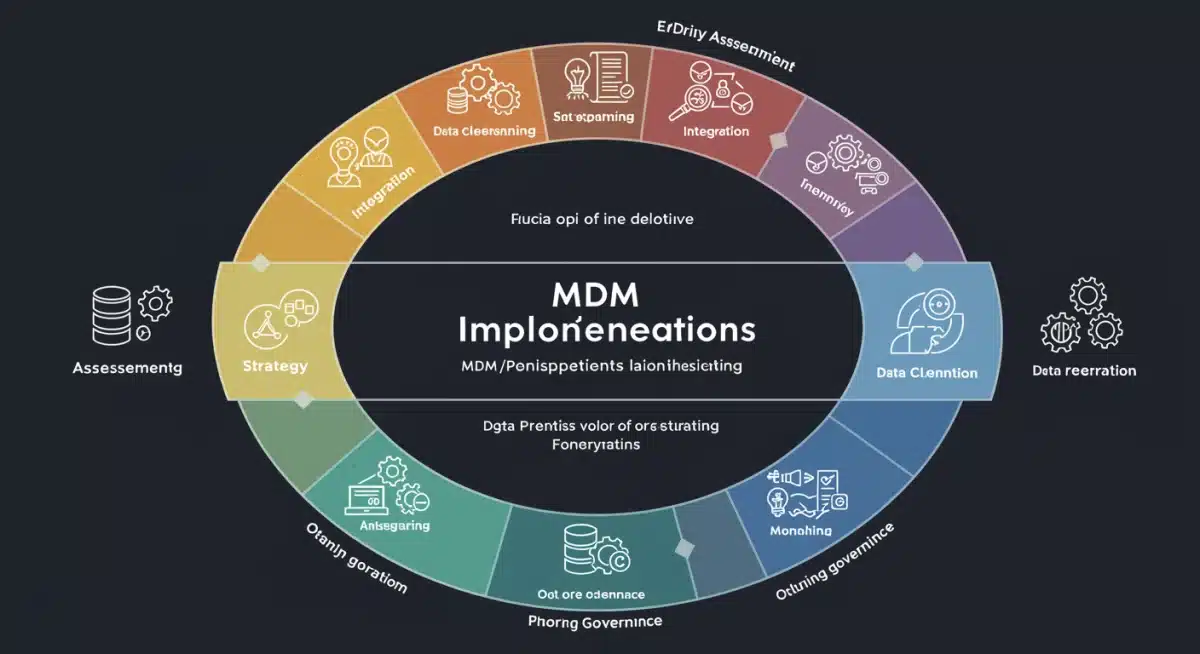
The journey to a fully functional MDM system involves several distinct, yet interconnected, phases. Each phase builds upon the previous one, contributing to the overall success of the initiative.
- Data assessment and profiling: Understanding the current state of data quality and identifying inconsistencies.
- Data cleansing and enrichment: Correcting errors, removing duplicates, and adding missing information.
- Data integration: Connecting MDM with source systems to synchronize master data.
- Data governance setup: Operationalizing the policies and procedures defined in the strategy phase.
- User training and adoption: Ensuring that business users understand and utilize the new MDM system effectively.
Best practices include leveraging automation tools for data cleansing and matching, establishing clear data ownership, and continuously monitoring data quality metrics. In the US, where businesses often operate across different states with varying data infrastructure, ensuring seamless integration and data flow is a significant challenge that requires careful planning and robust technical solutions.
Successful implementation also hinges on effective change management. Communicating the benefits to end-users and providing adequate training can significantly accelerate adoption and ensure the long-term success of the MDM initiative. This practical approach paves the way for achieving the ambitious goal of a 20% improvement in data quality by year-end 2025.
Measuring Success and Continuous Improvement
Implementing MDM is not a one-time project but an ongoing journey of continuous improvement. Once the initial implementation is complete, it’s crucial to establish clear metrics to measure success and to foster a culture of continuous data quality enhancement. For US companies, this means regularly assessing the impact of MDM on key business processes and adapting to evolving data needs and regulatory changes.
Defining Key Performance Indicators (KPIs) related to data quality, operational efficiency, and business outcomes is essential. These KPIs provide tangible evidence of the MDM initiative’s value and help justify ongoing investment. Regular audits and feedback loops are vital for identifying areas for improvement and ensuring the MDM system remains effective.
Indicators of MDM success
Measuring the effectiveness of an MDM program requires a multi-faceted approach, looking at both quantitative and qualitative indicators. These metrics help paint a complete picture of the MDM’s impact on the organization.
- Reduced data errors: A direct measure of improved data quality.
- Faster reporting cycles: Indicating increased efficiency in data access and processing.
- Improved customer satisfaction: Reflecting better-personalized services and accurate communication.
- Compliance adherence: Demonstrating the ability to meet regulatory requirements effortlessly.
- Cost savings: Resulting from fewer data-related errors and more efficient operations.
Furthermore, collecting feedback from business users is invaluable. Their real-world experience can highlight pain points and suggest enhancements that might not be apparent from data metrics alone. Regular reviews of the data governance framework and MDM policies ensure they remain relevant and effective.
The commitment to continuous improvement ensures that the MDM solution evolves with the business, delivering sustained value and helping US organizations maintain their competitive edge. By year-end 2025, a continuously optimized MDM system will be a cornerstone of data-driven success, demonstrably improving data quality and business outcomes.
Challenges and Considerations for US Businesses
While the benefits of MDM are substantial, US businesses face unique challenges during implementation. The sheer scale and diversity of operations, coupled with a complex regulatory landscape, demand careful consideration and strategic planning to overcome potential hurdles. Understanding these challenges upfront can help organizations prepare and mitigate risks effectively.
One significant challenge is the integration with a multitude of disparate legacy systems that often exist within large US enterprises. These systems may use different data formats, terminologies, and data models, making data unification a complex technical undertaking. Another hurdle is securing adequate funding and resources, as MDM projects can be costly and require specialized expertise.
Navigating common pitfalls
Addressing potential issues proactively is crucial for a smooth MDM implementation. Many common pitfalls can be avoided with thorough planning and a clear understanding of the project’s scope and requirements.
- Lack of executive sponsorship: Without strong leadership support, MDM initiatives can lose momentum.
- Poor data governance: Inadequate policies and procedures can undermine data quality efforts.
- Scope creep: Expanding the project scope without proper planning can lead to delays and cost overruns.
- Resistance to change: Employees may be reluctant to adopt new processes, requiring robust change management.
- Data security and privacy concerns: Ensuring compliance with US data protection laws is paramount.
The geographically dispersed nature of many US businesses also presents challenges in coordinating data collection, standardization, and governance across different regions. This necessitates robust communication strategies and centralized oversight to maintain consistency. Furthermore, the rapid pace of technological change requires MDM solutions to be flexible and adaptable, capable of integrating new data sources and technologies.
By acknowledging and strategically addressing these challenges, US businesses can navigate the complexities of MDM implementation more effectively. This proactive approach ensures that the path to unified data sources and improved data quality by 20% by year-end 2025 is not only achievable but also sustainable.
| Key Aspect | Brief Description |
|---|---|
| MDM Goal | Unify data sources and improve data quality by 20% by 2025. |
| Key Benefit | Enhanced decision-making, improved customer experience, regulatory compliance. |
| Implementation Phases | Assessment, cleansing, integration, governance setup, user training. |
| US Challenges | Legacy system integration, regulatory complexity, change management. |
Frequently Asked Questions About MDM in the US
Master data refers to critical business information like customer, product, or employee details that are shared across multiple systems. For US businesses, it’s vital for consistent operations, accurate reporting, regulatory compliance, and delivering a unified customer experience across diverse markets and regulations.
MDM improves data quality by establishing a single source of truth, standardizing data definitions, and implementing processes for data cleansing, validation, and governance. This systematic approach reduces errors, eliminates duplicates, and ensures consistency, directly contributing to measurable improvements in data accuracy over time.
US businesses often face challenges such as integrating numerous legacy systems, navigating a complex and evolving regulatory landscape (e.g., CCPA, state-specific privacy laws), securing robust executive sponsorship, and managing organizational change effectively across geographically dispersed operations.
Data governance is fundamental to MDM success. It defines the policies, roles, and responsibilities for managing master data, ensuring its accuracy, consistency, and compliance. Without strong governance, the benefits of MDM can quickly erode, leading to a return of data quality issues.
The duration of MDM implementation varies widely depending on the organization’s size, data complexity, and scope. A phased approach, starting with a critical data domain, might see initial benefits within 6-12 months, with full enterprise-wide deployment potentially taking several years for large US corporations.
Conclusion
Implementing Master Data Management in the US is a strategic imperative that offers profound benefits, from enhancing operational efficiency to ensuring regulatory compliance. By focusing on a well-defined strategy, meticulous execution, and a commitment to continuous improvement, US businesses can confidently unify their data sources and achieve the ambitious goal of improving data quality by 20% by year-end 2025. This journey, while challenging, lays the groundwork for a data-driven future, enabling more informed decisions, superior customer experiences, and sustained competitive advantage in a rapidly evolving digital landscape.