Edge Computing 2025: US Businesses Cut Latency 30%
US businesses can achieve a 30% reduction in latency by 2025 by strategically implementing edge computing solutions, optimizing data processing closer to the source for enhanced real-time operations and improved user experiences.
By: Eduarda Moura on July 15, 2025
Last updated on: November 28, 2025
US businesses can achieve a 30% reduction in latency by 2025 by strategically implementing edge computing solutions, optimizing data processing closer to the source for enhanced real-time operations and improved user experiences.
In an increasingly data-driven world, the imperative for speed and efficiency is paramount. For US businesses, embracing edge computing latency reduction strategies promises a transformative impact, with projections indicating a potential 30% decrease in operational latency by 2025. This technological shift is not merely an upgrade; it’s a fundamental re-architecture of how data is processed and utilized, directly impacting competitiveness and innovation.
Understanding Edge Computing: Beyond the Cloud
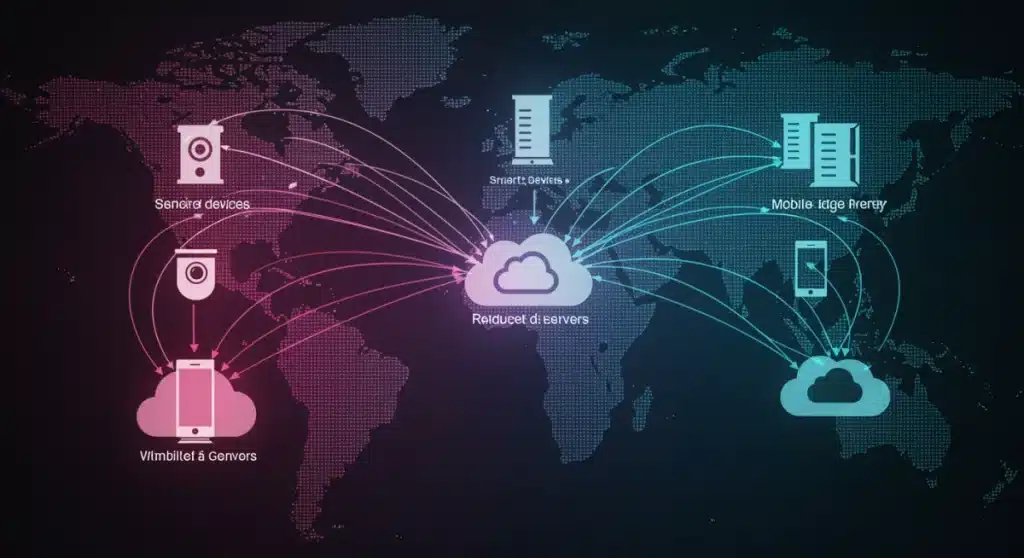
Edge computing represents a paradigm shift from traditional centralized cloud processing. Instead of sending all data to a remote data center, edge computing brings computational power and data storage closer to the source of data generation. This distributed approach is critical for applications demanding real-time responses and high bandwidth, which are becoming increasingly common across various industries.
The fundamental principle behind edge computing is to minimize the physical distance data must travel. This proximity directly translates into reduced latency, as the time taken for data to journey to a distant server and return is significantly cut. For US businesses operating in competitive markets, this reduction is not just a technical detail; it’s a strategic advantage that can unlock new capabilities and improve existing processes.
The core concept of distributed processing
Distributed processing at the edge involves placing miniature data centers or processing units at the network’s periphery. These units can be strategically located in factories, retail stores, smart cities, or even on mobile devices. Their primary function is to filter, process, and analyze data locally before deciding what information needs to be sent to the central cloud.
Local Data Processing: Data is handled closer to its origin, reducing transmission time.
Reduced Network Traffic: Only essential or aggregated data is sent to the cloud, easing bandwidth strain.
Enhanced Security: Localized processing can offer better control over sensitive data, meeting compliance requirements.
Improved Reliability: Operations can continue even with intermittent or lost cloud connectivity.
Key components of an edge ecosystem
An effective edge computing ecosystem comprises several interconnected components working in harmony. These include edge devices, which are the source of data; edge gateways, which aggregate and process data from multiple devices; and edge servers, which provide more substantial computational power closer to the edge. The orchestration of these components is crucial for seamless operation and maximizing the benefits of reduced latency.
Furthermore, robust connectivity solutions, including 5G and Wi-Fi 6, are integral to edge deployments. These advanced networking technologies provide the necessary speed and reliability to ensure data can be transferred efficiently between edge devices and localized processing units. Without a strong network foundation, the benefits of edge computing in reducing latency would be significantly diminished.
In essence, edge computing is about optimizing the data processing pipeline. By moving computation closer to where data is generated, businesses can overcome the inherent limitations of cloud-only architectures, paving the way for faster insights, more responsive applications, and ultimately, a more agile and competitive operational framework. The projected 30% latency reduction is a testament to the profound impact this technology is poised to have.
Why Latency Reduction Matters for US Businesses
Latency, often perceived as a minor annoyance, can have profound implications for business operations and customer experience. In the context of modern digital ecosystems, even milliseconds of delay can translate into lost revenue, decreased productivity, and compromised safety. For US businesses, understanding the critical role of latency reduction is key to unlocking new levels of efficiency and innovation.
High latency can cripple applications that rely on immediate feedback, such as real-time analytics, autonomous systems, and interactive customer interfaces. As businesses increasingly adopt IoT devices, AI, and machine learning, the volume and velocity of data demand processing capabilities that traditional cloud models struggle to provide without introducing unacceptable delays. Edge computing directly addresses this challenge by bringing computation closer to the data source.
Impact on operational efficiency
Reduced latency directly translates to improved operational efficiency across various sectors. In manufacturing, for instance, real-time monitoring of machinery can prevent costly downtime by detecting anomalies instantly. For logistics, optimized route planning and fleet management become more responsive, adapting to dynamic conditions in real-time. This immediate feedback loop empowers businesses to make quicker, more informed decisions.
Manufacturing: Predictive maintenance and quality control in real-time.
Healthcare: Remote patient monitoring and urgent data analysis for critical care.
Retail: Personalized in-store experiences and inventory management.
Energy: Smart grid management and real-time anomaly detection.
Enhancing customer experience and revenue
In today’s digital economy, customer experience is a primary differentiator. Applications that respond instantly and seamlessly deliver a superior user experience, leading to higher engagement and satisfaction. Consider online gaming, augmented reality (AR) applications, or even sophisticated e-commerce platforms; minimal latency is not just preferred, it’s expected.
For US businesses, this directly impacts revenue. Faster loading times for websites, instant responses from chatbots, and seamless AR experiences can significantly reduce bounce rates and increase conversion rates. Moreover, the ability to deliver personalized services in real-time based on immediate data analysis creates a more compelling and sticky customer journey. The goal of a 30% reduction in latency is therefore not just about technical performance, but about direct business outcomes.
Ultimately, addressing latency is about future-proofing business operations. As the digital landscape evolves, the demands for instant data processing will only intensify. By proactively adopting edge computing to mitigate latency, US businesses are not only solving current challenges but also positioning themselves to capitalize on future technological advancements and maintain a competitive edge.
Key Technologies Driving Edge Computing Adoption
The rapid growth of edge computing is not a standalone phenomenon but is fueled by the convergence of several powerful technological advancements. These innovations provide the necessary infrastructure, connectivity, and processing capabilities that make edge deployments feasible and highly effective. Understanding these key technologies is crucial for US businesses looking to leverage edge computing for significant latency reduction.
From advanced networking to specialized hardware and sophisticated software, each component plays a vital role in creating a robust edge ecosystem. The synergy between these technologies allows data to be processed with unprecedented speed and efficiency at the network’s periphery, delivering on the promise of real-time insights and applications.
The role of 5G and Wi-Fi 6
High-speed, low-latency connectivity is the backbone of any effective edge computing strategy. 5G networks, with their dramatically increased bandwidth and reduced latency, are perfectly suited to facilitate the rapid data transfer required between edge devices and local processing units. Similarly, Wi-Fi 6 offers significant improvements in speed and efficiency for local area networks, enhancing in-building and campus-level edge deployments.
5G: Provides ultra-low latency and high bandwidth for expansive mobile and industrial edge applications.
Wi-Fi 6: Optimizes local network performance, supporting dense device environments at the edge.
Seamless Integration: Both technologies enable a fluid data flow from device to edge server.
Specialized edge hardware and software
The unique demands of edge environments have spurred the development of specialized hardware and software solutions. Edge hardware is often designed to be compact, rugged, and capable of operating in diverse conditions, from factory floors to remote outdoor locations. These devices are optimized for power efficiency and can perform significant processing locally, reducing reliance on constant cloud connectivity.
On the software front, containerization technologies like Docker and Kubernetes are pivotal. They allow applications to be easily packaged and deployed across various edge devices, ensuring consistency and scalability. Furthermore, AI/ML inference at the edge, where pre-trained models analyze data locally, is becoming increasingly common, enabling immediate decision-making without round-trips to the cloud. This combination of robust hardware and agile software is instrumental in achieving the desired 30% latency reduction.
The continuous evolution of these technologies ensures that edge computing capabilities will only become more powerful and accessible. For US businesses, staying abreast of these advancements and strategically integrating them into their infrastructure will be critical for harnessing the full potential of edge computing and maintaining a competitive edge in a rapidly digitizing world.
Implementation Strategies for US Businesses
Successfully integrating edge computing into existing infrastructure requires a well-thought-out strategy. For US businesses aiming to achieve a 30% reduction in latency by 2025, a phased approach focusing on specific use cases and scalable deployments is often the most effective. It’s not just about adopting new technology, but about redesigning workflows and data management practices.
The journey to optimized edge computing involves careful planning, from identifying the most impactful applications to selecting the right technology partners and ensuring robust security measures. A clear roadmap will help businesses navigate the complexities and maximize the return on investment in edge infrastructure.
Identifying prime use cases for edge deployment
Not every application benefits equally from edge computing. Businesses should first identify areas where latency is a critical bottleneck and where real-time processing offers significant value. Common prime use cases include:
Industrial IoT (IIoT): Real-time machine monitoring, predictive maintenance, and quality control on factory floors.
Smart Cities: Traffic management, public safety, and environmental monitoring requiring immediate data analysis.
Autonomous Vehicles: Instant data processing for navigation, obstacle detection, and safety systems.
Focusing on these high-impact areas allows businesses to demonstrate tangible benefits early on, building momentum for broader adoption. A pilot project in a controlled environment can provide valuable insights and fine-tune the implementation strategy before a wider rollout.
Building a scalable edge infrastructure
Scaling edge infrastructure involves more than just deploying more devices. It requires a cohesive architecture that can manage diverse edge nodes, ensure data consistency, and integrate seamlessly with existing cloud resources. US businesses should consider hybrid cloud models that allow for flexible data routing and processing between the edge and centralized cloud environments.
Choosing the right hardware and software platforms that support scalability and interoperability is paramount. Open standards and vendor-agnostic solutions can prevent vendor lock-in and provide greater flexibility for future expansions. Furthermore, robust data management and orchestration tools are essential for efficiently deploying, monitoring, and updating applications across a distributed edge network. The goal is to create an infrastructure that can grow and adapt to evolving business needs without compromising performance or security.
Ultimately, a successful edge computing implementation is a strategic investment that requires a holistic approach. By carefully selecting use cases, building a scalable architecture, and continuously optimizing operations, US businesses can effectively leverage edge computing to achieve significant latency reductions and unlock new opportunities for growth and innovation.
Security and Data Governance at the Edge
While edge computing offers significant advantages in reducing latency and enhancing operational efficiency, it also introduces new complexities, particularly concerning security and data governance. Distributing computation closer to the data source means extending the attack surface and requiring robust measures to protect sensitive information across a broader network. For US businesses, addressing these challenges proactively is paramount to a successful and compliant edge deployment.
The decentralized nature of edge environments necessitates a re-evaluation of traditional security models. Instead of a single, highly fortified central data center, businesses must secure numerous geographically dispersed edge nodes, each potentially vulnerable to physical and cyber threats. This expanded scope demands a comprehensive and adaptive security strategy.
Protecting distributed edge nodes
Securing edge nodes requires a multi-layered approach that encompasses physical security, network security, and data encryption. Physical security measures, such as tamper-resistant hardware and secure enclosures, are crucial for protecting devices in exposed locations. On the network front, robust firewalls, intrusion detection systems, and secure communication protocols (like VPNs) are essential to prevent unauthorized access and data breaches.
Zero Trust Architecture: Assume no device or user can be trusted by default, requiring verification for every access attempt.
Endpoint Protection: Implement strong authentication, malware detection, and regular patching for all edge devices.
Data Encryption: Encrypt data at rest and in transit between edge nodes and the cloud.
Anomaly Detection: Utilize AI/ML-powered tools to identify unusual activity that may indicate a security threat.
Compliance and data privacy considerations
Data governance at the edge is particularly critical given the increasing scrutiny around data privacy regulations. Businesses must ensure that all data processed at the edge complies with relevant laws, such as HIPAA for healthcare data or various state-level privacy acts in the US. This involves understanding where data resides, how it’s processed, and who has access to it.
Implementing data anonymization and pseudonymization techniques at the edge can help protect sensitive information while still allowing for valuable analysis. Furthermore, clear data retention policies and mechanisms for data deletion are vital for maintaining compliance. The ability to audit data flows and demonstrate adherence to regulatory requirements will be a key differentiator for businesses adopting edge computing. By proactively integrating security and governance into their edge strategies, US businesses can mitigate risks and build trust, ensuring that their pursuit of reduced latency does not come at the expense of data integrity or regulatory compliance.
Measuring and Optimizing Latency Reduction
Achieving a 30% reduction in latency by 2025 through edge computing is an ambitious goal that requires continuous measurement, analysis, and optimization. It’s not enough to simply deploy edge infrastructure; businesses must actively monitor its performance and refine their strategies to ensure the desired impact is realized. This involves leveraging sophisticated monitoring tools and adopting a data-driven approach to performance management.
Effective measurement provides the insights needed to identify bottlenecks, validate the efficacy of edge deployments, and make informed decisions about future investments. Without clear metrics, it’s challenging to prove the value proposition of edge computing and justify its ongoing operational costs.
Key metrics for latency measurement
To accurately assess latency reduction, businesses need to track a set of specific metrics. These metrics provide a quantitative understanding of how quickly data is processed and transmitted across the edge network. Key indicators include:
Round-Trip Time (RTT): Measures the time it takes for a signal to travel from a source to a destination and back.
Processing Latency: The time taken for an edge device or server to process a data packet.
Jitter: Variation in packet delay, which can impact real-time applications.
Throughput: The amount of data successfully transferred over a given period, indicating network capacity.
By establishing baseline measurements before edge implementation and continuously monitoring these metrics afterward, businesses can clearly demonstrate the impact of their edge computing initiatives on latency reduction. This data is invaluable for stakeholder communication and justifying further investments.
Tools and techniques for optimization
Optimizing edge computing performance involves a combination of advanced tools and strategic techniques. Network performance monitoring (NPM) solutions can provide real-time visibility into network health and identify areas of high latency. Application performance monitoring (APM) tools help pinpoint bottlenecks within edge applications themselves.
Techniques like load balancing across multiple edge servers, optimizing data compression algorithms, and intelligently caching frequently accessed data closer to the edge can significantly improve response times. Furthermore, regularly updating firmware and software on edge devices ensures they operate at peak efficiency. The continuous feedback loop of measurement and optimization is essential for not only achieving but also sustaining a 30% reduction in latency and maximizing the benefits of edge computing for US businesses.
The Future Outlook for Edge Computing in the US
The trajectory of edge computing in the United States points towards a future where distributed processing is not merely an option but a foundational element of digital infrastructure. As demands for real-time data processing, hyper-personalization, and autonomous systems continue to escalate, the inherent advantages of edge computing—particularly in reducing latency—will become indispensable. The projected 30% latency reduction by 2025 is just the beginning of a broader transformation.
This evolving landscape will see edge computing becoming more integrated, intelligent, and pervasive, touching almost every sector of the US economy. From smart manufacturing to advanced healthcare and responsive retail, edge technology will empower businesses to operate with unprecedented agility and insight.
Emerging trends and innovations
Several emerging trends are set to further accelerate edge computing adoption and impact. The development of more powerful, energy-efficient edge AI chips will enable sophisticated machine learning models to run directly on devices, leading to faster inference and decision-making. Furthermore, the integration of blockchain technology at the edge could enhance data security and integrity, particularly for sensitive applications.
Edge AI: More powerful AI inference on compact, low-power edge devices.
Quantum Edge: Early explorations into quantum computing capabilities at the edge for highly complex problems.
Serverless Edge: Function-as-a-Service (FaaS) models extending to the edge for event-driven, scalable processing.
Digital Twins: Real-time synchronization of physical assets with their digital counterparts, powered by edge data.
Long-term impact on US industries
The long-term impact of edge computing on US industries will be transformative. In manufacturing, it will enable fully autonomous factories, minimizing human error and maximizing output. For healthcare, remote diagnostics and personalized treatment plans will become more precise and accessible. The retail sector will leverage edge for hyper-personalized customer experiences, dynamic pricing, and fully automated inventory management.
Beyond individual industries, edge computing will foster a more resilient and responsive national infrastructure. Smart cities will become truly intelligent, adapting to citizen needs in real-time. The energy grid will be more efficient and secure, and transportation systems will be safer and more optimized. This widespread adoption underscores edge computing’s role not just as a technological advancement, but as a catalyst for economic growth and societal improvement across the United States.
The journey towards a fully ‘edged’ future will be continuous, marked by ongoing innovation and adaptation. US businesses that embrace this evolution, prioritizing strategic implementation and continuous optimization, will be best positioned to lead in the digital era, leveraging edge computing to unlock unparalleled levels of efficiency, innovation, and competitive advantage.
Key Aspect
Brief Description
Latency Reduction Goal
US businesses aim for a 30% decrease in data processing delays by 2025 using edge computing.
Core Concept
Processing data closer to its source, minimizing travel to distant cloud servers.
Improved operational efficiency, enhanced customer experience, and new business models.
Frequently Asked Questions About Edge Computing Latency
What is the primary benefit of edge computing for latency reduction?▼
The main benefit is processing data closer to its source, significantly reducing the physical distance data travels. This minimizes network delays inherent in sending all data to a centralized cloud, leading to faster response times for critical applications and operations.
How does 5G technology support edge computing for lower latency?▼
5G networks offer ultra-low latency, high bandwidth, and massive connectivity, making them ideal for edge computing. They enable rapid data transfer between edge devices and local processing units, crucial for real-time applications and ensuring efficient operation of distributed edge infrastructure.
What types of US businesses benefit most from reduced latency?▼
Businesses in sectors demanding real-time data processing, such as manufacturing (for predictive maintenance), healthcare (for remote monitoring), retail (for personalized experiences), and autonomous systems (for immediate decision-making), gain the most from latency reduction.
What are the main security challenges with edge computing?▼
Edge computing expands the attack surface due to distributed nodes, requiring robust physical and cyber security. Challenges include securing numerous remote devices, managing data privacy across diverse locations, and ensuring compliance with various data governance regulations like HIPAA.
How can businesses measure the effectiveness of edge computing in reducing latency?▼
Effectiveness is measured through key metrics like Round-Trip Time (RTT), processing latency, and jitter. Using network and application performance monitoring tools helps track these metrics, establish baselines, and identify areas for continuous optimization to achieve desired latency reductions.
Conclusion
The journey for US businesses to achieve a 30% reduction in latency by 2025 is not merely a technological aspiration but a strategic imperative that promises to redefine operational paradigms and unlock unprecedented competitive advantages. Edge computing stands at the forefront of this transformation, offering a powerful solution to the growing demands for real-time data processing and instant responsiveness. By strategically implementing edge solutions, leveraging advanced network technologies like 5G, and robustly addressing security and data governance, businesses can move beyond the limitations of traditional cloud architectures. The insights gained from continuous measurement and optimization will be crucial in maximizing the benefits of edge deployments, paving the way for more efficient operations, superior customer experiences, and a resilient, innovative future across various sectors of the American economy. Embracing edge computing today is an investment in tomorrow’s digital leadership.
Eduarda Moura has a degree in Journalism and a postgraduate degree in Digital Media. With experience as a copywriter, Eduarda strives to research and produce informative content, bringing clear and precise information to the reader.