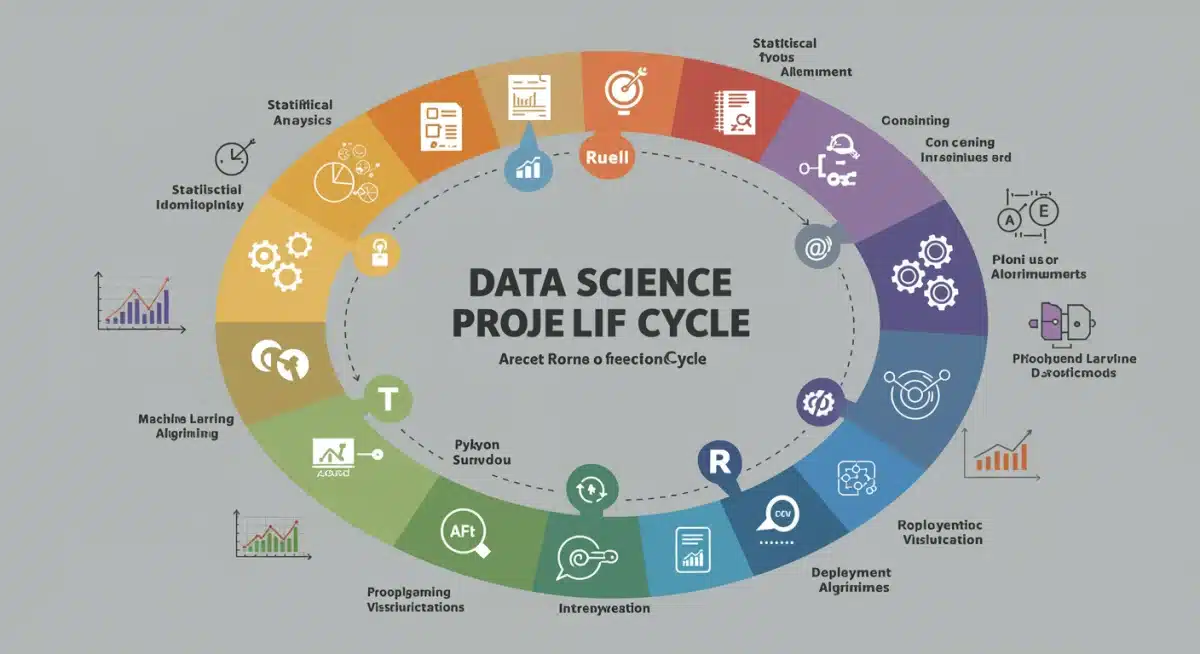
Data Scientists in US Businesses: Key Skills & 15% Performance Boost by 2025
Data scientists are becoming indispensable in US businesses, leveraging advanced analytical skills to extract actionable insights, optimize operations, and directly contribute to a projected 15% increase in overall business performance by 2025.
By: Eduarda Moura on September 10, 2025
Last updated on: November 28, 2025
Data scientists are becoming indispensable in US businesses, leveraging advanced analytical skills to extract actionable insights, optimize operations, and directly contribute to a projected 15% increase in overall business performance by 2025.
Have you ever wondered how leading US businesses are consistently outperforming their competitors? The answer often lies in their strategic utilization of data. The role of data scientists in US businesses is rapidly evolving, becoming a cornerstone for innovation and a direct driver of significant performance improvements. By 2025, their impact is projected to elevate business performance by a remarkable 15% across various sectors.
The evolving landscape of data science in US businesses
The demand for data scientists in the United States continues to surge, reflecting a profound shift in how companies approach decision-making. No longer confined to niche tech companies, data science has permeated every industry, from healthcare to finance, retail, and manufacturing. Businesses are recognizing that raw data, while abundant, only holds value when expertly analyzed and translated into actionable strategies. This realization has cemented the data scientist’s position as a critical asset.
The evolution from traditional business intelligence to advanced predictive analytics has necessitated a new breed of professionals. These experts are not just reporting on past events but are actively shaping future outcomes. They are building models that forecast market trends, personalize customer experiences, and optimize operational efficiencies, directly influencing revenue growth and cost reduction. The integration of data science is no longer a luxury but a strategic imperative for sustained competitive advantage.
From data to actionable insights
At its core, the data scientist’s role involves transforming complex datasets into clear, understandable, and actionable insights. This process often begins with identifying relevant data sources, which can range from customer transaction records to social media interactions and sensor data from IoT devices. The ability to discern valuable information from noise is a critical first step.
Data acquisition and cleaning: Sourcing, extracting, and preparing raw data for analysis, often involving significant data manipulation.
Exploratory data analysis (EDA): Discovering patterns, anomalies, and relationships within datasets to inform model development.
Statistical modeling: Applying advanced statistical techniques to validate hypotheses and quantify relationships between variables.
Machine learning implementation: Developing and deploying predictive and prescriptive models to automate decision-making processes.
The impact of these insights is tangible. For instance, in retail, data scientists predict purchasing behaviors, allowing for optimized inventory management and targeted marketing campaigns. In finance, they build fraud detection systems that save companies millions. These contributions underscore the direct link between data science expertise and business performance.
As US businesses navigate an increasingly data-driven world, the strategic deployment of data science teams becomes paramount. Their capacity to unlock hidden value within organizational data is not just an operational advantage, but a fundamental driver of growth, innovation, and resilience in a dynamic marketplace.
Key skills for data scientists in 2025
The skill set required for data scientists is constantly evolving, driven by advancements in technology and the increasing complexity of business problems. By 2025, a blend of technical prowess, business acumen, and soft skills will be essential for success. While foundational knowledge remains crucial, new areas of expertise are gaining prominence, reflecting the dynamic nature of the field.
Beyond traditional coding and statistical analysis, data scientists are expected to be adept at communicating complex findings to non-technical stakeholders and understanding the broader business context of their work. This holistic approach ensures that technical solutions are not only robust but also relevant and implementable within the organization’s strategic goals.
Advanced analytical techniques
Proficiency in advanced analytical methods is non-negotiable. This includes a deep understanding of various machine learning algorithms and their appropriate application.
Deep learning frameworks: Expertise in TensorFlow, PyTorch, and Keras for neural network development and deployment.
Natural language processing (NLP): Skills in extracting insights from unstructured text data, crucial for customer feedback and market analysis.
Computer vision: Capabilities in image and video analysis for applications in security, retail, and manufacturing.
Reinforcement learning: Understanding how to build systems that learn through trial and error, particularly useful for optimization problems.
These techniques empower data scientists to tackle more sophisticated problems, moving beyond simple prediction to complex pattern recognition and autonomous decision systems. The ability to implement these techniques efficiently and effectively is a significant differentiator.
Cloud computing and MLOps
The shift to cloud-based platforms is accelerating, making cloud proficiency a vital skill. Data scientists must be comfortable working with major cloud providers and understanding MLOps principles.
Cloud platforms: Experience with AWS, Azure, or Google Cloud Platform for data storage, processing, and model deployment.
Containerization: Knowledge of Docker and Kubernetes for building scalable and reproducible machine learning pipelines.
MLOps best practices: Understanding how to operationalize machine learning models, including monitoring, versioning, and continuous integration/delivery (CI/CD).
These skills ensure that models are not just developed but are also seamlessly integrated into production environments, providing continuous value to the business. The operational aspect of data science is becoming as important as the analytical one.
Ultimately, the successful data scientist of 2025 will be a versatile professional, capable of navigating both the technical intricacies of data analysis and the strategic demands of business innovation. Their continuous learning and adaptation to new technologies will be key to their, and their businesses’, success.
Driving a 15% increase in business performance
The promise of a 15% increase in business performance is not merely an ambitious target; it is a quantifiable outcome driven by the strategic application of data science. This improvement manifests in various forms, including enhanced revenue generation, significant cost reductions, superior operational efficiency, and heightened customer satisfaction. Data scientists are at the forefront of identifying these opportunities and implementing solutions.
By leveraging predictive analytics, businesses can anticipate market shifts, optimize pricing strategies, and personalize product offerings, directly impacting the bottom line. On the operational side, prescriptive models can streamline supply chains, reduce waste, and improve resource allocation, leading to substantial cost savings. The cumulative effect of these data-driven initiatives is a robust and measurable uplift in overall performance.
Revenue generation and customer insights
One of the most direct ways data scientists contribute to performance is through enhancing revenue streams. This often involves a deep dive into customer behavior and market dynamics.
Personalized marketing: Utilizing customer data to create highly targeted campaigns, increasing conversion rates and customer lifetime value.
Dynamic pricing: Implementing algorithms that adjust prices in real-time based on demand, competition, and inventory levels.
Churn prediction: Identifying at-risk customers and designing retention strategies before they leave, preserving revenue.
Product recommendation systems: Building sophisticated engines that suggest relevant products or services, boosting sales and cross-selling opportunities.
The precision afforded by data science allows businesses to move beyond broad marketing efforts to hyper-personalized interactions, fostering stronger customer relationships and driving sustained revenue growth.
Operational efficiency and cost reduction
Beyond revenue, data scientists play a crucial role in optimizing internal processes and reducing operational costs. This involves analyzing vast amounts of operational data to find inefficiencies.
Supply chain optimization: Predicting demand fluctuations and optimizing logistics to reduce inventory holding costs and prevent stockouts.
Fraud detection: Developing advanced models that identify and prevent fraudulent activities across various transactions, saving significant financial losses.
Predictive maintenance: Forecasting equipment failures in manufacturing or logistics, allowing for proactive maintenance and minimizing downtime.
Resource allocation: Optimizing staffing levels, energy consumption, and other resources to ensure maximum efficiency with minimal waste.
These contributions streamline operations, ensuring that resources are utilized effectively and costs are kept in check, directly contributing to the 15% performance increase. The strategic integration of data science transforms raw data into a powerful tool for achieving business excellence and sustainable growth.
Challenges and opportunities in data science adoption
While the benefits of integrating data scientists into US businesses are clear, the path to full adoption and optimal utilization is not without its challenges. Organizations often grapple with issues ranging from data quality and infrastructure limitations to talent acquisition and cultural resistance. Overcoming these hurdles is crucial for realizing the full potential of data-driven strategies and achieving the projected 15% performance uplift.
However, these challenges also present significant opportunities for innovation and competitive differentiation. Businesses that successfully navigate these complexities will be better positioned to capitalize on the insights generated by their data science teams, solidifying their market leadership and fostering a culture of continuous improvement.
Data quality and infrastructure challenges
Poor data quality is a pervasive issue that can severely impede the effectiveness of any data science initiative. Inconsistent, incomplete, or inaccurate data can lead to flawed models and unreliable insights, undermining trust in data-driven decisions.
Data silos: Disconnected data sources across different departments make a unified view of information difficult to achieve.
Lack of data governance: Absence of clear policies for data collection, storage, and usage leads to inconsistencies and compliance risks.
Legacy systems: Outdated technological infrastructure can hinder the integration of modern data science tools and platforms.
Scalability issues: Inability of existing systems to handle the ever-increasing volume and velocity of data generated by businesses.
Addressing these infrastructure and quality issues requires significant investment in data engineering, robust governance frameworks, and a commitment to migrating to more scalable, cloud-native solutions. This foundational work is essential for any successful data science program.
Talent acquisition and retention
The demand for skilled data scientists far outstrips the supply, making talent acquisition and retention a significant challenge for many US businesses. The multidisciplinary nature of the role requires a unique blend of statistical, programming, and business skills, which are in high demand.
Skill gap: A shortage of professionals possessing the specific combination of technical and soft skills required for advanced data science roles.
Competitive compensation: High salaries and attractive benefits offered by leading tech companies make it difficult for smaller businesses to compete for top talent.
Retention strategies: The need for continuous learning opportunities, challenging projects, and a supportive work environment to keep data scientists engaged.
Cultural integration: Ensuring that data scientists are integrated effectively into existing teams and that their contributions are valued and understood across the organization.
To overcome these talent challenges, businesses are increasingly investing in upskilling existing employees, fostering partnerships with academic institutions, and building strong internal data science communities. Creating an environment where data scientists can thrive is key to attracting and retaining the best minds in the field.
By proactively addressing these challenges, US businesses can transform potential roadblocks into pathways for growth, ensuring that their data science initiatives are robust, impactful, and contribute meaningfully to their strategic objectives.
Ethical considerations and responsible AI
As data scientists wield increasing influence over business operations and decision-making, the ethical implications of their work become paramount. The development and deployment of AI models come with responsibilities related to fairness, transparency, privacy, and accountability. Ensuring that data science initiatives are conducted ethically and align with societal values is not just a moral imperative but also a crucial factor for building trust and maintaining long-term business viability.
Responsible AI practices are becoming a cornerstone of modern data science, guiding the development of models that are not only effective but also equitable and explainable. Neglecting these considerations can lead to significant reputational damage, regulatory penalties, and a loss of customer confidence, ultimately undermining the very performance gains that data science aims to achieve.
Bias in algorithms
One of the most pressing ethical concerns is the potential for bias in algorithms. If the data used to train models reflects existing societal biases, the models themselves can perpetuate or even amplify these biases, leading to unfair or discriminatory outcomes.
Data collection: Ensuring diverse and representative datasets to prevent underrepresentation of certain groups.
Algorithmic fairness testing: Implementing methods to detect and mitigate bias in model predictions, such as disparate impact analysis.
Transparency and explainability: Developing models that can explain their decisions, allowing for scrutiny and identification of potential biases.
Regular auditing: Continuously monitoring models in production for signs of bias and drift, adjusting as necessary.
Addressing algorithmic bias requires a proactive approach, integrating fairness considerations throughout the entire data science lifecycle, from problem definition to model deployment and monitoring. It’s a continuous process of evaluation and refinement.
Data privacy and security
With vast amounts of sensitive personal and business data being processed, data privacy and security are critical ethical and legal concerns. Data scientists must adhere to strict regulations and best practices to protect information.
Anonymization techniques: Applying methods like differential privacy to protect individual identities within datasets.
Compliance with regulations: Adhering to data protection laws such as GDPR and CCPA, which dictate how personal data is handled.
Secure data handling: Implementing robust security measures to prevent unauthorized access, breaches, and misuse of data.
Consent management: Ensuring clear and informed consent from individuals for the collection and use of their data.
By prioritizing data privacy and security, businesses not only comply with legal requirements but also build a foundation of trust with their customers and stakeholders. This trust is invaluable and contributes significantly to brand reputation and sustained business success.
Ultimately, the ethical integration of data science and AI is not just about avoiding pitfalls; it is about harnessing technology for positive societal impact while driving business performance responsibly. Data scientists in 2025 will be expected to be not only technical experts but also ethical stewards of data and AI.
Future outlook: Data science trends for 2025
Looking ahead to 2025, the field of data science is poised for even more transformative changes. Several emerging trends will redefine the role of data scientists and further amplify their impact on US businesses. These developments promise to make data analysis more accessible, efficient, and powerful, driving even greater performance gains and fostering new avenues for innovation.
The convergence of advanced analytics with other cutting-edge technologies, such as edge computing and quantum computing, will unlock previously unimaginable possibilities. Businesses that stay ahead of these trends will be best equipped to leverage data science as a true competitive differentiator, securing their position in an increasingly data-centric global economy.
Automated machine learning (AutoML)
AutoML platforms are designed to automate many of the repetitive tasks in the machine learning workflow, making data science more efficient and accessible to a broader range of users.
Model selection and tuning: Automating the process of choosing the best model and optimizing its hyperparameters.
Feature engineering: Automatically creating new, more informative features from raw data to improve model performance.
Increased productivity: Allowing data scientists to focus on more complex problems and strategic thinking rather than routine tasks.
Democratization of AI: Enabling business analysts and domain experts to build and deploy models with less specialized knowledge.
While AutoML won’t replace data scientists, it will augment their capabilities, enabling them to deliver insights faster and at scale. It will shift the focus from manual coding to strategic oversight and interpretation.
Edge AI and real-time analytics
The processing of data closer to its source, at the ‘edge’ of the network, is gaining traction. This reduces latency and enhances privacy, enabling real-time decision-making.
Instant insights: Processing data immediately as it is generated, critical for applications like autonomous vehicles and smart factories.
Reduced bandwidth: Minimizing the need to send all data to a central cloud, saving costs and improving efficiency.
Enhanced privacy: Keeping sensitive data localized, reducing exposure to potential breaches.
Decentralized intelligence: Distributing analytical capabilities across various devices and sensors, creating more responsive systems.
Edge AI will empower businesses to react instantaneously to changing conditions, optimize processes in real-time, and deliver highly responsive customer experiences. This trend will significantly impact industries requiring immediate data processing, such as manufacturing, logistics, and retail.
Quantum computing’s influence
While still in its nascent stages, quantum computing holds the potential to revolutionize data science by solving problems that are currently intractable for classical computers.
Complex optimization: Tackling highly complex optimization problems in logistics, finance, and drug discovery at unprecedented speeds.
Advanced cryptography: Developing new encryption methods and breaking existing ones, impacting data security profoundly.
Material science: Simulating molecular structures with high fidelity, accelerating innovation in chemistry and materials.
Machine learning advancements: Potentially enabling new types of machine learning algorithms that can process data in fundamentally different ways.
Although widespread commercial application is still some years away, data scientists will need to monitor developments in quantum computing and understand its potential implications for their field. Early adopters may gain a significant competitive advantage.
These trends highlight a future where data scientists will be more strategic, more efficient, and more impactful than ever before. Their ability to adapt to these advancements will be crucial for businesses aiming to achieve and surpass the projected 15% performance increase by 2025.
Key Impact Area
Brief Description
Revenue Growth
Data scientists drive revenue through personalized marketing, dynamic pricing, and optimized product recommendations.
Cost Reduction
Optimizing supply chains, detecting fraud, and predictive maintenance lead to significant cost savings.
Operational Efficiency
Streamlining processes and resource allocation enhances overall business productivity.
Innovation & Adaptation
Enabling businesses to adapt to market changes and innovate with new data-driven products and services.
Frequently asked questions about data scientists in US businesses
What is the primary role of a data scientist in US businesses?▼
Data scientists analyze complex datasets to extract actionable insights, build predictive models, and inform strategic business decisions. They translate raw data into understandable intelligence that drives growth, efficiency, and innovation across various departments.
How do data scientists contribute to business performance?▼
They contribute by optimizing operations, personalizing customer experiences, identifying market trends, and reducing costs through data-driven recommendations. Their work directly impacts revenue generation, operational efficiency, and competitive advantage, aiming for a 15% performance increase.
What key skills will be essential for data scientists by 2025?▼
Beyond foundational statistics and programming, essential skills for 2025 include deep learning, NLP, computer vision, cloud computing (AWS, Azure), MLOps, and strong communication abilities. Ethical AI practices will also be critically important.
What challenges do businesses face in adopting data science?▼
Challenges include poor data quality, fragmented data infrastructure, a significant talent gap in skilled professionals, and integrating data science culture within existing organizational structures. Overcoming these requires strategic investment and planning.
How does responsible AI impact data science initiatives?▼
Responsible AI ensures models are fair, transparent, and respect user privacy. It involves addressing algorithmic bias, complying with data protection regulations, and prioritizing ethical considerations to build trust and avoid negative societal or business impacts.
Conclusion
The strategic importance of data scientists in US businesses cannot be overstated. As we approach 2025, their ability to transform raw data into actionable insights will continue to be a primary catalyst for innovation, efficiency, and significant financial growth. The projected 15% increase in business performance underscores their invaluable contribution, making data scientists not just analysts, but architects of future business success. By embracing the evolving skill sets, addressing challenges, and upholding ethical considerations, US businesses can fully harness the transformative power of data science.
Eduarda Moura has a degree in Journalism and a postgraduate degree in Digital Media. With experience as a copywriter, Eduarda strives to research and produce informative content, bringing clear and precise information to the reader.