Data Mesh Architecture: 2025 Strategy for Faster US Data Access
Data Mesh Architecture, a decentralized approach to data management, is poised to significantly reduce data access times by up to two months for US organizations by 2025, fostering agility and domain-driven data ownership.
By: Eduarda Moura on July 25, 2025
Last updated on: November 28, 2025
Data Mesh Architecture is emerging as a critical framework to enable US organizations to achieve a two-month acceleration in data access by 2025, promoting decentralized data ownership and enhanced analytical capabilities.
In today’s fast-paced digital economy, the ability to access and utilize data swiftly is no longer a luxury but a fundamental necessity. US organizations are constantly seeking innovative strategies to unlock the full potential of their data assets. This pursuit has led many to consider the transformative power of data mesh architecture, a paradigm shift promising to significantly accelerate data access and empower business domains. By adopting a data mesh approach, enterprises can anticipate shaving critical months off their data delivery cycles, directly impacting their agility and competitive edge.
Understanding the Data Mesh Paradigm Shift
The traditional centralized data lake or data warehouse models, while foundational for decades, often struggle to keep pace with the increasing volume, velocity, and variety of modern data. These monolithic structures can become bottlenecks, leading to delays in data accessibility and inhibiting innovation. Data mesh architecture offers a decentralized alternative, treating data as a product owned by specific business domains rather than a centralized IT function.
This fundamental shift empowers domain teams to be responsible for their data from ingestion to consumption, ensuring higher data quality and relevance. It moves away from a single point of failure and promotes a more scalable and resilient data ecosystem. The promise of faster data access stems from this distributed ownership and the inherent agility it brings.
From Centralized to Decentralized Data Governance
One of the core tenets of data mesh is the move towards federated computational governance. Instead of a single, rigid set of rules enforced by a central team, governance becomes a collaborative effort. This doesn’t mean a free-for-all, but rather a set of global policies enforced locally by domain teams through automated mechanisms.
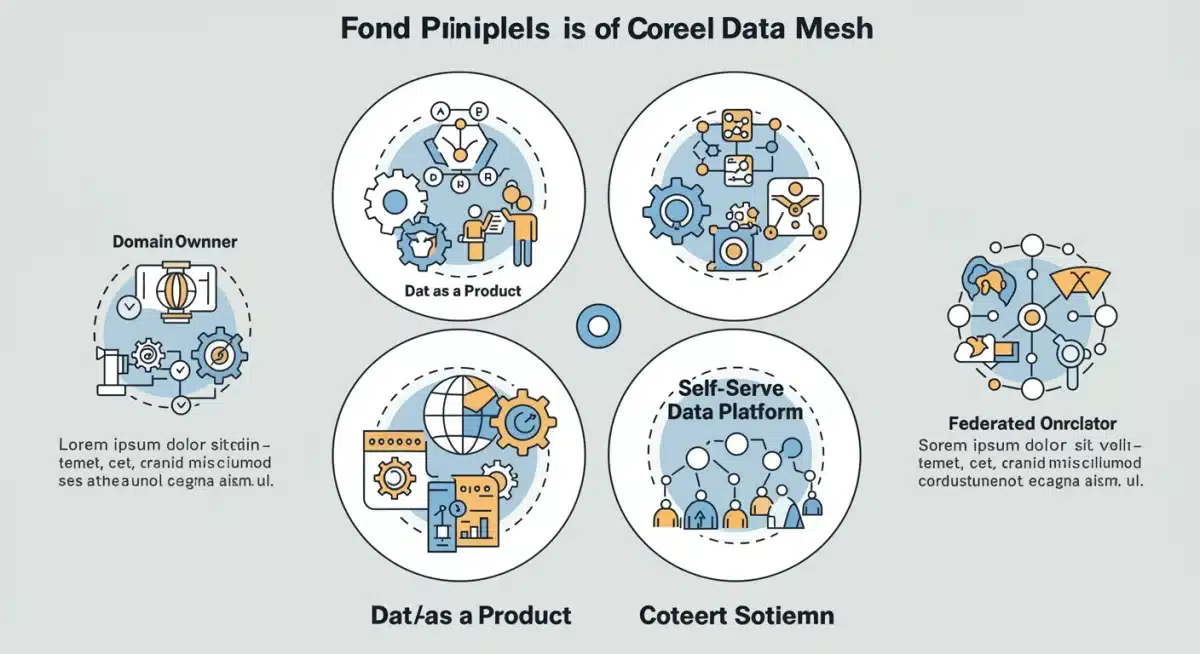
Domain Ownership: Business units become accountable for their data, treating it as a product.
Data as a Product: Data is designed, built, and served with the same rigor as any software product.
Self-Serve Data Platform: A platform is provided to enable domain teams to build and manage data products independently.
Federated Computational Governance: Automated global policies guide local decision-making and ensure interoperability.
By embracing these principles, US organizations can break down data silos and foster a culture where data producers and consumers are inherently aligned. This alignment dramatically reduces the time spent on data requests, transformations, and validations, directly contributing to the projected two-month acceleration in data access.
Accelerating Data Access: The Two-Month Advantage
The claim of achieving two-month faster data access is not hyperbole; it’s a direct outcome of the operational efficiencies introduced by a well-implemented data mesh. In traditional setups, data consumers often face lengthy queues for data requests, complex data preparation tasks, and a lack of understanding regarding data lineage and quality. Data mesh addresses these pain points head-on.
When data is treated as a product, domain teams are incentivized to make it easily discoverable, understandable, and consumable. This includes providing clear documentation, robust APIs, and adherence to established quality standards. The self-serve data platform further empowers data consumers to find and utilize data products without constant reliance on central data teams.
Impact on Key Business Operations
Faster data access translates into tangible benefits across various business functions. For marketing teams, it means quicker insights into campaign performance and customer behavior, enabling more agile adjustments. For product development, rapid access to usage data fuels faster iteration cycles and more informed feature decisions. In financial services, real-time data access can be critical for fraud detection and risk management.
Consider the scenario where a new data source needs to be integrated for an urgent analytical project. In a traditional environment, this could involve weeks of coordination, data modeling, and ETL pipeline development by a central team. With data mesh, the owning domain team can expose the data as a product, and the consuming team can integrate it with minimal friction, drastically reducing the time to insight. This efficiency gain, compounded across numerous data interactions, forms the basis for the significant acceleration in data access.
Key Pillars for a Successful Data Mesh Implementation
Implementing a data mesh is not merely a technological upgrade; it’s a fundamental organizational and cultural transformation. Success hinges on a clear understanding and commitment to its foundational pillars. Without these, organizations risk replicating old problems with new technology.
The transition requires a significant investment in people, processes, and technology, but the long-term benefits in agility and innovation far outweigh the initial challenges. US organizations looking to gain a competitive edge must meticulously plan their data mesh journey.
Strategic Considerations for US Enterprises
For US organizations, unique considerations arise, including navigating complex regulatory landscapes (e.g., HIPAA, CCPA), integrating with diverse legacy systems, and managing a highly skilled but often distributed workforce. A phased approach, starting with a pilot domain, is often recommended to build momentum and demonstrate value.
Organizational Buy-in: Secure leadership commitment and cross-functional collaboration.
Cultural Shift: Foster a culture of data ownership and product thinking among domain teams.
Platform Enablement: Build or acquire a robust self-serve data platform.
Data Product Definition: Clearly define what constitutes a data product and its lifecycle.
These pillars collectively support the creation of an environment where data flows freely and efficiently, enabling domain teams to publish and consume data products with unprecedented speed. The outcome is not just faster data access, but a more resilient, scalable, and adaptable data ecosystem tailored for the demands of 2025 and beyond.
Challenges and Mitigation Strategies in Adoption
While the benefits of data mesh are compelling, its adoption is not without hurdles. Organizations often face challenges related to cultural resistance, skill gaps, and the initial investment required for platform development. Overcoming these challenges is crucial for realizing the full potential of a data mesh architecture.
A common misconception is that data mesh eliminates the need for central data teams. Instead, their role evolves from data custodians to platform enablers and governance facilitators. This shift requires new skill sets and a different mindset, which can be a significant internal adjustment. Addressing these challenges proactively is key to a smooth transition.
Navigating the Roadblocks to Implementation
One significant challenge is ensuring data interoperability across diverse domains. Without standardized formats, metadata, and access patterns, data products can become isolated islands, defeating the purpose of a mesh. Establishing clear contracts for data products and investing in robust metadata management tools are vital.
Cultural Resistance: Address fear of change through clear communication and training.
Skill Gaps: Invest in upskilling existing staff and strategic new hires for data product development and platform engineering.
Interoperability: Define common standards for data products, including schemas, formats, and APIs.
Cost and Complexity: Start small with pilot projects to demonstrate ROI and manage complexity incrementally.
By implementing a thoughtful change management strategy, providing comprehensive training, and focusing on incremental delivery, US organizations can effectively mitigate these challenges. The goal is to build momentum and demonstrate tangible value early on, fostering wider adoption and ensuring the long-term success of the data mesh initiative.
Measuring Success: KPIs for Data Mesh Architecture
To truly understand the impact of data mesh architecture, organizations must establish clear key performance indicators (KPIs) that align with their strategic objectives. Simply deploying the architecture is not enough; measuring its effectiveness in accelerating data access and empowering domain teams is paramount.
These KPIs should extend beyond technical metrics to encompass business outcomes, demonstrating how data mesh directly contributes to improved decision-making, faster innovation, and enhanced operational efficiency. Without a robust measurement framework, it’s difficult to justify ongoing investment and refine the implementation strategy.
Quantifying the Benefits of Decentralized Data
Key metrics will naturally revolve around the speed and ease of data access. This includes tracking the time it takes for a new data product to be available for consumption, the number of successful data product integrations, and the reduction in data request backlogs. Furthermore, measuring data quality and data product usage will provide insights into the value being generated.
Time to Data Access: Measure the average time from data source identification to consumption.
Number of Data Products: Track the growth of discoverable and usable data products.
Data Product Usage: Monitor how frequently data products are accessed and by whom.
Data Quality Scores: Assess the reliability and accuracy of data products over time.
By consistently monitoring these KPIs, US organizations can gain a clear picture of their data mesh’s performance. This data-driven approach allows for continuous improvement, ensuring that the architecture evolves to meet changing business needs and continues to deliver on its promise of accelerated data access and business value.
The Future Landscape: Data Mesh in 2025 and Beyond
As we look towards 2025, data mesh architecture is poised to become a dominant force in enterprise data management, particularly within the competitive landscape of US organizations. Its ability to democratize data, foster agility, and accelerate insights makes it an indispensable strategy for businesses striving for innovation and competitive advantage.
The evolution will likely see more sophisticated self-serve platforms, enhanced automation for governance, and deeper integration with AI and machine learning workflows. The focus will shift from just enabling data access to actively driving intelligent business outcomes at speed.
Emerging Trends and Strategic Imperatives
Expect to see increased adoption of industry-specific data mesh patterns, as organizations tailor the framework to their unique regulatory and operational requirements. The emphasis on data observability and data contracts will grow, ensuring high levels of trust and reliability in data products. Furthermore, the integration of data mesh with data fabric concepts will likely become more prevalent, creating a unified and intelligent data ecosystem.
Hyper-automation: Increased automation in data product creation, deployment, and governance.
AI-driven Insights: Tighter integration with AI/ML tools to generate proactive insights from data products.
Data Observability: Advanced monitoring and alerting for data product health and usage.
Cross-organizational Data Sharing: Facilitation of secure and compliant data exchange between partners.
For US organizations, embracing data mesh architecture is not just about staying current; it’s about building a future-proof data strategy that can adapt to unforeseen challenges and capitalize on emerging opportunities. The two-month faster data access is merely a symptom of a deeper transformation that will redefine how businesses interact with and derive value from their most critical asset: data.
Key Aspect
Brief Description
Decentralized Ownership
Business domains own and manage their data as products, reducing bottlenecks.
Data as a Product
Data is treated with product management rigor, ensuring quality and usability.
Self-Serve Platform
Enables domain teams to independently create, publish, and consume data products.
Federated Governance
Global policies with local enforcement ensure data consistency and compliance.
Frequently Asked Questions About Data Mesh
What is the primary benefit of data mesh architecture for US organizations?▼
The primary benefit is significantly faster data access, potentially by two months, enabling quicker insights and more agile decision-making. It empowers domain teams, reduces central IT bottlenecks, and fosters a data-driven culture, crucial for competitive US markets.
How does data mesh differ from traditional data warehouses or data lakes?▼
Unlike centralized data warehouses or lakes, data mesh decentralizes ownership, treating data as products owned by business domains. This distributed approach enhances scalability, reduces dependencies, and accelerates data delivery, overcoming limitations of monolithic systems.
What are the core principles guiding a successful data mesh implementation?▼
Key principles include domain ownership of data, treating data as a product, providing a self-serve data platform, and implementing federated computational governance. Adhering to these principles ensures a cohesive, scalable, and efficient data ecosystem.
What challenges might US organizations face when adopting data mesh?▼
Challenges include cultural resistance to decentralization, skill gaps in data product development, ensuring interoperability across diverse domains, and managing initial costs. Effective change management and a phased approach can help mitigate these hurdles.
How can organizations measure the success of their data mesh strategy?▼
Success can be measured through KPIs such as time to data access, number of active data products, data product usage rates, and improvements in data quality scores. These metrics provide tangible evidence of the architecture’s impact on business agility and efficiency.
Conclusion
The journey towards a truly data-driven enterprise is continuous, and data mesh architecture represents a significant leap forward for US organizations. By embracing its decentralized, domain-oriented principles, businesses can not only achieve the ambitious goal of two-month faster data access by 2025 but also lay the groundwork for sustainable innovation. The shift requires strategic planning, cultural adaptation, and a commitment to treating data as a first-class product, but the rewards in agility, insight, and competitive advantage are clear and compelling. As technology continues to evolve, data mesh will undoubtedly play a pivotal role in shaping the future of data management across the United States.
Eduarda Moura has a degree in Journalism and a postgraduate degree in Digital Media. With experience as a copywriter, Eduarda strives to research and produce informative content, bringing clear and precise information to the reader.