Optimizing Cloud Spend 2025: Cut Costs by 18% for US Enterprises
Optimizing cloud spend in 2025 is crucial for US enterprises aiming to achieve an 18% cost reduction by adopting advanced FinOps practices, leveraging automation, and strategically managing cloud resources.
By: Eduarda Moura on July 4, 2025
Last updated on: November 28, 2025
Optimizing cloud spend in 2025 is essential for US enterprises, offering a realistic path to an 18% cost reduction by implementing strategic FinOps methodologies, advanced resource management, and proactive cost governance.
In the rapidly evolving digital landscape, the imperative for US enterprises to master cloud spend optimization has never been more critical. As cloud adoption continues its upward trajectory, so too does the complexity and potential for runaway costs. For businesses aiming to thrive in 2025, merely migrating to the cloud is no longer sufficient; the focus must shift decisively towards smart, efficient management of these powerful resources. This article delves into seven expert strategies designed to help US enterprises achieve a significant 18% reduction in their cloud expenditures, ensuring technological advancement doesn’t come at an unsustainable financial cost.
Embracing FinOps for Financial Accountability
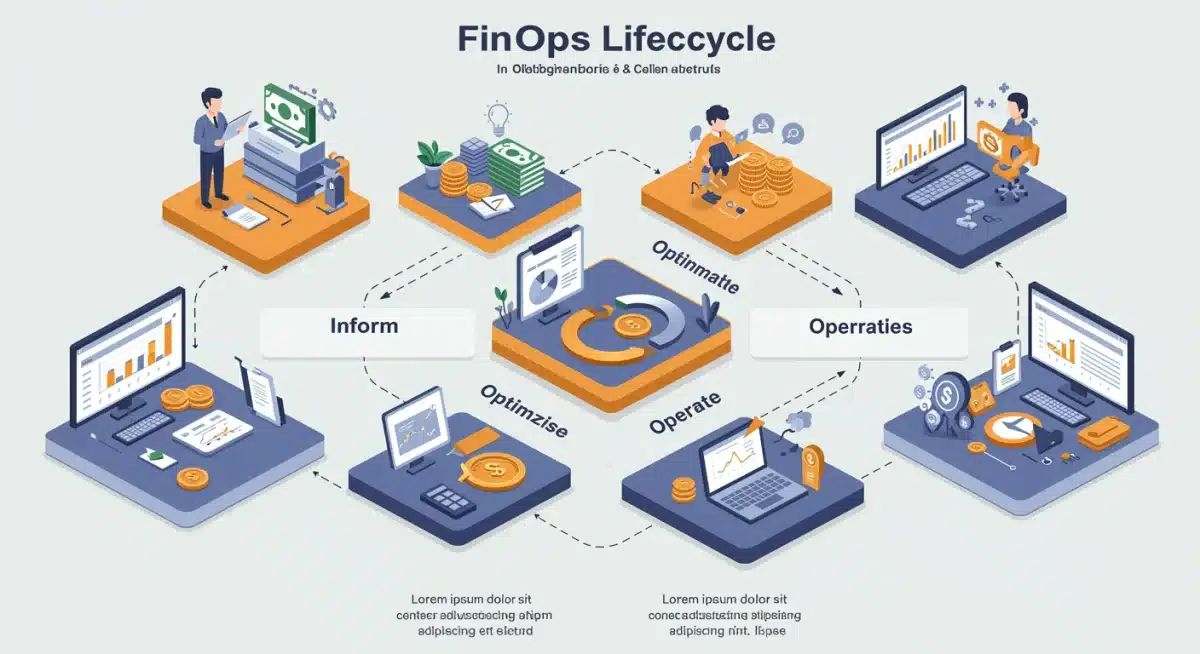
FinOps, a portmanteau of “Finance” and “DevOps,” represents a cultural practice that brings financial accountability to the variable spend model of cloud. It empowers teams to make business trade-offs balancing speed, cost, and quality. Implementing a robust FinOps framework is foundational for any enterprise serious about cost reduction in the cloud.
This methodology encourages collaboration between engineering, finance, and business teams, fostering a shared understanding of cloud costs and driving better financial decision-making. By integrating financial practices into daily cloud operations, organizations can gain unprecedented visibility and control over their expenditures.
Establishing a FinOps Culture
Cultivating a FinOps culture requires more than just new tools; it demands a shift in mindset. It involves educating teams on cost implications and empowering them with the data to make informed choices.
Cross-functional teams: Foster collaboration between engineering, finance, and procurement departments.
Cost visibility: Implement tools and processes to provide granular insights into cloud spending.
Shared responsibility: Promote accountability for cloud costs across all relevant teams.
Implementing FinOps Tools and Processes
Effective FinOps relies on a suite of tools and well-defined processes to track, analyze, and optimize cloud spend. These tools range from native cloud provider dashboards to third-party FinOps platforms that offer advanced analytics and automation capabilities.
By systematically adopting FinOps principles, US enterprises can move beyond reactive cost cutting to proactive financial management, laying the groundwork for sustained savings and efficient resource utilization. This cultural and operational shift is paramount for achieving the targeted 18% cost reduction in 2025.
Leveraging Cloud Cost Management Tools and Dashboards
Visibility is the first step towards control. Without a clear understanding of where cloud resources are being consumed and at what cost, effective optimization is impossible. Modern cloud cost management tools and dashboards provide the necessary insights to identify waste and opportunities for savings.
These platforms aggregate data from various cloud providers, offering a unified view of an organization’s entire cloud footprint. They often include features such as cost allocation, budgeting, forecasting, and anomaly detection, which are critical for proactive cost governance.
Unified Cost Visibility
A consolidated view of cloud spending helps enterprises track costs across different departments, projects, and environments. This eliminates silos and provides a comprehensive financial picture.
Centralized dashboards: Utilize tools that consolidate billing data from AWS, Azure, Google Cloud, and other providers.
Tagging and labeling: Enforce strict tagging policies to accurately attribute costs to specific teams or applications.
Custom reports: Generate tailored reports to meet the specific needs of finance and engineering stakeholders.
Budgeting and Forecasting
Beyond current spend, effective tools enable robust budgeting and forecasting, allowing enterprises to set financial targets and predict future expenditures. This helps in preventing budget overruns and planning for future cloud investments.
By actively using these tools, US enterprises can transform raw billing data into actionable intelligence, making informed decisions that directly contribute to their goal of cloud spend optimization and an 18% cost reduction. The insights gained from these platforms are invaluable for identifying underutilized resources and optimizing procurement strategies.
Rightsizing and Eliminating Unused Resources
One of the most common sources of cloud waste is over-provisioned or entirely unused resources. Virtual machines, storage volumes, and databases are often deployed with more capacity than required, leading to unnecessary expenses. Rightsizing involves adjusting resource allocations to match actual demand, while eliminating unused resources is about identifying and decommissioning idle assets.
This strategy requires continuous monitoring and analysis, as demand patterns can change over time. Automated tools can play a significant role in identifying rightsizing opportunities and flagging idle resources for removal.
Identifying Over-provisioned Instances
Many instances are launched using default settings or based on peak load assumptions that rarely materialize. Analyzing CPU, memory, and network utilization metrics can reveal instances that are consistently underutilized.
Automated recommendations: Use cloud provider tools or third-party solutions to receive rightsizing suggestions.
Scheduled review cycles: Regularly review resource usage with engineering teams to adjust sizing.
Decommissioning Idle Resources
Resources can become idle for various reasons, such as abandoned test environments, decommissioned applications, or forgotten snapshots. These resources continue to incur costs without providing any business value.
Implementing a systematic process for identifying and terminating idle resources is crucial. This often involves automated scripts and policies that flag resources that have shown no activity for a defined period. By diligently rightsizing and eliminating unused resources, US enterprises can significantly reduce their cloud infrastructure costs, directly contributing to the 18% savings target for 2025.
Optimizing Storage and Data Transfer Costs
Storage and data transfer can represent a substantial portion of cloud bills, especially for data-intensive applications. Optimizing these costs involves selecting the right storage classes, implementing intelligent tiering, and minimizing unnecessary data egress.
Cloud providers offer various storage classes, each with different cost structures and performance characteristics. Matching data to the appropriate storage class based on access frequency and retention requirements can lead to considerable savings.
Intelligent Storage Tiering
Automating the movement of data between different storage classes based on access patterns can significantly reduce costs. Data that is frequently accessed can reside in high-performance, higher-cost storage, while less frequently accessed data can be moved to cheaper archival storage.
Lifecycle policies: Configure policies to automatically transition data between storage tiers.
Data classification: Categorize data based on its criticality, access frequency, and compliance requirements.
Archival solutions: Utilize cold storage options for long-term retention of infrequently accessed data.
Minimizing Data Egress Charges
Data transfer costs, particularly data egress (data leaving the cloud provider’s network), can be surprisingly high. Strategies to minimize these costs include using Content Delivery Networks (CDNs), optimizing network architecture, and compressing data.
By proactively managing storage classes and data transfer patterns, US enterprises can unlock significant savings. This strategic approach to data management is a key component of effective cloud spend optimization, helping them achieve their ambitious cost reduction goals for 2025.
Automating Cost Governance and Policy Enforcement
Manual cost management is prone to errors and inconsistencies, especially in large, dynamic cloud environments. Automating cost governance and policy enforcement ensures that optimization strategies are consistently applied and maintained across the organization.
This involves setting up automated rules and policies that prevent unapproved resource deployments, enforce tagging standards, and automatically shut down non-production resources during off-hours. Automation not only reduces costs but also frees up engineering teams to focus on innovation.
Implementing Automated Shutdown Schedules
Non-production environments (development, testing, staging) often run 24/7 even when not in use. Implementing automated schedules to shut down these resources during nights and weekends can yield significant savings.
Tools and scripts can be configured to automatically start and stop instances based on predefined schedules, ensuring resources are only active when needed. This simple yet effective strategy is often one of the quickest ways to realize immediate cost reductions.
Enforcing Tagging and Resource Naming Conventions
Consistent tagging is fundamental for accurate cost allocation and visibility. Automated policies can ensure that all new resources are properly tagged before deployment, preventing “untagged” or “orphan” resources from accumulating.
Policy-as-code: Define and enforce cloud policies through code, integrating them into CI/CD pipelines.
Automated alerts: Set up notifications for policy violations, allowing for quick remediation.
Resource lifecycle management: Automate the provisioning and de-provisioning of resources based on predefined policies.
Through robust automation, US enterprises can establish a self-regulating cloud environment that continuously optimizes costs without constant manual intervention, making the 18% cost reduction target more attainable.
Strategic Use of Reserved Instances and Savings Plans
Cloud providers offer significant discounts for commitments to specific usage levels over a period, typically one or three years. Reserved Instances (RIs) and Savings Plans are powerful mechanisms for reducing compute costs, but they require careful planning and management to maximize their benefits.
These purchasing options are best suited for stable, predictable workloads. For variable workloads, a combination of on-demand and commitment-based pricing can offer the best balance of flexibility and cost savings.
Analyzing Usage Patterns for Commitments
Before making a commitment, it’s essential to thoroughly analyze historical usage data to identify consistent resource consumption patterns. Over-committing can lead to unused capacity, negating potential savings.
Historical data analysis: Examine past usage to identify stable baselines for compute, database, and other services.
Flexibility options: Understand the flexibility of RIs and Savings Plans across different instance types and regions.
Managing and Optimizing Commitments
Once commitments are made, continuous monitoring is necessary to ensure they are being fully utilized. Cloud providers offer tools to track RI and Savings Plan utilization, and third-party solutions can provide more advanced recommendations.
By strategically acquiring and managing RIs and Savings Plans, US enterprises can lock in substantial discounts on their cloud compute and database costs, a critical strategy for achieving their cloud spend optimization goals and the ambitious 18% cost reduction for 2025. This requires a proactive and informed approach to cloud procurement.
Vendor Negotiation and Multi-Cloud Strategy
While cloud providers offer standard pricing, larger enterprises with significant spend often have opportunities to negotiate custom pricing agreements. Furthermore, a well-executed multi-cloud strategy can provide leverage for negotiation and optimize costs by selecting the best-fit provider for each workload.
Engaging directly with cloud vendor account managers to discuss potential discounts, enterprise agreements, or volume-based pricing is a valuable strategy for maximizing cost efficiency. A multi-cloud approach, when implemented thoughtfully, can also mitigate vendor lock-in and optimize for specific services.
Negotiating Enterprise Agreements
For enterprises with substantial cloud expenditures, negotiating an Enterprise Agreement (EA) can unlock significant discounts beyond standard public pricing. These agreements often include committed spend tiers, custom pricing for specific services, and dedicated support.
Preparation is key for successful negotiation. Enterprises should have a clear understanding of their current and projected cloud spend, their architectural roadmap, and be prepared to articulate their long-term commitment to the vendor.
Strategic Multi-Cloud Adoption
A multi-cloud strategy isn’t just about avoiding vendor lock-in; it’s also about optimizing costs by leveraging the competitive pricing and specialized services of different providers. By placing workloads where they are most cost-effective, enterprises can drive down overall cloud expenses.
Workload assessment: Evaluate applications and services to determine the most suitable cloud provider based on cost, performance, and features.
Interoperability: Design architectures that allow for seamless integration and data transfer between different cloud environments.
Vendor comparison: Regularly compare pricing models and service offerings across providers to identify cost-saving opportunities.
By combining assertive vendor negotiation with a strategic multi-cloud approach, US enterprises can significantly enhance their cloud spend optimization efforts, contributing substantially to the 18% cost reduction target in 2025 while maintaining flexibility and resilience.
Key Strategy
Brief Description
Embrace FinOps
Integrate financial accountability into cloud operations for collaborative cost management.
Rightsizing Resources
Adjust cloud resource allocations to match actual demand and eliminate idle assets.
Automate Governance
Implement policies and scripts for continuous cost optimization without manual intervention.
Strategic Commitments
Utilize Reserved Instances and Savings Plans for predictable workloads to secure discounts.
Frequently Asked Questions About Cloud Spend Optimization
What is FinOps and why is it crucial for cloud cost reduction?▼
FinOps is a cultural practice that integrates financial accountability into cloud operations, fostering collaboration between finance and engineering teams. It’s crucial because it provides visibility, enables data-driven decision-making, and promotes a shared understanding of cloud costs, leading to more efficient resource utilization and significant savings.
How can enterprises identify and eliminate unused cloud resources?▼
Enterprises can identify unused resources by continuously monitoring usage metrics for CPU, memory, and network activity. Tools from cloud providers and third-party solutions can flag idle instances, storage volumes, and forgotten snapshots. Implementing automated shutdown schedules for non-production environments and regular audits are also effective strategies.
What role does automation play in cloud cost governance?▼
Automation is vital for consistent cloud cost governance. It allows enterprises to enforce policies like mandatory tagging, implement automated shutdown/startup schedules for non-production environments, and prevent unapproved resource deployments. This reduces manual effort, minimizes human error, and ensures that cost optimization strategies are continuously applied across the entire cloud footprint.
Are Reserved Instances and Savings Plans suitable for all cloud workloads?▼
Reserved Instances (RIs) and Savings Plans are best suited for stable, predictable cloud workloads with consistent usage patterns over one or three years. While they offer significant discounts, they may not be ideal for highly variable or short-term workloads where on-demand pricing or spot instances might be more cost-effective. Careful analysis of historical data is essential before commitment.
How can a multi-cloud strategy contribute to cloud cost optimization?▼
A multi-cloud strategy contributes to cost optimization by enabling enterprises to leverage competitive pricing and specialized services from different providers. By strategically placing workloads on the most cost-effective cloud for their specific needs, organizations can reduce overall expenses, mitigate vendor lock-in, and gain greater negotiation leverage with individual cloud vendors.
Conclusion
Achieving an 18% reduction in cloud spend for US enterprises in 2025 is an ambitious yet entirely attainable goal, provided a strategic and comprehensive approach to cloud spend optimization is adopted. The seven expert strategies outlined—from embracing FinOps and leveraging powerful cost management tools to rightsizing resources, optimizing storage, automating governance, and making strategic commitments—form a robust framework for financial efficiency. By combining these technical and cultural shifts, enterprises can not only curb runaway costs but also foster a more sustainable, agile, and innovative cloud environment, ensuring their digital investments deliver maximum business value.
Eduarda Moura has a degree in Journalism and a postgraduate degree in Digital Media. With experience as a copywriter, Eduarda strives to research and produce informative content, bringing clear and precise information to the reader.