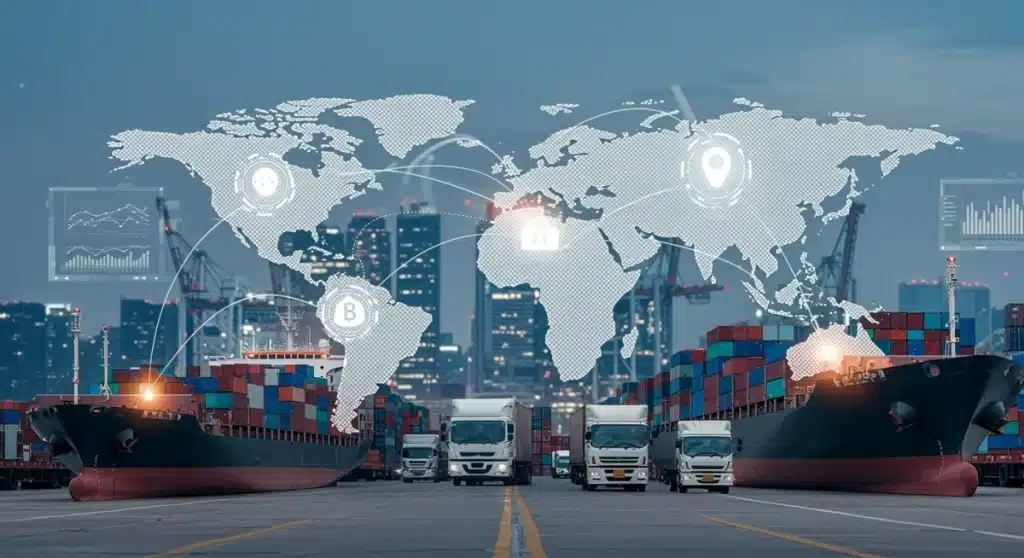
Blockchain in Supply Chains: 25% Transparency by 2025
Blockchain adoption in supply chains is poised to deliver a significant 25% increase in transparency by mid-2025, fundamentally transforming how products move from origin to consumer.
By: Eduarda Moura on May 27, 2025
Last updated on: November 28, 2025
Blockchain adoption in supply chains is poised to deliver a significant 25% increase in transparency by mid-2025, fundamentally transforming how products move from origin to consumer.
The global economy relies heavily on the intricate dance of supply chains, yet opacity and inefficiencies often plague these vital networks. However, a revolutionary shift is underway as the integration of blockchain technology promises to deliver a remarkable blockchain adoption in supply chains: achieving 25% greater transparency by mid-2025. This transformation is not merely a technical upgrade; it represents a fundamental re-imagining of trust, traceability, and efficiency across industries.
The Imperative for Supply Chain Transparency
In today’s interconnected world, consumers, regulators, and businesses alike demand unprecedented visibility into product origins, manufacturing processes, and ethical sourcing. Traditional supply chain models, often characterized by fragmented data and siloed systems, struggle to meet this growing need. The lack of transparency can lead to significant challenges, from counterfeit goods and unethical labor practices to inefficient recalls and damaged brand reputation. Addressing these issues is no longer optional but a strategic imperative for long-term viability and customer loyalty.
The drive for greater transparency is fueled by several factors, including regulatory pressures, consumer activism, and the sheer complexity of modern global logistics. Companies are realizing that a clear, verifiable record of a product’s journey can unlock immense value, not just in compliance but also in operational efficiency and market differentiation. This push for clarity sets the stage for technologies like blockchain to emerge as critical enablers.
Addressing Data Silos and Trust Deficits
One of the primary hurdles in achieving supply chain transparency is the existence of data silos. Information often resides in disparate systems across multiple organizations, making it difficult to create a unified, trustworthy record. Blockchain offers a solution by providing a shared, immutable ledger.
Immutable Records: Once data is recorded on a blockchain, it cannot be altered, ensuring the integrity of information.
Shared Ledger: All authorized participants have access to the same, up-to-date information, fostering collaboration.
Enhanced Trust: The cryptographic security of blockchain builds trust among parties who may not otherwise fully trust each other.
By overcoming these limitations, blockchain paves the way for a new era where every step of the supply chain can be verified and understood. This not only benefits end-consumers but also empowers businesses with better control and insights into their operations.
The ultimate goal is to move beyond simply knowing where a product is at any given moment, to understanding its entire lifecycle, from raw material to final delivery. This comprehensive view allows for proactive problem-solving, improved quality control, and a stronger ethical footprint, all contributing to a more resilient and responsible supply chain ecosystem.
Blockchain’s Core Mechanisms for Enhanced Visibility
At its heart, blockchain provides a distributed, decentralized, and immutable ledger that records transactions in a secure and verifiable manner. This inherent design makes it uniquely suited to address the transparency challenges within supply chains. Each ‘block’ in the chain contains a timestamped batch of transactions, which, once validated, is added to the chain, creating an unchangeable record. This foundational structure enables a level of traceability and accountability previously unattainable.
The cryptographic links between blocks ensure that any attempt to tamper with past records would be immediately evident, thus upholding the integrity of the data. This security feature is paramount in environments where multiple parties, often with competing interests, need to share sensitive information without compromising its veracity. The transparency doesn’t mean all data is public; rather, it means authorized participants can access and verify relevant data points, creating a network of trust.
Smart Contracts for Automated Processes
Beyond basic record-keeping, smart contracts introduce an automated layer to blockchain-powered supply chains. These self-executing contracts, with the terms of the agreement directly written into code, automatically execute predefined actions when certain conditions are met.
Automated Payments: Payments can be released automatically upon delivery and verification of goods.
Compliance Checks: Smart contracts can verify that goods meet specific regulatory or quality standards before proceeding to the next stage.
Inventory Management: Automatic updates to inventory records based on goods movement can reduce manual errors and delays.
The automation provided by smart contracts significantly reduces administrative overhead, minimizes disputes, and accelerates the flow of goods and information. This efficiency gain contributes directly to the overall transparency by ensuring that processes are followed consistently and verifiably.
The combination of immutable ledgers and smart contracts transforms the supply chain from a series of disconnected transactions into a seamless, self-auditing ecosystem. This not only enhances visibility but also drastically reduces the potential for human error and fraudulent activities, building a more robust and trustworthy system for all stakeholders involved.
Current Landscape of Blockchain Adoption
While the concept of blockchain in supply chains has been discussed for years, its practical implementation is now gaining significant momentum. Major industries, from food and pharmaceuticals to luxury goods and automotive, are piloting and deploying blockchain solutions. These early adopters are demonstrating tangible benefits, proving the technology’s potential to revolutionize operations. The journey from conceptualization to widespread adoption is accelerating, driven by successful case studies and the increasing availability of enterprise-grade blockchain platforms.
Companies are often starting with specific, high-value use cases where transparency is critical, such as tracking ethically sourced materials or proving product authenticity. As these initial projects yield positive results, the scope of blockchain integration is expanding across broader segments of their supply chains. This phased approach allows organizations to learn, adapt, and scale their blockchain initiatives effectively, mitigating risks associated with new technology deployment.
Industry-Specific Implementations and Successes
Different industries are leveraging blockchain for unique transparency challenges:
Food & Beverage: IBM Food Trust uses blockchain to trace food products from farm to fork, drastically reducing recall times and enhancing consumer safety.
Pharmaceuticals: Blockchain is being used to combat counterfeit drugs and ensure the integrity of the cold chain for temperature-sensitive medicines.
Logistics: Companies like Maersk and IBM’s TradeLens platform are streamlining global shipping documentation and improving cargo visibility.
These examples illustrate that blockchain is not a one-size-fits-all solution but rather a versatile technology adaptable to diverse industry needs. The success stories are inspiring more companies to explore its potential, leading to a snowball effect in adoption rates.
The current landscape indicates a maturing ecosystem for blockchain in supply chains, with a growing number of vendors offering specialized solutions and an increasing understanding among businesses of how to best leverage this technology. This foundational progress is crucial for achieving the ambitious transparency targets set for mid-2025, demonstrating a clear path forward for widespread integration.
Challenges and Roadblocks to Widespread Integration
Despite the undeniable benefits, the path to widespread blockchain adoption in supply chains is not without its hurdles. Implementing a new technology that requires collaboration across multiple independent entities presents complex technical, organizational, and regulatory challenges. Overcoming these obstacles will be critical for achieving the projected 25% increase in transparency by mid-2025.
One significant challenge is the interoperability between different blockchain platforms and legacy systems. Many companies already have extensive IT infrastructures, and integrating blockchain without disrupting existing operations requires careful planning and robust solutions. Furthermore, the initial investment in blockchain technology, both in terms of infrastructure and expertise, can be substantial, posing a barrier for smaller businesses.
Overcoming Technical and Organizational Hurdles
Technical complexities often revolve around scalability and data privacy. While public blockchains face scalability issues, enterprise-focused private or consortium blockchains offer better performance but require careful governance.
Interoperability: Ensuring different blockchain networks and traditional systems can communicate seamlessly.
Data Privacy: Balancing the need for transparency with the imperative to protect sensitive commercial data.
Standardization: Developing common standards and protocols for data exchange across diverse supply chain participants.
Organizational hurdles include obtaining buy-in from all stakeholders, managing change within large organizations, and fostering a collaborative environment among competitors or business partners. Education and training are essential to bridge the knowledge gap and ensure effective utilization of blockchain tools.
Addressing these challenges requires a concerted effort from technology providers, industry consortia, and individual businesses. Collaborative initiatives and the development of open standards will be key to lowering adoption barriers and accelerating the integration of blockchain into mainstream supply chain operations.
Measuring the 25% Transparency Goal: Metrics and Impact
The ambitious goal of achieving 25% greater transparency by mid-2025 necessitates clear metrics and a deep understanding of its impact. Measuring transparency isn’t as straightforward as tracking sales figures; it involves assessing the depth, breadth, and reliability of information available across the supply chain. This goal signifies a significant leap from current levels of visibility, promising profound changes in how businesses operate and how consumers interact with products.
To quantify this 25% increase, organizations will likely look at a combination of qualitative and quantitative indicators. This includes the percentage of products traceable to their origin, the reduction in time taken to identify and resolve supply chain issues, and the improved accuracy of shared data. The impact extends beyond mere numbers, touching upon brand reputation, consumer trust, and regulatory compliance, all of which contribute to a more sustainable and ethical global trade environment.
Key Performance Indicators for Transparency
Several KPIs can help gauge progress towards the 25% transparency target:
Traceability Coverage: The percentage of raw materials and finished goods with verifiable blockchain records.
Dispute Resolution Time: Reduction in the time taken to settle disputes related to product origin, quality, or delivery.
Audit Efficiency: Improved speed and accuracy of compliance audits due to readily available immutable data.
Consumer Trust Scores: Metrics reflecting increased consumer confidence in product authenticity and ethical sourcing.
These metrics provide a tangible way to track progress and demonstrate the value generated by blockchain implementation. The focus is not just on collecting data but on making that data actionable and accessible to all authorized parties, fostering a truly transparent ecosystem.
Ultimately, achieving the 25% transparency goal means building more resilient, trustworthy, and efficient supply chains. It signals a future where information asymmetry is significantly reduced, enabling better decision-making, reducing risks, and enhancing the overall integrity of global commerce for all stakeholders involved.
The Future Outlook: Beyond 2025
As we approach mid-2025 and potentially achieve the 25% transparency goal, the journey for blockchain in supply chains will be far from over. This milestone will serve as a springboard for even greater integration and innovation. The foundational work laid by early adopters and the development of more robust, scalable platforms will pave the way for a future where fully transparent and interconnected supply chains are the norm, not the exception. The trajectory suggests an evolution towards more intelligent, self-optimizing networks.
Looking beyond 2025, we can anticipate a convergence of blockchain with other emerging technologies, such as Artificial Intelligence (AI), the Internet of Things (IoT), and advanced analytics. This synergy will create hyper-efficient, predictive supply chains that can anticipate disruptions, automate complex decisions, and provide real-time, granular insights into every facet of product movement. The focus will shift from merely tracking to truly understanding and optimizing the entire value chain.
Integration with Emerging Technologies
The combination of blockchain with other advanced technologies promises to unlock new levels of efficiency and insight:
IoT Devices: Sensors can automatically record data (temperature, location, humidity) onto the blockchain, providing real-time, verifiable conditions.
Artificial Intelligence: AI can analyze vast amounts of blockchain data to identify patterns, predict disruptions, and optimize routes or inventory.
Digital Twins: Creating virtual replicas of physical products or processes, enhanced by blockchain data, for comprehensive monitoring and simulation.
These integrations will transform supply chains into intelligent, self-managing systems, capable of responding dynamically to changing conditions and consumer demands. The enhanced transparency provided by blockchain will be a critical enabler for these advanced functionalities, ensuring the integrity and trustworthiness of the data flowing through these complex networks.
The long-term vision is a global trade infrastructure built on trust, efficiency, and verifiable data, driven by blockchain and its technological partners. This future promises not only greater transparency but also enhanced sustainability, reduced waste, and a more equitable distribution of value across the entire supply chain ecosystem, benefiting businesses, consumers, and the planet alike.
Key Aspect
Brief Description
Transparency Goal
Achieve 25% greater supply chain transparency by mid-2025.
Core Mechanism
Distributed, immutable ledger for verifiable transaction records.
Key Benefit
Enhanced trust, traceability, and operational efficiency across the chain.
Future Outlook
Integration with AI/IoT for hyper-efficient, predictive supply chains.
Frequently Asked Questions About Blockchain in Supply Chains
What is the primary benefit of blockchain in supply chains?▼
The primary benefit is enhanced transparency and traceability. Blockchain creates an immutable, shared record of every transaction and movement, allowing all authorized participants to verify a product’s journey from origin to consumer, significantly reducing fraud and increasing trust.
How does blockchain increase transparency by 25%?▼
The 25% increase is a projected goal driven by the verifiable, tamper-proof nature of blockchain records. It means a quarter more of supply chain data will be accessible and reliable, improving visibility into sourcing, production, and logistics compared to current fragmented systems.
Are all supply chain data public on a blockchain?▼
No, not all data is public. Enterprise blockchain solutions often use private or consortium networks where access is permissioned. This allows companies to share relevant data with authorized partners while keeping sensitive commercial information confidential, balancing transparency with privacy needs.
What industries are leading blockchain adoption in supply chains?▼
Industries like food and beverage, pharmaceuticals, logistics, and luxury goods are at the forefront. They leverage blockchain to address critical issues such as food safety, counterfeit products, shipping documentation, and authenticating high-value items, demonstrating tangible benefits.
What are the main challenges for blockchain integration?▼
Key challenges include interoperability with legacy systems, scalability of blockchain networks, data privacy concerns among competitors, and the need for industry-wide standardization. Overcoming these requires collaborative efforts and robust technological solutions for seamless integration.
Conclusion
The pursuit of 25% greater transparency in supply chains by mid-2025 through blockchain adoption marks a pivotal moment in global commerce. This ambitious goal reflects a growing recognition of blockchain’s transformative power to build trust, enhance efficiency, and foster accountability across complex networks. While challenges remain, the increasing number of successful implementations and the ongoing innovation in the field indicate a clear trajectory towards a more visible, resilient, and ethical supply chain ecosystem. The future promises not just improved tracking but intelligent, predictive networks, ultimately benefiting businesses, consumers, and the global economy.
Eduarda Moura has a degree in Journalism and a postgraduate degree in Digital Media. With experience as a copywriter, Eduarda strives to research and produce informative content, bringing clear and precise information to the reader.