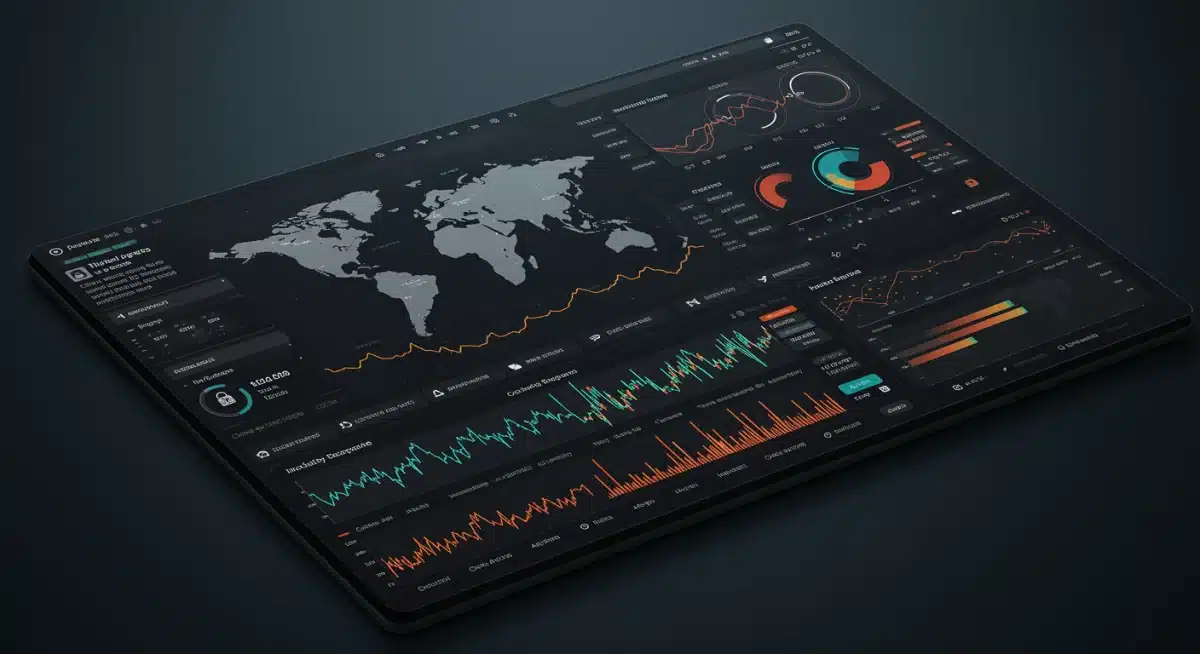
AI Cybersecurity: 30% Data Breach Reduction by 2025 in US
AI-powered cybersecurity offers a robust framework for US businesses to significantly reduce data breaches by 30% by 2025 through advanced threat detection, proactive defense mechanisms, and automated incident response, safeguarding sensitive information.
By: Eduarda Moura on June 13, 2025
Last updated on: November 28, 2025
AI-powered cybersecurity is poised to revolutionize how US businesses combat cyber threats, offering practical solutions to reduce data breaches by an ambitious 30% by 2025 through intelligent automation and predictive analytics.
The digital landscape is a battlefield, and for US businesses, the stakes have never been higher.
Each year, data breaches cost billions, eroding trust and compromising sensitive information.
However, a powerful new ally is emerging: AI cybersecurity US businesses are beginning to leverage.
This article delves into the practical solutions AI offers to achieve a significant 30% reduction in data breaches by 2025.
The evolving threat landscape and AI’s crucial role
Cyber threats are growing exponentially in sophistication and volume. Traditional security measures, while essential,
often struggle to keep pace with polymorphic malware, advanced persistent threats (APTs), and increasingly clever phishing schemes.
This escalating challenge necessitates a paradigm shift in defense strategies, moving towards more intelligent and adaptive systems.
Artificial intelligence (AI) offers this critical evolution, providing capabilities that human analysts simply cannot match in speed or scale.
AI’s ability to process vast amounts of data, identify subtle patterns, and learn from past incidents makes it an indispensable tool
in modern cybersecurity. It transforms security operations from reactive to proactive, empowering businesses to anticipate and neutralize threats before they inflict significant damage.
For US businesses, embracing AI isn’t just an advantage; it’s becoming a necessity for survival in a hostile digital environment.
Automated threat detection and anomaly identification
One of AI’s most impactful applications in cybersecurity is its capacity for automated threat detection.
AI algorithms can continuously monitor network traffic, system logs, and user behavior for anomalies that indicate a potential breach.
Unlike rule-based systems that rely on known signatures, AI can detect novel threats by identifying deviations from normal patterns.
Behavioral analytics: AI learns baseline user and system behaviors, flagging unusual activities.
Machine learning for malware: Identifies new malware variants by analyzing their characteristics, not just known signatures.
Network intrusion detection: Monitors network traffic for suspicious connections or data exfiltration attempts.
Predictive analysis: Forecasts potential attack vectors based on current threat intelligence and historical data.
The continuous learning aspect of AI means that its threat detection capabilities improve over time, adapting to new attack methodologies.
This dynamic defense mechanism is crucial for businesses facing an ever-changing threat landscape, offering a layer of protection that is both robust and flexible.
Proactive defense mechanisms with AI and machine learning
Beyond detection, AI and machine learning (ML) are pivotal in establishing proactive defense mechanisms.
These technologies enable security systems to not only identify threats but also to predict and prevent them before they fully materialize.
By analyzing vast datasets of past attacks and vulnerabilities, AI can forecast where and how future breaches might occur, allowing businesses to fortify their defenses strategically.
This proactive stance significantly reduces the window of opportunity for attackers. Instead of merely reacting to incidents,
organizations can deploy countermeasures based on intelligent predictions, closing security gaps before they are exploited.
This shift from reactive to predictive security is a cornerstone of achieving a 30% reduction in data breaches.
Intelligent patching and vulnerability management
Vulnerability management is a critical area where AI excels in proactive defense.
AI-powered tools can scan systems for vulnerabilities more efficiently and comprehensively than manual methods.
They can prioritize patches based on the likelihood of exploitation and the potential impact of a breach, ensuring that the most critical weaknesses are addressed first.
Automated vulnerability scanning: Continuously identifies security flaws across all endpoints and applications.
Risk-based prioritization: AI assesses the severity and exploitability of vulnerabilities to guide patching efforts.
Predictive patching: Recommends patches based on emerging threat intelligence and historical attack patterns.
By intelligently managing vulnerabilities, businesses can significantly reduce their attack surface.
This proactive approach ensures that systems are consistently updated and secured against known and emerging threats, minimizing opportunities for attackers to gain entry.
Automated incident response and remediation
When a security incident does occur, the speed and efficiency of the response are paramount.
AI-powered systems can automate many aspects of incident response, drastically reducing the time it takes to contain and remediate breaches.
This automation not only minimizes damage but also frees up human security teams to focus on more complex strategic tasks.
Automated incident response (AIR) workflows can be triggered by AI-detected anomalies, initiating actions such as isolating compromised systems,
blocking malicious IP addresses, or rolling back configurations to a pre-incident state.
This rapid response capability is vital for mitigating the impact of sophisticated attacks that can propagate quickly through networks.
Streamlined security operations with SOAR
Security Orchestration, Automation, and Response (SOAR) platforms, heavily reliant on AI,
integrate various security tools and automate repetitive tasks. This integration creates a seamless and highly efficient security operation center (SOC).
Automated playbooks: Pre-defined responses to common security incidents are executed automatically by AI.
Threat intelligence integration: SOAR platforms ingest global threat intelligence to enrich incident data.
Contextual analysis: AI provides deeper insights into incidents by correlating data from multiple sources.
The efficiency gained through AI-driven SOAR solutions allows businesses to respond to threats at machine speed,
significantly reducing dwell times and the overall cost of breaches. This technological advancement is a game-changer for businesses aiming for robust cybersecurity.
Enhanced data privacy and compliance with AI
Beyond preventing breaches, AI plays a critical role in maintaining data privacy and ensuring compliance with stringent regulations.
With data protection laws like GDPR and CCPA setting high standards, businesses must meticulously manage sensitive information.
AI can automate compliance checks, identify data privacy risks, and ensure that data handling practices align with regulatory requirements.
This capability is particularly beneficial for US businesses operating across various states and potentially internationally,
where a patchwork of regulations can be challenging to navigate manually. AI provides the consistency and precision needed to avoid costly penalties and reputational damage.
AI-driven data classification and access control
AI can automatically classify data based on its sensitivity and regulatory requirements.
This intelligent classification enables more granular access controls, ensuring that only authorized personnel can access sensitive information.
Automated data discovery: AI identifies and categorizes sensitive data across all systems.
Policy enforcement: Ensures that access policies are consistently applied based on data classification.
Anomaly detection in data access: Flags unusual attempts to access sensitive data, indicating potential insider threats.
By leveraging AI for data classification and access control, businesses can significantly enhance their data privacy posture.
This not only helps in meeting compliance obligations but also builds greater trust with customers and partners, knowing their data is securely managed.
Challenges and considerations for AI adoption
While the benefits of AI in cybersecurity are undeniable, its adoption is not without challenges.
Businesses must carefully consider several factors to ensure a successful implementation.
These include the quality of data used to train AI models, the need for skilled personnel, and the ethical implications of autonomous decision-making in security.
Addressing these challenges proactively is crucial for maximizing the effectiveness of AI-powered cybersecurity solutions.
A well-planned strategy that accounts for these considerations will ensure that AI becomes a true asset rather than an additional layer of complexity.
Data quality and bias in AI models
The effectiveness of any AI system heavily relies on the quality and representativeness of its training data.
Biased or incomplete data can lead to skewed results, potentially causing AI to miss real threats or generate false positives.
Clean data pipelines: Ensure raw security data is properly cleaned and formatted for AI training.
Diverse datasets: Train AI models on a wide range of threat data to improve generalization.
Bias detection and mitigation: Regularly audit AI models for biases and implement strategies to correct them.
Investing in robust data governance and quality control mechanisms is essential for building trustworthy AI cybersecurity systems.
Without high-quality data, even the most advanced algorithms will underperform, potentially leaving businesses vulnerable.
Strategic implementation for US businesses by 2025
Achieving a 30% reduction in data breaches by 2025 for US businesses requires a strategic and phased approach to AI implementation.
It’s not about simply deploying AI tools but integrating them thoughtfully into existing security frameworks and operational workflows.
This involves careful planning, pilot programs, continuous evaluation, and a commitment to ongoing investment in both technology and human expertise.
The goal is to create a symbiotic relationship between human intelligence and artificial intelligence,
where AI augments human capabilities, allowing security teams to operate with unprecedented efficiency and foresight.
This strategic integration will be the key differentiator for businesses successfully navigating the complex cyber threat landscape.
Building a skilled AI cybersecurity workforce
The successful deployment and management of AI cybersecurity solutions require a skilled workforce.
Businesses must invest in training existing staff and recruiting new talent with expertise in AI, machine learning, and data science.
Upskilling current staff: Provide training in AI tools, data analysis, and advanced threat hunting.
Recruiting AI specialists: Hire data scientists and AI engineers to develop and refine security models.
Cross-functional collaboration: Foster collaboration between security, IT, and data science teams.
A well-trained and knowledgeable team is crucial for harnessing the full potential of AI in cybersecurity.
Without the right human expertise, even the most advanced AI tools will not deliver their promised benefits, making workforce development a critical component of any AI strategy.
Key Aspect
AI’s Role in Cybersecurity
Threat Detection
Automates identification of known and unknown threats, anomalies, and behavioral deviations.
Proactive Defense
Predicts vulnerabilities and prioritizes patching, reducing attack surface before exploitation.
Incident Response
Automates and accelerates containment and remediation, minimizing breach impact.
Compliance & Privacy
Ensures data classification, access control, and regulatory adherence through automation.
Frequently asked questions about AI cybersecurity
How does AI improve threat detection over traditional methods?▼
AI enhances threat detection by analyzing vast datasets for subtle anomalies and patterns that traditional, signature-based systems often miss. It can identify zero-day exploits and polymorphic malware by learning normal system behavior and flagging deviations, offering a more dynamic and adaptive defense against evolving threats.
What are the biggest challenges in implementing AI for cybersecurity?▼
Key challenges include ensuring high-quality, unbiased training data for AI models, addressing the scarcity of skilled AI cybersecurity professionals, managing the complexity of integrating AI with existing security infrastructure, and overcoming potential ethical concerns related to autonomous decision-making in security operations.
Can AI completely replace human security analysts?▼
No, AI is designed to augment, not replace, human security analysts. While AI excels at automating repetitive tasks, processing vast data, and identifying patterns, human expertise is crucial for strategic decision-making, complex problem-solving, ethical considerations, and adapting to novel, unforeseen attack vectors that AI alone cannot fully comprehend.
How does AI help US businesses with data privacy and compliance?▼
AI assists US businesses by automating data classification, ensuring sensitive information is correctly identified and protected according to regulations like CCPA. It also enforces granular access controls, monitors for unusual data access, and helps maintain a clear audit trail, simplifying compliance and reducing the risk of privacy breaches.
What is the role of machine learning in proactive cybersecurity?▼
Machine learning in proactive cybersecurity identifies vulnerabilities before exploitation. It analyzes historical attack data and threat intelligence to predict potential attack vectors, prioritize patching efforts, and recommend preventative measures. This allows businesses to fortify defenses strategically, shifting from reactive responses to anticipatory protection.
Conclusion
The journey towards a 30% reduction in data breaches for US businesses by 2025, driven by AI-powered cybersecurity,
is not merely an aspiration but a tangible goal within reach. By strategically implementing AI for enhanced threat detection,
proactive defense, and automated incident response, businesses can build a resilient and intelligent security posture.
While challenges exist, a thoughtful approach to data quality, workforce development, and ethical considerations will pave the way for a more secure digital future.
Embracing AI is no longer an option but a strategic imperative for safeguarding critical assets and maintaining trust in an increasingly interconnected world.
Eduarda Moura has a degree in Journalism and a postgraduate degree in Digital Media. With experience as a copywriter, Eduarda strives to research and produce informative content, bringing clear and precise information to the reader.