AI Content Creation: 50% Time Savings for US Agencies by 2025
AI-driven content creation is poised to save US agencies a remarkable 50% in production time by 2025, fundamentally reshaping workflows and delivering substantial financial benefits across the industry.
By: Eduarda Moura on September 3, 2025
Last updated on: November 28, 2025
The integration of AI into content creation processes is projected to deliver an impressive 50% reduction in production time for US agencies by 2025, leading to substantial financial advantages and operational efficiencies.
The landscape of digital marketing and content production is undergoing a profound transformation, with artificial intelligence emerging as a pivotal force. The promise of AI content creation to revolutionize how US agencies operate, specifically by saving up to 50% on production time by 2025, represents not just a technological shift but a significant financial opportunity. This isn’t merely about automating tasks; it’s about reimagining entire workflows, enhancing creative output, and ultimately, boosting the bottom line in an increasingly competitive market.
The Emergence of AI in Content Production Workflows
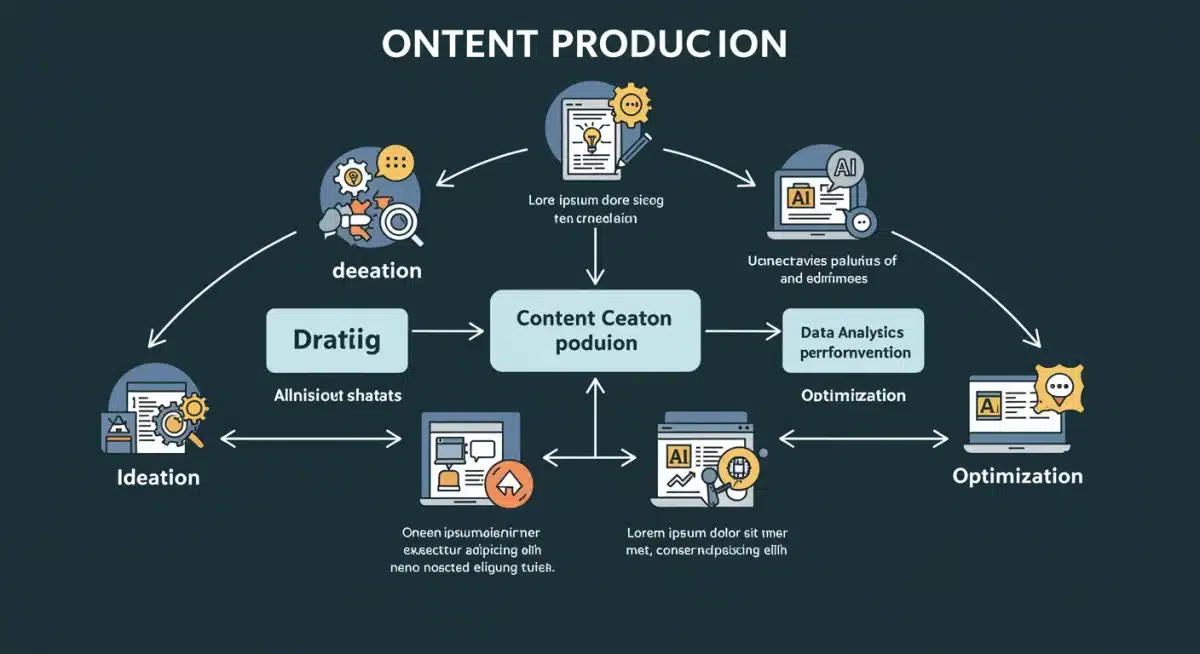
Artificial intelligence is no longer a futuristic concept; it’s a present-day reality rapidly integrating into the core operations of content agencies. From ideation to final publication, AI tools are streamlining processes, reducing manual labor, and enabling agencies to scale their output without proportionally increasing their workforce. This integration is fundamentally altering the traditional content pipeline, making it faster, more efficient, and often, more effective.
Agencies are leveraging AI for various stages of content creation, moving beyond simple grammar checks to sophisticated tasks like generating draft articles, optimizing for SEO, and even personalizing content at scale. The initial skepticism surrounding AI’s creative capabilities is quickly being replaced by an appreciation for its ability to augment human talent, allowing creative professionals to focus on strategic thinking and high-level conceptualization rather than repetitive tasks.
AI-Powered Ideation and Research
One of the most time-consuming phases in content creation is often ideation and research. AI tools are proving invaluable here, rapidly analyzing vast datasets to identify trends, popular topics, and audience interests. This capability significantly reduces the time spent on brainstorming and preliminary research.
Topic generation based on current market trends and competitor analysis.
Keyword research and semantic analysis for SEO optimization.
Audience insight extraction from social media and search data.
Content gap analysis to identify underserved areas in the market.
By automating these foundational steps, agencies can kickstart their content projects with a clearer direction and a data-backed strategy, ensuring that the content produced is relevant and likely to resonate with the target audience. This precision in targeting minimizes wasted effort and maximizes the potential return on investment for content campaigns.
Automated Content Drafting and Generation
Perhaps the most talked-about application of AI in content creation is its ability to generate text. While AI-generated content still requires human oversight and refinement, its capacity to produce initial drafts or even complete pieces of certain content types is a game-changer for efficiency. This doesn’t mean AI is replacing writers; instead, it’s empowering them to achieve more in less time.
The financial implications of this are substantial. Reducing the time spent on drafting translates directly into lower labor costs per piece of content and an increased capacity for agencies to take on more projects. This scalability is crucial for growth in a demanding market where content volume is often a key differentiator. The focus shifts from generating words to refining narratives and ensuring brand voice consistency.
In essence, AI acts as a powerful assistant, handling the heavy lifting of initial content generation, freeing up human writers to inject their unique creativity, critical thinking, and emotional intelligence into the final product. This hybrid approach yields superior results faster, positioning agencies that adopt it at a significant competitive advantage.
Quantifying the 50% Time Saving: A Financial Perspective
The projection of a 50% time saving in content production for US agencies by 2025 is not an arbitrary figure; it’s a realistic estimate based on the accelerating capabilities of AI and its current adoption trajectory. To understand the profound financial impact, one must look at both direct cost reductions and indirect benefits.
Direct cost reductions stem from decreased labor hours per content piece. If a task that previously took 8 hours now takes 4 hours with AI assistance, the labor cost for that task is effectively halved. This saving compounds across all content types and projects within an agency, leading to massive overall efficiency gains. Furthermore, the ability to produce more content with the same or even a smaller team mitigates the need for extensive hiring, especially in a tight labor market.
Operational Efficiency and Resource Allocation
Beyond direct labor cost savings, AI-driven content creation significantly enhances operational efficiency. Agencies can reallocate human resources from repetitive, time-consuming tasks to more strategic, high-value activities. This strategic reallocation is key to unlocking greater innovation and improving client satisfaction.
Reduced turnaround times for client projects, leading to higher client retention.
Increased capacity for handling a larger volume of content requests.
Opportunity for creative teams to focus on complex strategy and conceptual development.
Lower overhead costs associated with project management and revisions.
The ability to deliver results faster and more consistently strengthens an agency’s competitive position. Clients are increasingly seeking partners who can provide not just quality but also speed and efficiency, making AI adoption a critical differentiator. The financial impact extends to improved profitability margins as operational costs decrease while output quality and volume increase.
Case Studies and Early Adopter Successes
Early adopters of AI in content creation are already reporting significant gains. While the 50% mark might seem ambitious, some agencies are already approaching it in specific areas of their content workflows. These success stories provide valuable blueprints for broader industry adoption.
For instance, an agency specializing in e-commerce product descriptions might find that AI can generate thousands of unique, SEO-optimized descriptions in a fraction of the time it would take a human team. Similarly, agencies creating social media content can use AI to rapidly test different copy variations and identify the most engaging language, thereby optimizing campaign performance and reducing iterative design costs.
Challenges and Considerations for AI Adoption
While the benefits of AI in content creation are clear, its adoption is not without challenges. Agencies must navigate issues related to initial investment, integration with existing systems, and the crucial need for human oversight to maintain quality and brand voice.
The initial investment in AI tools and training can be substantial, requiring a clear ROI strategy. Furthermore, integrating new AI platforms with existing content management systems and workflows demands careful planning and execution to ensure seamless operation. These hurdles, while present, are often outweighed by the long-term gains in efficiency and financial savings.
Maintaining Quality and Brand Voice
One of the primary concerns with AI-generated content is maintaining quality, originality, and a consistent brand voice. AI models, while sophisticated, still require human guidance to produce content that truly resonates emotionally and strategically with an audience.
Human editors remain essential for fact-checking and refining AI output.
Training AI models on specific brand guidelines and tone of voice.
Ensuring originality and avoiding generic or repetitive content.
Injecting human creativity and emotional intelligence into AI-generated drafts.
The goal is not to replace human creativity but to augment it. Agencies must view AI as a powerful co-pilot, not an autonomous creator. This collaborative approach ensures that the content produced is not only efficient but also high-quality, authentic, and reflective of the brand’s unique identity.
Ethical Implications and Data Security
As AI becomes more ingrained in content creation, ethical considerations and data security become paramount. Agencies must be mindful of potential biases in AI algorithms, ensure proper attribution for source material, and protect client data. Transparency in AI usage is also becoming increasingly important for building trust with clients and audiences.
Developing robust internal policies for AI use, including guidelines for data privacy and ethical content generation, is crucial. Agencies need to educate their teams on these policies and ensure compliance to mitigate risks and uphold professional standards. The long-term success of AI integration hinges on responsible and ethical implementation.
The Future Landscape: AI as a Strategic Imperative
Looking towards 2025 and beyond, AI will transition from being a competitive advantage to a strategic imperative for US agencies. Those that fail to integrate AI into their content creation processes risk falling behind in terms of efficiency, scalability, and cost-effectiveness. The 50% time saving is not just a projection; it’s a benchmark for future operational excellence.
Agencies that proactively embrace AI will be better positioned to attract top talent, offer more competitive pricing to clients, and deliver innovative content solutions at an unprecedented pace. This forward-thinking approach will redefine industry standards and client expectations. The continuous evolution of AI capabilities means that these tools will only become more sophisticated and integrated into daily workflows.
Investing in AI Training and Development
To fully capitalize on the benefits of AI, agencies must invest in training their teams. This includes not only understanding how to operate AI tools but also developing the critical thinking skills necessary to effectively guide and refine AI outputs. Continuous learning will be key to staying ahead in this rapidly evolving field.
Developing in-house expertise in AI content strategy and prompt engineering will become a valuable asset. Agencies might also consider collaborating with AI developers to customize solutions that specifically address their unique operational needs and client demands. This investment in human capital will ensure that the technology serves the agency’s strategic goals.
Measuring ROI and Continuous Optimization
Effective AI adoption requires continuous measurement of its impact and ongoing optimization of processes. Agencies need to establish clear KPIs for tracking time savings, cost reductions, and improvements in content performance. This data-driven approach will inform further investments and adjustments to AI strategies.
Regularly reviewing the performance of AI tools and updating models based on feedback and new data will ensure that the technology remains aligned with agency objectives. The iterative process of implementation, measurement, and refinement is crucial for maximizing the long-term financial and operational benefits of AI-driven content creation.
The journey towards 50% time savings is an ongoing one, requiring adaptability and a commitment to innovation. Agencies that embrace this journey will not only survive but thrive in the dynamic digital landscape of 2025.
Strategic Implementation of AI for Maximum Impact
Achieving the projected 50% time savings requires more than just acquiring AI tools; it demands a strategic and phased implementation approach. Agencies should identify specific areas within their content production where AI can deliver the most immediate and significant impact, gradually expanding its role across the entire workflow.
Starting with tasks that are highly repetitive and data-intensive, such as initial draft generation for evergreen content or bulk meta-description creation, can provide quick wins and build internal confidence in AI’s capabilities. This incremental adoption allows teams to adapt without overwhelming disruption.
Phased Rollout and Pilot Programs
A phased rollout strategy, beginning with pilot programs, is often the most effective way to integrate AI. This allows agencies to test different tools, gather feedback from their teams, and refine their processes before widespread implementation.
Identify specific content types or client projects for initial AI pilots.
Train a core team of content creators and editors on new AI tools.
Establish clear metrics for measuring success and time savings during the pilot phase.
Gather qualitative feedback from creative teams on usability and effectiveness.
Pilot programs also help in identifying potential bottlenecks or unexpected challenges, allowing agencies to address them proactively. This iterative approach minimizes risks and ensures that the transition to AI-powered workflows is smooth and productive for all stakeholders.
Integration with Existing MarTech Stacks
For AI to deliver its full potential, it must seamlessly integrate with an agency’s existing marketing technology (MarTech) stack. Disjointed tools can create new inefficiencies, negating the benefits of automation. API-driven integrations and compatible platforms are crucial for a unified workflow.
The goal is to create an ecosystem where AI tools enhance rather than complicate existing processes. This might involve choosing AI platforms that are designed for easy integration or investing in custom solutions that bridge gaps between different systems. A well-integrated MarTech stack ensures data flows smoothly, and content creation remains a cohesive, streamlined process from start to finish.
By strategically implementing AI, agencies can not only achieve significant time savings but also enhance the overall quality and impact of their content output, securing a strong competitive edge in the evolving digital landscape.
Future-Proofing Agencies with AI Capabilities
The rapid advancements in AI mean that today’s cutting-edge solutions could be tomorrow’s industry standard. Agencies must adopt a mindset of continuous learning and adaptation to truly future-proof their operations against technological obsolescence. This involves not just using AI, but understanding its underlying principles and anticipating its next iterations.
Developing internal AI champions and fostering a culture of innovation can ensure that an agency remains at the forefront of technological adoption. This proactive stance will enable them to quickly integrate new AI functionalities as they emerge, maintaining their competitive edge and maximizing long-term financial benefits.
Staying Ahead of AI Trends and Developments
The AI landscape is dynamic, with new models, tools, and applications emerging constantly. Agencies need to dedicate resources to staying informed about these developments, assessing their potential impact, and identifying opportunities for further integration into their content workflows. This vigilance is crucial for sustained success.
Subscribing to industry reports and AI research publications.
Attending webinars and conferences focused on AI in marketing.
Experimenting with beta versions of new AI content tools.
Fostering partnerships with AI technology providers.
By actively monitoring the AI ecosystem, agencies can make informed decisions about technology investments and strategic shifts, ensuring that their content creation processes remain optimized and efficient. This continuous engagement with AI innovation is fundamental to achieving and sustaining the 50% time-saving goal.
Building a Hybrid Human-AI Workforce
The ultimate vision for agencies leveraging AI is not a fully automated content factory, but a highly effective hybrid workforce where humans and AI collaborate seamlessly. This synergy combines the efficiency and analytical power of AI with the creativity, empathy, and strategic insight of human professionals.
Training employees to work effectively alongside AI tools, viewing them as collaborators rather than competitors, is key to building this hybrid workforce. This approach emphasizes upskilling human talent in areas where AI excels, such as complex problem-solving, emotional storytelling, and strategic client management. The result is a more productive, innovative, and resilient agency capable of delivering exceptional results in the AI era.
Key Aspect
Brief Description
Time Savings Goal
US agencies target 50% reduction in content production time by 2025 through AI integration.
Financial Impact
Significant cost reductions, increased profitability, and enhanced competitive advantage.
Key AI Applications
Ideation, research, automated drafting, SEO optimization, and content personalization.
Frequently Asked Questions About AI in Content Creation
What specific tasks can AI automate in content creation?▼
AI can automate various tasks including keyword research, topic ideation, generating initial drafts for articles or social media posts, summarizing long texts, optimizing content for SEO, and even personalizing content for different audience segments. This frees up human creatives for more strategic work.
How does AI ensure content quality and originality?▼
While AI can generate content, human oversight remains crucial for quality. Agencies apply strict editorial guidelines, fact-checking processes, and human editors to refine AI-generated drafts. Advanced AI models are also being trained to minimize plagiarism and produce unique, brand-aligned content.
What is the financial impact of 50% time savings for agencies?▼
A 50% time saving translates to significant financial benefits, including reduced labor costs per project, increased capacity to handle more clients or projects without proportional staff increases, improved profit margins, and the ability to offer more competitive pricing, strengthening market position.
Will AI replace human content creators in agencies?▼
No, AI is not expected to replace human content creators entirely. Instead, it serves as a powerful assistant, automating mundane tasks and augmenting human capabilities. This allows human creatives to focus on high-level strategy, creative storytelling, emotional connection, and maintaining unique brand voices, fostering a hybrid workforce.
What are the key challenges in adopting AI for content creation?▼
Key challenges include the initial investment in AI tools and training, seamless integration with existing MarTech stacks, maintaining a consistent brand voice and quality, and addressing ethical concerns like data privacy and algorithmic bias. Strategic planning and continuous adaptation are essential for successful adoption.
Conclusion
The advent of AI in content creation represents a paradigm shift for US agencies, promising not just incremental improvements but transformative efficiencies. The projected 50% reduction in production time by 2025 is a testament to AI’s burgeoning capabilities and its potential to reshape the financial landscape of the industry. Agencies that strategically embrace AI, investing in both technology and talent, are poised to unlock unprecedented levels of productivity, profitability, and innovation. This isn’t merely about adapting to a new tool; it’s about redefining the future of content, where human creativity and artificial intelligence converge to deliver unparalleled results in a dynamic digital world.
Eduarda Moura has a degree in Journalism and a postgraduate degree in Digital Media. With experience as a copywriter, Eduarda strives to research and produce informative content, bringing clear and precise information to the reader.