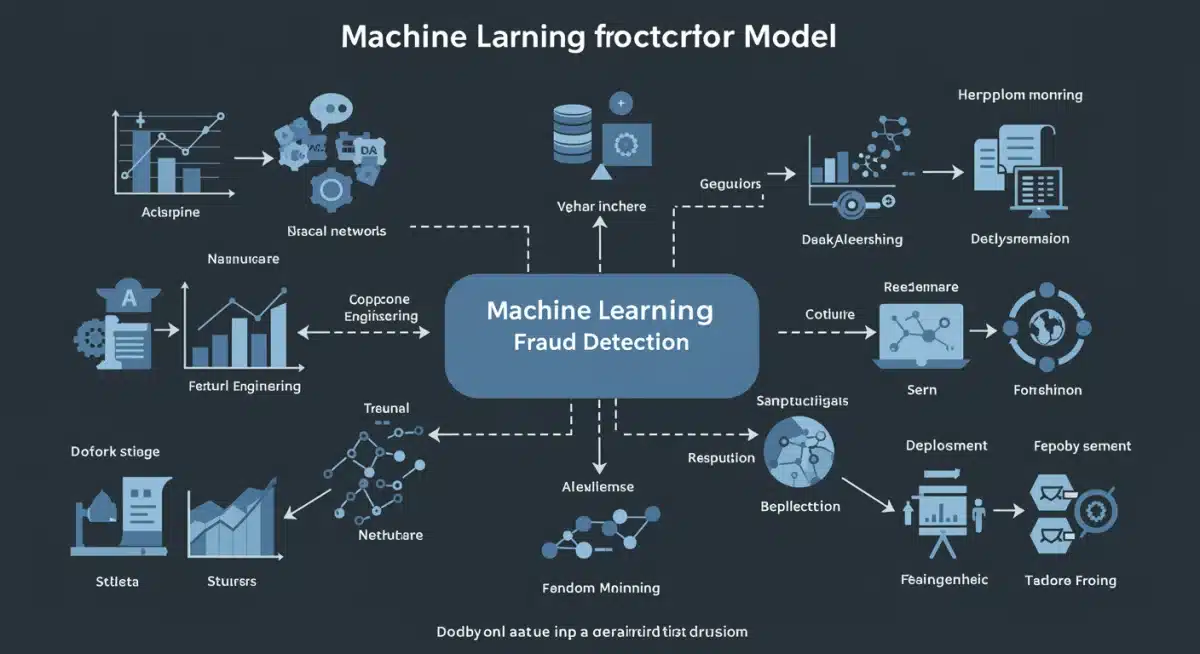
Advanced machine learning techniques are fundamentally transforming fraud detection within US financial services, enabling institutions to unlock hidden patterns, reduce annual losses by 12%, and bolster their security infrastructure against evolving threats.
By: Eduarda Moura on October 7, 2025
Last updated on: November 28, 2025
Advanced machine learning techniques are fundamentally transforming fraud detection within US financial services, enabling institutions to unlock hidden patterns, reduce annual losses by 12%, and bolster their security infrastructure against evolving threats.
In the dynamic landscape of US financial services, the battle against fraud is a continuous, escalating challenge. Traditional rule-based systems often fall short against increasingly sophisticated schemes, leaving institutions vulnerable. This article delves into how ML fraud detection finance is revolutionizing the industry by identifying hidden patterns and significantly reducing annual losses, often by as much as 12%.
The evolving threat landscape in financial services
The financial sector in the United States faces a relentless barrage of fraudulent activities, ranging from credit card fraud and identity theft to complex money laundering schemes. These threats are not static; they evolve rapidly, often exploiting new technologies and human vulnerabilities. The sheer volume and velocity of transactions make manual oversight impossible, necessitating a more advanced approach.
Cybercriminals are constantly refining their methods, making it harder for conventional security measures to keep pace. The digital transformation of banking, while offering unprecedented convenience, also expands the attack surface for fraudsters. This continuous arms race demands innovative solutions that can adapt and learn from new patterns of illicit behavior, a domain where machine learning truly shines.
The limitations of traditional fraud detection methods
Historically, fraud detection relied heavily on predefined rules and thresholds. While effective against known fraud types, these systems often generate high false positive rates, inconveniencing legitimate customers and diverting valuable resources. Moreover, they are inherently reactive, struggling to detect novel fraud patterns until after significant losses have occurred.
High false positives: Legitimate transactions are often flagged, leading to customer frustration and operational inefficiencies.
Rule-based rigidity: Inability to adapt to new fraud schemes without manual rule updates.
Lagging detection: Fraud is often identified after it has already caused financial damage.
Data overload: Difficulty in analyzing vast datasets for subtle anomalies.
The static nature of these systems means they are easily bypassed by cunning fraudsters who quickly learn the rules. This necessitates a paradigm shift towards predictive and adaptive technologies that can anticipate and neutralize threats before they materialize into significant losses for financial institutions.
Introduction to advanced machine learning techniques
Machine learning offers a powerful antidote to the limitations of traditional fraud detection. By leveraging algorithms that can learn from data, ML models can identify complex, non-obvious patterns indicative of fraudulent activity. These techniques move beyond simple rules, enabling a more nuanced and proactive approach to security.
The core principle involves training algorithms on historical transaction data, including both legitimate and fraudulent instances. The model then learns to distinguish between these categories, developing a sophisticated understanding of what constitutes normal versus anomalous behavior. This iterative learning process allows the system to continuously improve its accuracy and adaptability.
Supervised learning for known fraud patterns
Supervised learning models are trained on datasets where the outcome (fraudulent or legitimate) is already known. This allows the model to learn the specific characteristics associated with different types of fraud. Common algorithms include decision trees, random forests, and support vector machines.
Decision trees: Create a flowchart-like structure where each internal node represents a test on an attribute, each branch represents an outcome, and each leaf node represents a class label (fraud or legitimate).
Random forests: An ensemble method that operates by constructing multiple decision trees during training and outputting the class that is the mode of the classes (classification) or mean prediction (regression) of the individual trees.
Support vector machines (SVMs): Powerful for classification by finding the optimal hyperplane that separates data points into different classes with the largest margin.
These methods are highly effective for detecting established fraud types, where a clear historical record exists. They provide a strong baseline for fraud detection, capable of processing large volumes of data with high efficiency and accuracy, forming the backbone of many advanced systems.
Unsupervised learning for novel fraud detection
While supervised learning excels at identifying known fraud, unsupervised learning is crucial for detecting novel, previously unseen fraud patterns. These algorithms work by identifying anomalies or outliers in data without prior labeling. This capability is vital in an environment where fraudsters constantly devise new schemes.
Unsupervised methods are particularly valuable when historical fraud data is scarce or incomplete. They operate by clustering similar data points together and flagging those that deviate significantly from these clusters. This allows financial institutions to catch emerging threats that might otherwise slip through rule-based or supervised systems.
Clustering and anomaly detection algorithms
Clustering algorithms group similar data points together, while anomaly detection focuses on identifying data points that do not conform to expected behavior. Techniques like K-means clustering, isolation forests, and autoencoders are frequently employed.
K-means clustering: Partitions data into K distinct clusters, where each data point belongs to the cluster with the nearest mean. Anomalies are data points far from any cluster centroid.
Isolation forests: An ensemble-based anomaly detection algorithm that works by isolating anomalies in a tree structure. Anomalies are easier to isolate than normal points.
Autoencoders: Neural networks trained to reconstruct their input. Anomalies result in high reconstruction errors, as the network struggles to accurately rebuild data it hasn’t seen before.
The strength of unsupervised learning lies in its ability to discover patterns without explicit instruction, making it an indispensable tool for identifying zero-day fraud attacks and adapting to the ever-changing tactics of cybercriminals. This proactive approach significantly enhances the resilience of financial systems.
Deep learning and neural networks in financial fraud
Deep learning, a subset of machine learning, utilizes neural networks with multiple layers to learn complex representations of data. These models are particularly adept at handling vast, unstructured datasets and uncovering highly intricate fraud patterns that simpler algorithms might miss. Their ability to learn hierarchical features makes them incredibly powerful.
In financial fraud detection, deep learning models can analyze not just numerical transaction data but also textual information from customer interactions, voice patterns, and even image data from document verification. This multi-modal analysis provides a richer context for fraud detection, leading to more accurate and robust systems.
Recurrent neural networks (RNNs) for sequential data
Financial transactions often occur in sequences, where the order of events can be crucial for identifying fraud. Recurrent Neural Networks (RNNs), especially Long Short-Term Memory (LSTM) networks, are designed to process sequential data, making them ideal for analyzing transaction histories.
RNNs can remember past information and use it to inform decisions about current events, allowing them to detect deviations from typical spending habits or transaction sequences. For instance, an unusual sequence of high-value international transactions following a period of low domestic activity could be flagged as suspicious.
Sequence analysis: Identify anomalies in the order and timing of financial transactions.
Temporal patterns: Detect unusual shifts in spending behavior over time.
Improved context: Leverage historical context to assess the risk of current transactions.
The power of deep learning lies in its capacity to build highly sophisticated models that can discern subtle, temporal dependencies in data, which are often key indicators of advanced fraudulent activities. This contributes significantly to reducing false positives while increasing detection rates.
Real-world impact: reducing losses by 12% annually
The adoption of advanced machine learning techniques in US financial services is not merely theoretical; it is yielding tangible results. Institutions implementing these solutions are reporting significant reductions in fraud-related losses, with many experiencing a decrease of 12% or more annually. This translates into billions of dollars saved across the industry.
Beyond direct financial savings, the enhanced fraud detection capabilities also lead to improved customer trust and satisfaction. By preventing fraud before it impacts customers, financial institutions can protect their reputation and foster stronger relationships. The efficiency gains from reduced false positives also free up human analysts to focus on more complex cases.
Case studies and success stories
Several leading US financial institutions have publicly shared their successes with ML-driven fraud detection. One major bank reported a 15% reduction in credit card fraud losses within the first year of implementing an AI-powered system, along with a 20% decrease in false positives. Another institution saw a 10% improvement in detecting identity theft attempts.
These successes are often attributed to the ML systems’ ability to process vast amounts of data in real-time, identify emerging fraud trends, and continuously learn from new data. The ability to adapt quickly to new threats provides a critical competitive advantage in the fight against financial crime. The continuous refinement of these models ensures long-term effectiveness.
Challenges and future directions in ML fraud detection
Despite the immense promise and proven benefits, implementing and maintaining advanced ML fraud detection systems comes with its own set of challenges. These include data quality issues, the need for specialized talent, regulatory compliance, and the constant arms race with fraudsters who also leverage advanced technologies.
Ensuring data privacy and security while leveraging vast datasets for training is paramount. Ethical considerations surrounding algorithmic bias and fairness also need to be carefully addressed. As ML models become more complex, their interpretability can decrease, posing challenges for explaining decisions to regulators and customers.
Interpretability and explainable AI (XAI)
One of the significant challenges is the ‘black box’ nature of some complex ML models, particularly deep learning networks. Understanding why a model flags a transaction as fraudulent is crucial for regulatory compliance, appealing false positives, and continuously improving the model. Explainable AI (XAI) is an emerging field dedicated to making AI decisions more transparent.
Regulatory compliance: Providing clear explanations for fraud classifications to satisfy audit requirements.
Model debugging: Understanding model failures to identify and correct biases or errors.
Customer trust: Explaining to customers why their transactions were flagged helps build confidence.
The future of ML fraud detection finance will likely involve a greater emphasis on hybrid models that combine the predictive power of deep learning with the transparency of simpler models, alongside advancements in XAI techniques. This will ensure that while fraud detection remains highly effective, it also becomes more understandable and accountable.
Ethical considerations and regulatory compliance
The deployment of machine learning in sensitive areas like financial fraud detection necessitates careful consideration of ethical implications and strict adherence to regulatory frameworks. Algorithms must be designed to be fair, unbiased, and transparent, avoiding discrimination while effectively combating illicit activities.
Regulators in the US, such as the Federal Reserve and the CFPB, are increasingly scrutinizing AI applications in finance. Institutions must demonstrate that their ML models are robust, validated, and do not inadvertently disadvantage certain demographic groups. Data governance and privacy standards, like those under GDPR (even for US entities handling global data) and state-specific privacy laws, also play a critical role.
Ensuring fairness and preventing bias
Algorithmic bias can arise if training data reflects historical biases or if the model inadvertently learns to discriminate. This could lead to legitimate transactions from certain demographics being disproportionately flagged as fraudulent. Mitigating bias requires careful data curation, model auditing, and the use of fairness-aware machine learning techniques.
Continuous monitoring and regular audits are essential to detect and correct any emergent biases in live systems. Financial institutions must commit to developing and deploying AI responsibly, ensuring that their fraud detection systems uphold principles of equity and non-discrimination, thereby maintaining public trust and regulatory compliance.
Addressing these ethical and regulatory challenges is not just about compliance; it’s about building sustainable, trustworthy AI systems that serve all customers fairly. The responsible integration of ML will define the next generation of financial security.
Key Aspect
Description
Traditional Limitations
Rule-based systems suffer from high false positives and inability to detect novel fraud patterns.
ML Impact
Advanced ML techniques reduce annual fraud losses by 12% by identifying complex, hidden patterns.
Key ML Techniques
Supervised, unsupervised, and deep learning methods are employed for diverse fraud detection.
Future Challenges
Interpretability, bias prevention, and regulatory compliance are critical for future ML adoption.
Frequently asked questions about ML fraud detection
What is the primary benefit of using ML for fraud detection in US financial services?▼
The primary benefit is the ability to detect complex, hidden fraud patterns that traditional rule-based systems miss. This significantly reduces annual losses, often by 12% or more, and enhances overall security infrastructure against evolving threats.
How do supervised and unsupervised learning differ in fraud detection?▼
Supervised learning uses labeled historical data to identify known fraud types, while unsupervised learning uncovers novel fraud patterns by detecting anomalies without prior labeling, crucial for emerging threats.
What role do deep learning and neural networks play?▼
Deep learning models, especially RNNs, analyze vast, complex, and sequential data like transaction histories to uncover intricate fraud patterns, improving detection accuracy and adapting to sophisticated schemes.
Are there ethical concerns with using ML in financial fraud detection?▼
Yes, ethical concerns include algorithmic bias, ensuring fairness, and the need for explainable AI (XAI) to understand model decisions. Compliance with data privacy and anti-discrimination regulations is also critical.
How can financial institutions ensure regulatory compliance with ML systems?▼
Institutions must implement robust data governance, conduct regular model audits for bias, ensure transparency through XAI, and adhere to privacy laws. Demonstrating model robustness and fairness to regulators is key.
Conclusion
The integration of advanced machine learning techniques marks a transformative era for fraud detection in US financial services. By enabling institutions to move beyond reactive, rule-based systems to proactive, adaptive solutions, ML is not only significantly reducing annual losses but also bolstering customer trust and operational efficiency. While challenges related to interpretability, bias, and regulatory compliance persist, ongoing advancements in explainable AI and responsible development practices are paving the way for even more sophisticated and trustworthy systems. The future of financial security undoubtedly lies in the continued evolution and strategic deployment of these powerful analytical tools.
Eduarda Moura has a degree in Journalism and a postgraduate degree in Digital Media. With experience as a copywriter, Eduarda strives to research and produce informative content, bringing clear and precise information to the reader.