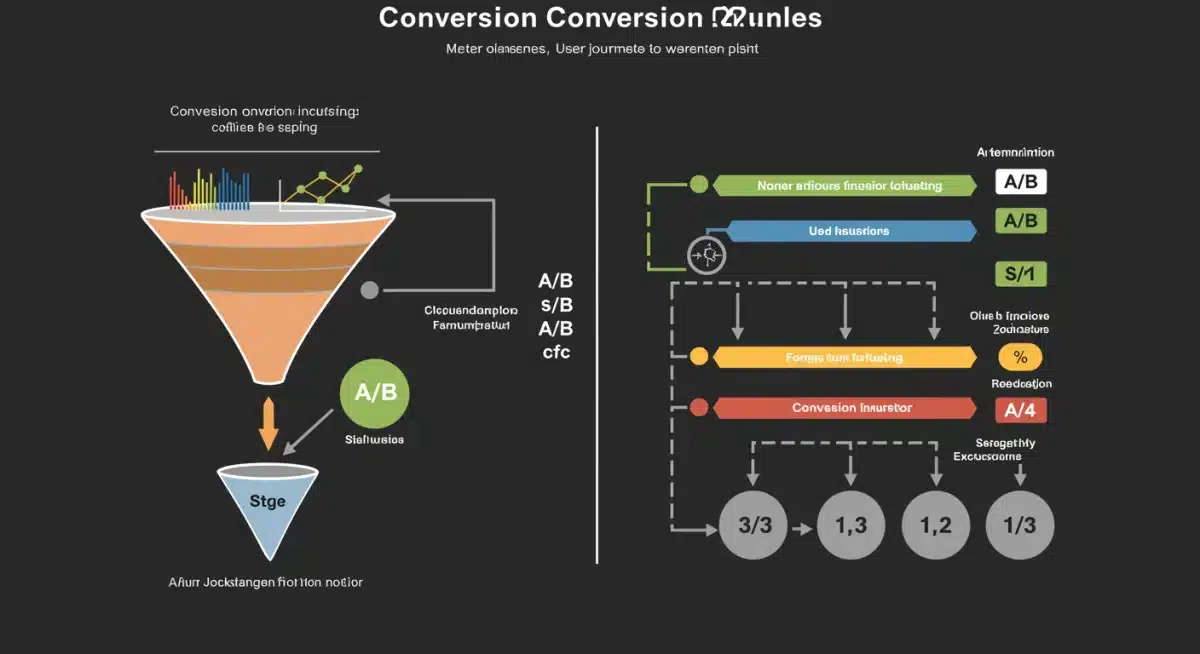
A/B Testing with Advanced Analytics: Boost US Conversions 10% by 2025
Integrating A/B Testing Analytics provides US websites with a powerful framework to optimize user experience and significantly increase conversion rates, aiming for a 10% boost by 2025 through data-driven decisions.
By: Eduarda Moura on August 13, 2025
Last updated on: November 28, 2025
Implementing A/B Testing Analytics offers US websites a robust strategy to refine user experience and achieve a projected 10% increase in conversion rates by 2025, leveraging sophisticated data insights.
In today’s hyper-competitive digital landscape, US websites are constantly seeking innovative ways to stand out and convert visitors into loyal customers. The ability to precisely understand user behavior and adapt accordingly is no longer a luxury but a necessity. This is where the power of A/B testing with advanced analytics: optimizing user experience and increasing conversion rates by 10% for US websites in 2025 emerges as a game-changer, offering a scientific approach to digital growth.
Understanding the Core of A/B Testing
A/B testing, often referred to as split testing, is a fundamental methodology in digital optimization. It involves comparing two versions of a webpage or app element to determine which one performs better. This simple yet powerful technique allows businesses to make data-driven decisions rather than relying on assumptions or intuition, directly impacting their bottom line.
The essence of A/B testing lies in its ability to isolate variables. By changing only one element at a time, such as a headline, call-to-action button, or image, marketers can accurately measure the impact of that specific change on user behavior. This precision is crucial for understanding what resonates with an audience and what falls flat, providing actionable insights for continuous improvement.
The Mechanics of a Successful A/B Test
Hypothesis Formulation: Begin with a clear, testable hypothesis about how a change will improve a specific metric.
Variant Creation: Develop two versions (A and B) of the element being tested.
Traffic Splitting: Divide website traffic evenly between the two versions to ensure fair comparison.
Data Collection: Monitor key metrics, such as conversion rates, bounce rates, or time on page, over a statistically significant period.
Analysis and Implementation: Evaluate results to determine the winning variant and implement it permanently.
Ultimately, A/B testing provides a structured framework for experimentation, enabling US businesses to iterate and optimize their digital assets systematically. This iterative process is key to unlocking sustained growth and maintaining a competitive edge in a fast-evolving market.
Integrating Advanced Analytics for Deeper Insights
While A/B testing provides the ‘what’ – what changes led to better performance – advanced analytics offers the ‘why’ and ‘how.’ Integrating sophisticated analytical tools with A/B testing platforms transforms raw data into profound insights about user motivation and interaction patterns. This synergy is critical for achieving significant uplifts in conversion rates.
Advanced analytics goes beyond surface-level metrics to uncover complex user behaviors. It involves techniques such as segmentation, behavioral analysis, and predictive modeling, which can reveal nuanced differences in how various user groups respond to different website elements. This deeper understanding allows for more targeted and effective optimization strategies.
Leveraging Advanced Analytics Tools
Heatmaps and Session Recordings: Visualize where users click, scroll, and spend their time, identifying areas of interest or friction.
Funnel Analysis: Track user progression through conversion paths, pinpointing drop-off points and opportunities for optimization.
Cohorts and Segmentation: Group users based on shared characteristics or behaviors to understand how different segments react to variations.
Predictive Analytics: Forecast future user behavior and identify potential issues or opportunities before they fully materialize.
By combining the experimental rigor of A/B testing with the diagnostic power of advanced analytics, US websites can move beyond simple A/B comparisons to develop a holistic understanding of their audience. This integrated approach ensures that every optimization effort is grounded in comprehensive data, leading to more impactful results.
Optimizing User Experience (UX) Through Data
User experience is paramount. A seamless, intuitive, and engaging UX is directly correlated with higher conversion rates. A/B testing, when informed by advanced analytics, becomes an invaluable tool for systematically improving every facet of the user journey, ensuring that each interaction is optimized for maximum impact.
Data-driven UX optimization is about understanding user pain points and preferences through empirical evidence. Instead of guessing what users want, businesses can test hypotheses about design, content, and functionality, and then measure the direct impact on user engagement and conversion metrics. This scientific approach minimizes risk and maximizes the return on UX investments.
Key UX Elements to Optimize
Navigation and Information Architecture: Test different menu structures, labeling conventions, and content organization to improve discoverability.
Page Layout and Visual Hierarchy: Experiment with element placement, whitespace, and visual cues to guide user attention effectively.
Content Clarity and Persuasion: Test headlines, body copy, calls-to-action, and value propositions to ensure clear communication and compelling messaging.
Form Design and Flow: Optimize form fields, error messages, and multi-step processes to reduce friction and improve completion rates.
The continuous cycle of testing, analyzing, and refining UX elements ensures that US websites remain agile and responsive to evolving user expectations. This commitment to data-backed UX improvements is a cornerstone of achieving and sustaining high conversion rates.
Boosting Conversion Rates: The 10% Target for US Websites
The ambitious goal of increasing conversion rates by 10% for US websites by 2025 is not merely aspirational; it is achievable through a strategic blend of A/B testing and advanced analytics. This target reflects the potential for significant growth when businesses commit to a rigorous, data-centric optimization strategy.
Achieving a 10% uplift requires more than isolated tests. It demands a culture of continuous experimentation, where every element of the website is viewed as an opportunity for improvement. This means not only identifying obvious friction points but also uncovering subtle psychological triggers and behavioral patterns that influence conversion decisions.
Consider the cumulative effect of multiple small improvements. A 1% increase here, a 2% increase there, all add up. Advanced analytics helps in prioritizing these tests by identifying areas with the highest potential impact, ensuring that resources are allocated efficiently for maximum conversion gains.
To hit the 10% target, US businesses need to focus on:
Strategic Test Prioritization: Use data to identify high-impact areas for A/B testing.
Multivariate Testing: Simultaneously test multiple variables to understand complex interactions.
Personalization: Leverage insights from analytics to deliver tailored experiences that resonate with individual user segments.
Post-Conversion Analysis: Understand what happens after a conversion to optimize customer lifetime value and retention.
By systematically applying these principles, US websites can build a robust optimization engine that consistently drives higher conversion rates, making the 10% goal a realistic and attainable milestone.
Real-World Impact and Case Studies
The theoretical benefits of A/B testing and advanced analytics are powerfully demonstrated through numerous real-world success stories. US companies across various industries have leveraged these tools to achieve remarkable improvements in their digital performance, validating the efficacy of data-driven optimization.
Consider an e-commerce giant that used A/B testing to optimize its checkout process. By simplifying form fields and clarifying progress indicators, they reduced cart abandonment by 7%, directly translating to millions in additional revenue. This was not a single test but a series of iterative improvements guided by analytics, revealing where users were encountering friction.
Another example involves a SaaS company that used advanced analytics to segment its user base. They discovered that new users responded differently to onboarding flows than returning users. By A/B testing personalized onboarding experiences for each segment, they increased product adoption rates by 12% among new sign-ups, significantly improving their customer acquisition efficiency.
These case studies underscore a crucial point: success doesn’t come from a single ‘magic bullet’ test. It’s the result of a continuous, systematic approach to experimentation and analysis. Companies that embed A/B testing and advanced analytics into their operational DNA are those that consistently outperform their competitors.
Best Practices for Implementation and Continuous Optimization
Implementing a successful A/B testing program with advanced analytics requires more than just tools; it demands a strategic approach and a commitment to best practices. For US websites aiming for consistent growth, establishing a robust optimization framework is essential.
Firstly, fostering a culture of experimentation within the organization is paramount. This means encouraging teams to formulate hypotheses, run tests, and learn from both successes and failures. It’s about empowering employees with data and the tools to act on it, moving away from subjective decision-making.
Key Best Practices:
Clear Goals and KPIs: Define specific, measurable goals for each test and align them with broader business objectives.
Statistical Significance: Ensure tests run long enough to achieve statistical significance, avoiding premature conclusions.
Avoid Simultaneous Tests: Isolate variables by running one primary A/B test per element at a time to accurately attribute results.
Documentation and Learning: Maintain a detailed record of all tests, hypotheses, results, and learnings to build an institutional knowledge base.
Iterative Process: View optimization as an ongoing cycle of testing, learning, and refining, rather than a one-time project.
By adhering to these best practices, US websites can maximize the effectiveness of their A/B testing efforts and ensure that advanced analytics consistently drives meaningful improvements. This continuous optimization loop is the engine for achieving and surpassing conversion rate targets in the dynamic digital landscape.
Key Point
Brief Description
A/B Testing Foundation
Compares two versions of an element to identify the best performer, driving data-backed decisions.
Advanced Analytics Integration
Provides deeper insights into user behavior, explaining ‘why’ tests succeed or fail.
UX Optimization
Systematically improves user experience elements based on testing outcomes and analytical insights.
10% Conversion Target
Achievable goal for US websites by 2025 through continuous, data-driven optimization efforts.
Frequently Asked Questions About A/B Testing and Analytics
What is the primary benefit of combining A/B testing with advanced analytics?▼
The primary benefit is gaining a comprehensive understanding of user behavior. A/B testing shows ‘what’ works, while advanced analytics explains ‘why,’ enabling more informed and impactful optimization strategies for US websites.
How can A/B testing increase conversion rates by 10% for US websites?▼
By systematically testing and optimizing elements like headlines, calls-to-action, and user flows, A/B testing allows for continuous improvement. The cumulative effect of these data-driven enhancements can lead to significant conversion rate increases, reaching or exceeding 10%.
What types of advanced analytics are most useful for UX optimization?▼
Heatmaps, session recordings, funnel analysis, and user segmentation are particularly useful. These tools provide visual and behavioral insights into how users interact with a website, pinpointing areas for UX improvement.
Is A/B testing only for large businesses?▼
No, A/B testing is beneficial for businesses of all sizes. While larger companies might have more resources, accessible tools and platforms make it feasible for small and medium-sized businesses in the US to implement effective testing strategies and gain competitive advantages.
How often should US websites conduct A/B tests?▼
A/B testing should be an ongoing, continuous process. The frequency depends on traffic volume and the number of elements needing optimization. The goal is to always be learning and refining the user experience based on fresh data and evolving user behaviors.
Conclusion
The convergence of A/B testing and advanced analytics represents a pivotal shift in how US websites approach digital growth and optimization. Moving beyond guesswork, this powerful combination provides a scientific, data-driven pathway to truly understand and cater to user needs. By systematically optimizing every touchpoint of the user journey, businesses can not only enhance user experience but also achieve significant, measurable increases in conversion rates. The target of a 10% uplift in conversions by 2025 is not just an ambitious goal but a tangible outcome for those committed to embracing this strategic approach. As the digital landscape continues to evolve, the ability to rapidly test, learn, and adapt will be the ultimate differentiator for success.
Eduarda Moura has a degree in Journalism and a postgraduate degree in Digital Media. With experience as a copywriter, Eduarda strives to research and produce informative content, bringing clear and precise information to the reader.