Optimizing AI Model Performance: 7 Expert Tips for US Data Scientists
This article offers 7 expert tips for US data scientists to enhance AI model performance, covering critical areas from data strategy to deployment, ensuring robust and efficient AI systems.
By: Eduarda Moura on November 21, 2025
Last updated on: November 28, 2025
Optimizing AI model performance is paramount for US data scientists seeking to develop robust and efficient AI systems that deliver tangible business value in today’s competitive landscape.
For US data scientists navigating the complex landscape of artificial intelligence, mastering the art of optimizing AI model performance is not just an advantage; it’s a necessity. In a world where data-driven decisions dictate success, ensuring your AI models operate at peak efficiency can significantly impact outcomes, from predictive accuracy to operational costs. This guide delves into seven expert tips, offering insider knowledge to elevate your AI projects this year.
Understanding the Foundations of AI Performance
Before diving into specific optimization techniques, it’s crucial to grasp the fundamental elements that dictate an AI model’s performance. It’s not solely about the algorithm chosen, but a holistic interplay of data quality, computational resources, and strategic development practices. A strong foundation ensures that subsequent optimization efforts yield maximum impact and sustainable results.
The journey to high-performing AI begins long before model training. It starts with a clear understanding of the problem statement, the data available, and the metrics that truly define success for your specific application. Without this clarity, even the most advanced optimization techniques can fall short.
The Role of Data Quality and Quantity
Data is the lifeblood of any AI model. Its quality and quantity directly influence performance. Poor data can lead to biased models, reduced accuracy, and unreliable predictions, regardless of how sophisticated the model architecture might be. Therefore, investing in meticulous data collection, cleaning, and preprocessing is non-negotiable.
Data cleaning: Remove inconsistencies, missing values, and outliers. This step is often time-consuming but critical for model integrity.
Feature engineering: Create new features from existing data to improve model understanding and predictive power. This requires domain expertise and creativity.
Data augmentation: Increase the size and diversity of training datasets, especially for computer vision and natural language processing tasks, to enhance generalization.
Computational Resources and Infrastructure
The hardware and software infrastructure supporting AI development and deployment play a significant role. Access to powerful GPUs, TPUs, and scalable cloud computing platforms can dramatically accelerate training times and enable the use of larger, more complex models. Efficient resource management is key to cost-effectiveness and rapid iteration.
In conclusion, a deep understanding of these foundational aspects—data quality and quantity, alongside robust computational resources—is the bedrock upon which all subsequent AI performance optimization strategies are built. Neglecting these areas can undermine even the most sophisticated efforts.
Tip 1: Meticulous Data Preprocessing and Feature Engineering
The quality of your data directly correlates with the performance of your AI model. This first tip emphasizes the paramount importance of meticulous data preprocessing and intelligent feature engineering. These steps transform raw data into a format that models can effectively learn from, significantly reducing noise and highlighting relevant patterns.
Data scientists often spend a substantial portion of their project time on these initial stages, and for good reason. A well-preprocessed dataset with thoughtfully engineered features can often outperform a more complex model trained on raw or poorly prepared data.
Cleaning and Normalizing Your Data
Cleaning involves identifying and handling missing values, outliers, and inconsistencies. Normalization or standardization scales features to a comparable range, preventing features with larger values from dominating the learning process. This is particularly vital for algorithms sensitive to feature scales, such as support vector machines and neural networks.
Handling missing values: Employ imputation techniques like mean, median, mode, or more advanced methods like regression imputation.
Outlier detection: Use statistical methods (e.g., Z-score, IQR) or visualization tools to identify and address outliers, either by removal or transformation.
Data normalization: Apply techniques like Min-Max scaling or Z-score standardization to bring features into a consistent range.
Strategic Feature Engineering
Feature engineering is the process of using domain knowledge to create new input features from existing ones that help a machine learning model learn better. This creative process can unlock hidden patterns and improve model interpretability. It requires a deep understanding of the problem domain and the data itself.
For instance, in time-series data, extracting features like ‘day of the week,’ ‘month,’ or ‘lagged values’ can provide crucial temporal context to the model. In natural language processing, creating n-grams or TF-IDF scores from text can be more informative than raw word counts.
In essence, meticulous data preprocessing and strategic feature engineering lay the groundwork for superior AI model performance. By investing sufficient time and expertise in these stages, data scientists can significantly enhance the learning capabilities and predictive accuracy of their models.
Tip 2: Advanced Hyperparameter Tuning Strategies
Hyperparameters are configuration variables external to the model that are set before the training process begins. Their values significantly influence model performance, affecting everything from learning speed to generalization ability. Advanced hyperparameter tuning strategies move beyond simple grid search to more efficient and effective methods.
The goal is to find the optimal combination of hyperparameters that minimizes the model’s error on unseen data, ensuring it performs well in real-world scenarios. This often involves a delicate balance between exploration and exploitation of the hyperparameter space.
Beyond Grid and Random Search
While grid search systematically explores a predefined set of hyperparameter combinations and random search samples randomly from a distribution, more advanced methods offer greater efficiency, especially for models with many hyperparameters or computationally expensive training processes.
Bayesian optimization: Builds a probabilistic model of the objective function (e.g., validation accuracy) and uses it to select the most promising hyperparameters to evaluate next, balancing exploration and exploitation.
Gradient-based optimization: Suitable for models where hyperparameters are differentiable, allowing for direct optimization using gradient descent.
Evolutionary algorithms: Inspired by natural selection, these algorithms evolve a population of hyperparameter sets over generations, selecting the fittest based on performance.
Automated Machine Learning (AutoML) Tools
AutoML platforms are increasingly sophisticated, automating not only hyperparameter tuning but also other aspects of the machine learning pipeline, such as feature engineering and model selection. These tools can significantly reduce the manual effort and expertise required for optimization.
While AutoML can be a powerful accelerator, understanding the underlying principles of hyperparameter tuning remains crucial for data scientists. This knowledge allows for intelligent configuration of AutoML tools and informed decision-making when results are analyzed.
Implementing advanced hyperparameter tuning strategies is a critical step towards unlocking the full potential of your AI models. By leveraging more intelligent search methods and, where appropriate, AutoML tools, data scientists can achieve superior performance with greater efficiency.
Tip 3: Ensemble Methods for Robustness and Accuracy
Ensemble methods combine the predictions of multiple individual models to achieve better predictive performance than any single model could on its own. This approach leverages the wisdom of crowds, reducing variance, bias, or improving predictions, leading to more robust and accurate AI systems.
The core idea is that diverse models, each with their strengths and weaknesses, can collectively overcome individual limitations when their predictions are appropriately aggregated. This strategy is widely used in competitive machine learning and real-world applications.
Bagging and Boosting Techniques
Two of the most popular categories of ensemble methods are bagging and boosting. They differ in how they build and combine the individual models, but both aim to improve overall performance.
Bagging (Bootstrap Aggregating): Trains multiple models independently on different subsets of the training data (sampled with replacement). Predictions are then averaged (for regression) or voted (for classification). Random Forest is a prime example.
Boosting: Builds models sequentially, where each new model attempts to correct the errors of the previous ones. This focuses on misclassified instances. Gradient Boosting Machines (GBM) and XGBoost are powerful boosting algorithms.
Stacking and Blending
Beyond bagging and boosting, stacking and blending offer even more sophisticated ways to combine models. These techniques involve training a meta-model to learn how to best combine the predictions of base models.
Stacking involves training a meta-learner on the predictions of several base models, using a separate hold-out set to avoid overfitting. Blending is a simpler form of stacking where the meta-learner is trained on a validation set, and its predictions are then used on the test set. These methods can often extract more information from the data by learning complex relationships between base model predictions.
Ultimately, incorporating ensemble methods into your AI development pipeline can significantly enhance model robustness and accuracy. By strategically combining the strengths of multiple models, data scientists can achieve higher performance ceilings and more reliable predictions.
Tip 4: Optimizing Model Architecture and Complexity
The architecture and complexity of an AI model play a critical role in its performance. A model that is too simple might underfit, failing to capture complex patterns in the data, while an overly complex model risks overfitting, performing well on training data but poorly on unseen data. Finding the right balance is an art and a science, especially with deep learning models.
This tip focuses on strategies to fine-tune model architecture, ensuring it is appropriately complex for the task at hand without introducing unnecessary computational overhead or overfitting risks.
Regularization Techniques to Prevent Overfitting
Overfitting is a common challenge, especially in models with a large number of parameters. Regularization techniques help to mitigate this by adding a penalty for complexity during training, encouraging simpler models that generalize better.
L1 and L2 Regularization (Lasso and Ridge): These add penalties based on the absolute or squared values of weights, respectively, pushing weights towards zero and effectively simplifying the model.
Dropout: Randomly sets a fraction of input units to zero at each update during training, preventing complex co-adaptations on the training data. Widely used in neural networks.
Early stopping: Monitors model performance on a validation set during training and stops when performance starts to degrade, preventing the model from learning noise in the training data.
Neural Architecture Search (NAS)
For deep learning, Neural Architecture Search (NAS) automates the design of neural network architectures. Instead of manually designing networks, NAS algorithms explore a vast space of possible architectures to find one that performs optimally for a given task. This can lead to highly efficient and accurate models, albeit often at significant computational cost.
While NAS is computationally intensive, its potential to discover novel and superior architectures makes it a powerful tool for pushing the boundaries of AI performance. For many, simpler methods like transfer learning (using pre-trained models) or fine-tuning existing architectures offer a more practical approach to optimizing complexity.
In conclusion, carefully optimizing model architecture and complexity, coupled with effective regularization techniques, is crucial for building AI models that generalize well and deliver consistent performance across various datasets. It’s about achieving maximum predictive power with minimal unnecessary complexity.
Tip 5: Leveraging Transfer Learning and Pre-trained Models
Transfer learning is a powerful technique where a model trained on one task is re-purposed or fine-tuned for a different, but related, task. This approach is particularly effective when dealing with limited data for the target task, as it allows leveraging knowledge gained from vast datasets. For US data scientists, it’s a critical strategy for accelerating development and achieving high performance.
Instead of training models from scratch, which can be computationally expensive and time-consuming, transfer learning enables the reuse of features and learned representations, significantly boosting performance, especially in domains like computer vision and natural language processing.
Benefits of Using Pre-trained Models
Pre-trained models, often developed by large research institutions or tech giants on massive datasets, have already learned powerful and generalizable features. By using these models as a starting point, data scientists can achieve state-of-the-art performance with considerably less data and computational resources for their specific tasks.
Reduced training time: Significantly cuts down the time required to train a high-performing model.
Improved performance with less data: Achieves better accuracy even with smaller target datasets, as the model already has a strong foundation.
Access to advanced architectures: Allows smaller teams to utilize complex, cutting-edge model architectures that would be impractical to train from scratch.
Strategies for Effective Transfer Learning
The application of transfer learning involves several strategies, depending on the similarity between the source and target tasks, and the amount of data available for the target task. Common approaches include feature extraction and fine-tuning.
Feature extraction involves using the pre-trained model as a fixed feature extractor, taking the output of one of its layers as input to a new classifier. Fine-tuning, on the other hand, involves unfreezing some or all of the layers of the pre-trained model and re-training them on the new dataset with a very small learning rate. This allows the model to adapt its learned features more specifically to the new task.
By skillfully leveraging transfer learning and pre-trained models, data scientists can dramatically enhance the efficiency and performance of their AI projects, making sophisticated AI more accessible and impactful.
Tip 6: Robust Model Evaluation and Interpretability
Beyond simply achieving high accuracy, robust model evaluation and interpretability are crucial for ensuring AI models are trustworthy, fair, and truly useful in real-world applications. It’s not enough for a model to be right; we need to understand why it’s right and how it makes its decisions, especially in critical domains.
This tip emphasizes moving beyond single-metric evaluations to a comprehensive understanding of model behavior, including its limitations and potential biases. Interpretability tools provide insights into the ‘black box’ nature of complex AI models.
Beyond Accuracy: Comprehensive Evaluation Metrics
While accuracy is a common metric, it can be misleading, especially in imbalanced datasets. A comprehensive evaluation involves a suite of metrics that provide a more nuanced view of model performance.
Precision, Recall, F1-score: Essential for classification tasks, especially when dealing with imbalanced classes, as they focus on the model’s ability to correctly identify positive cases and avoid false positives/negatives.
ROC AUC: Measures the model’s ability to distinguish between classes across various thresholds, providing a robust summary of classifier performance.
RMSE/MAE: Key metrics for regression tasks, indicating the average magnitude of errors.
Techniques for Model Interpretability (XAI)
Explainable AI (XAI) refers to methods and techniques that make the decisions of AI systems understandable to humans. This is critical for debugging, building trust, and ensuring ethical AI deployment.
Local interpretability methods, like LIME (Local Interpretable Model-agnostic Explanations) and SHAP (SHapley Additive exPlanations), explain individual predictions. Global interpretability methods, such as permutation importance or partial dependence plots, reveal how features generally influence model predictions. These tools are invaluable for debugging models, identifying biases, and gaining insights into the underlying data relationships.
In summary, a robust evaluation framework combined with effective interpretability techniques empowers data scientists to build not just high-performing, but also understandable and trustworthy AI models, a critical aspect for successful deployment.
Tip 7: Continuous Monitoring and Retraining in Production
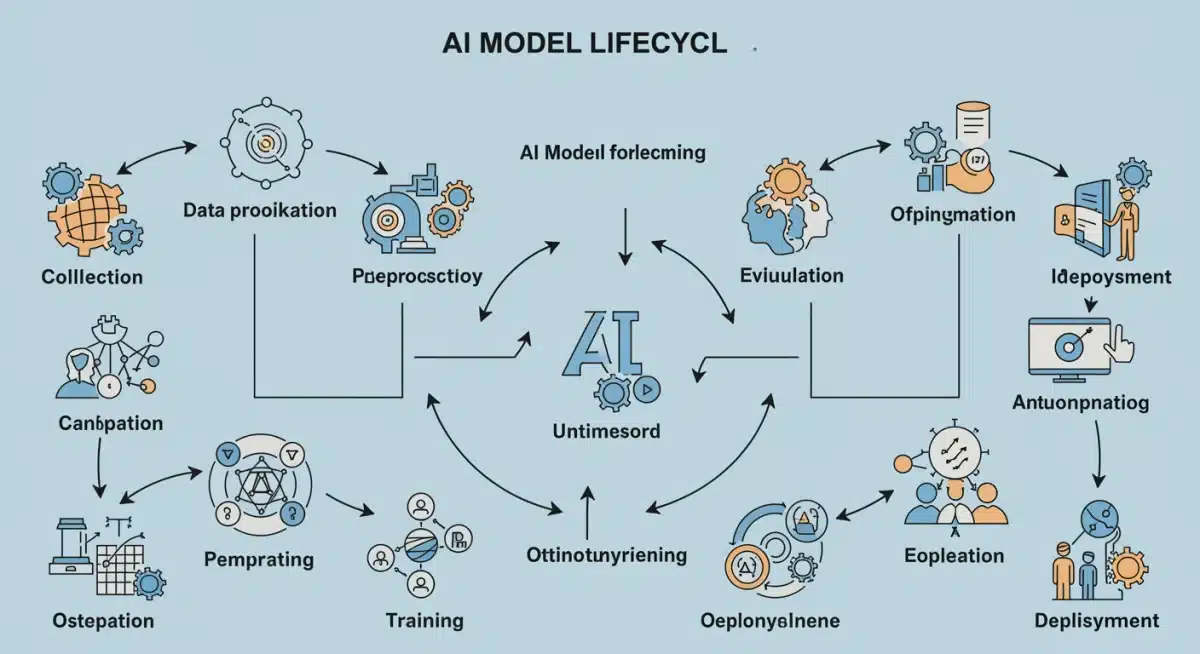
Deploying an AI model is not the end of the optimization journey; it’s just the beginning. Real-world data can drift over time, model performance can degrade, and new patterns may emerge. Continuous monitoring and strategic retraining are essential to maintain and optimize AI model performance in production environments.
This final tip highlights the importance of an iterative lifecycle for AI models, ensuring they remain relevant, accurate, and effective long after initial deployment.
Detecting Data and Concept Drift
Data drift occurs when the statistical properties of the input features change over time, while concept drift refers to changes in the relationship between input features and the target variable. Both can severely degrade model performance if not detected and addressed promptly.
Statistical process control: Monitor key data distributions and model outputs for significant deviations from baselines.
A/B testing: Continuously test new model versions against the currently deployed one to identify improvements or detect degradation.
Performance dashboards: Create dashboards to visualize key performance metrics (e.g., accuracy, precision, recall) over time, with alerts for drops below acceptable thresholds.
Strategic Retraining and Model Versioning
Once drift is detected or performance degrades, strategic retraining becomes necessary. This involves updating the model with new data that reflects current patterns. Effective model versioning and management are crucial to track changes and ensure reproducibility.
The retraining schedule depends on the application’s sensitivity to drift and the rate at which data patterns change. Some models may require daily retraining, while others might be updated quarterly. Automating the retraining pipeline ensures efficiency and consistency.
Ultimately, continuous monitoring and strategic retraining are indispensable for maintaining optimal AI model performance in dynamic real-world settings. By embracing this iterative approach, data scientists ensure their AI solutions deliver sustained value and adapt to evolving conditions.
Key Optimization Area
Brief Description
Data Preprocessing
Clean, normalize, and engineer features to enhance model learning and reduce noise.
Hyperparameter Tuning
Utilize advanced strategies like Bayesian optimization to find optimal model configurations efficiently.
Ensemble Methods
Combine multiple models (e.g., bagging, boosting) for improved accuracy and robustness.
Continuous Monitoring
Regularly track model performance in production to detect and address data/concept drift.
Frequently Asked Questions About AI Model Optimization
Why is data preprocessing so crucial for AI model performance?▼
Data preprocessing is crucial because AI models learn from the data they are fed. Clean, normalized, and well-structured data reduces noise, eliminates inconsistencies, and highlights relevant patterns, enabling models to learn more effectively and make accurate predictions, directly impacting their real-world utility.
What are the main benefits of using transfer learning?▼
Transfer learning significantly reduces training time, improves model performance with less data, and allows access to advanced model architectures. By leveraging knowledge from pre-trained models on vast datasets, data scientists can achieve state-of-the-art results more efficiently for their specific tasks, even with limited resources.
How do ensemble methods improve AI model robustness?▼
Ensemble methods enhance robustness by combining predictions from multiple diverse models. This approach averages out individual model biases and reduces variance, making the collective prediction more stable and accurate than any single model. It mitigates the risk of relying on a single fallible model.
What is the significance of model interpretability in AI?▼
Model interpretability, or Explainable AI (XAI), is significant because it allows data scientists and stakeholders to understand how an AI model makes its decisions. This fosters trust, helps in debugging, identifies potential biases, and ensures ethical deployment, especially in critical applications where transparency is paramount for accountability.
Why is continuous monitoring essential for deployed AI models?▼
Continuous monitoring is essential because real-world data environments are dynamic. Data and concept drift can occur, causing model performance to degrade over time. Regular monitoring allows for the timely detection of these issues, enabling strategic retraining and ensuring the model remains accurate and relevant in production.
Conclusion
The pursuit of optimal AI model performance is an ongoing journey, not a destination. For US data scientists, staying at the forefront of this rapidly evolving field demands a proactive and multi-faceted approach. By diligently applying these seven expert tips—from meticulous data preparation and advanced tuning strategies to leveraging transfer learning, embracing ensemble methods, ensuring interpretability, and committing to continuous monitoring—you can significantly elevate the impact and reliability of your AI solutions. The insights shared here are designed to empower you with the insider knowledge needed to build robust, high-performing, and trustworthy AI systems that deliver tangible value in today’s data-driven landscape.
Eduarda Moura has a degree in Journalism and a postgraduate degree in Digital Media. With experience as a copywriter, Eduarda strives to research and produce informative content, bringing clear and precise information to the reader.