AI in Healthcare: Boosting US Hospital Diagnostic Accuracy by 10%
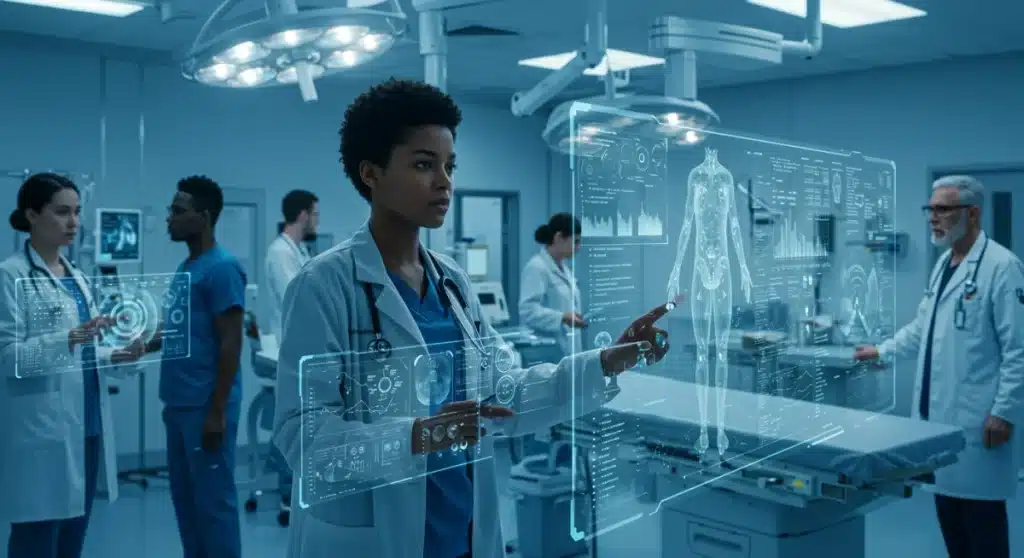
AI is significantly enhancing diagnostic accuracy in US hospitals, leading to a 10% improvement by leveraging advanced algorithms for faster and more precise disease detection, ultimately transforming patient outcomes and operational efficiency.
By: Eduarda Moura on August 27, 2025
Last updated on: November 28, 2025
AI is significantly enhancing diagnostic accuracy in US hospitals, leading to a 10% improvement by leveraging advanced algorithms for faster and more precise disease detection, ultimately transforming patient outcomes and operational efficiency.
Imagine a future where medical diagnoses are not just faster, but also demonstrably more accurate. In US hospitals, this future is rapidly becoming a reality, with artificial intelligence playing a pivotal role. The integration of AI healthcare diagnostics is now measurably improving diagnostic accuracy by a remarkable 10%, offering an insider’s look into a profound transformation in patient care.
The Dawn of AI in Diagnostic Medicine
The landscape of medical diagnostics is undergoing a seismic shift, driven by the relentless advancement of artificial intelligence. This isn’t merely about automating existing processes; it’s about fundamentally redefining how diseases are identified, understood, and treated.
AI’s capacity to process vast datasets at speeds impossible for humans is its core strength. From analyzing complex genomic information to interpreting nuanced radiological images, AI algorithms are proving to be invaluable tools for clinicians.
Leveraging Big Data for Better Insights
One of AI’s most compelling applications in diagnostics is its ability to synthesize information from various sources. This includes patient histories, lab results, imaging scans, and even real-time physiological data.
Integrated Patient Profiles: AI compiles comprehensive patient data, offering a holistic view for diagnosis.
Pattern Recognition: Algorithms identify subtle patterns and correlations that human eyes might miss.
Predictive Analytics: AI can forecast disease progression or risk factors based on existing data.
The integration of AI into diagnostic workflows is not replacing human expertise but rather augmenting it. It provides clinicians with a powerful co-pilot, enabling them to make more informed decisions with greater confidence. This collaborative model is at the heart of the observed improvements in diagnostic accuracy.
Enhanced Image Analysis: A Game Changer
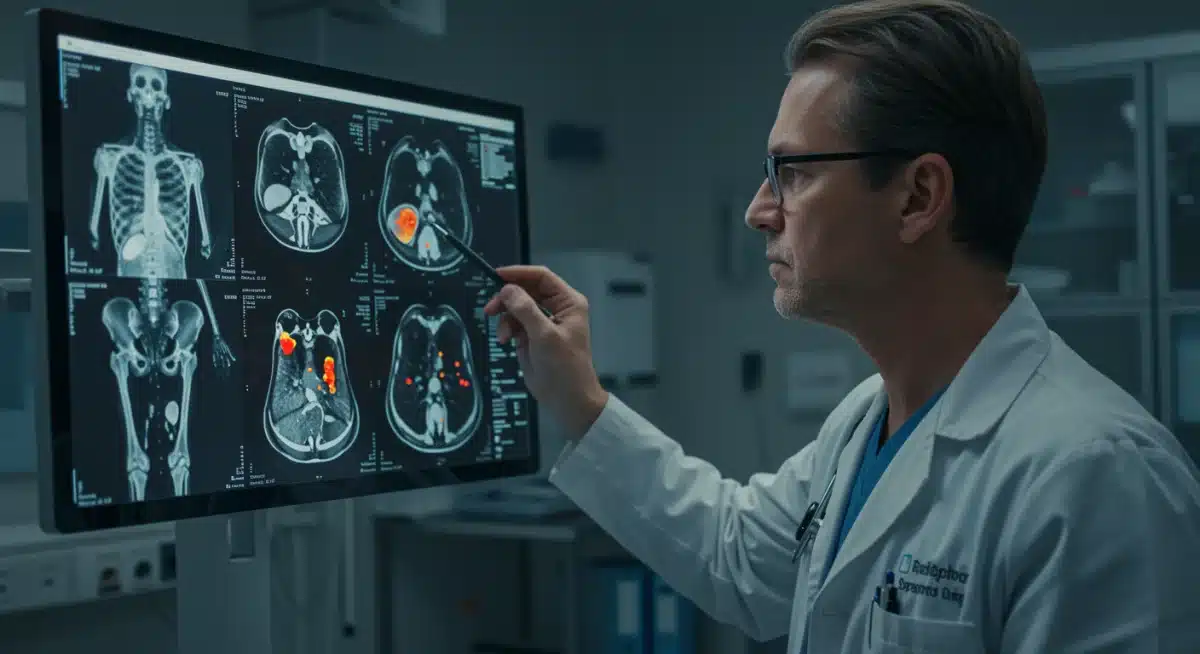
Radiology and pathology have long been cornerstones of diagnostic medicine, relying heavily on visual interpretation. AI is revolutionizing these fields by providing tools that can detect anomalies with unprecedented precision and speed.
Consider the sheer volume and complexity of medical images generated daily in a large US hospital. AI algorithms can sift through these images, flagging suspicious areas for further human review, thereby reducing the burden on radiologists and pathologists.
Precision in Radiology
AI’s impact on radiological diagnostics is particularly profound. Algorithms trained on millions of images can identify minute cancerous lesions, subtle fractures, or early signs of neurological conditions that might otherwise go unnoticed.
Reduced False Negatives: AI helps minimize instances where a disease is present but not detected.
Faster Interpretation: Preliminary AI analysis speeds up the diagnostic process, crucial in time-sensitive cases.
Improved Consistency: AI offers a consistent standard of review, reducing variability between different human interpreters.
This enhanced capability translates directly into earlier diagnoses, which are often critical for successful treatment outcomes. The synergy between human experts and AI systems is creating a new benchmark for diagnostic excellence.
Predictive Analytics and Early Disease Detection
Beyond current diagnoses, AI is also proving instrumental in predicting disease onset and progression. By analyzing genetic markers, lifestyle data, and historical health records, AI models can identify individuals at high risk for certain conditions long before symptoms appear.
This proactive approach to healthcare has the potential to transform public health strategies, shifting from reactive treatment to preventative intervention. Early detection is often synonymous with less invasive treatments and higher survival rates.
For example, in oncology, AI is being used to predict which patients are most likely to respond to specific therapies, personalizing treatment plans and minimizing ineffective interventions. This level of precision medicine is a direct result of AI’s analytical power.
The ability of AI to sift through vast amounts of heterogeneous data—from electronic health records to wearable device data—and identify subtle indicators of future health issues is unparalleled. This predictive capability is not only improving individual patient outcomes but also informing broader public health initiatives.
Overcoming Challenges and Ensuring Ethical AI Use
While the benefits of AI in healthcare diagnostics are clear, its integration is not without challenges. Issues such as data privacy, algorithmic bias, and the need for robust regulatory frameworks must be addressed to ensure responsible deployment.
Ensuring that AI models are trained on diverse and representative datasets is crucial to prevent biased outcomes that could disproportionately affect certain patient populations. Transparency in how AI makes its diagnostic recommendations is also paramount for building trust among clinicians and patients.
Addressing Algorithmic Bias
Algorithmic bias can arise from unrepresentative training data, leading to skewed results for certain demographics. Mitigating this requires careful data curation and continuous validation of AI models.
Diverse Datasets: Training AI on a wide range of patient data from various backgrounds.
Continuous Monitoring: Regularly auditing AI performance across different groups.
Human Oversight: Maintaining clinical review to catch and correct potential biases.
Ethical considerations extend to data security. Protecting sensitive patient information is a top priority, necessitating advanced encryption and strict access controls. The development of AI in healthcare must proceed with a strong ethical compass, balancing innovation with patient safety and privacy.
Economic Impact and Operational Efficiency
Beyond direct diagnostic improvements, AI also contributes significantly to the economic viability and operational efficiency of US hospitals. By streamlining workflows, reducing administrative burdens, and optimizing resource allocation, AI helps healthcare systems operate more effectively.
Faster and more accurate diagnoses mean patients spend less time undergoing unnecessary tests or receiving incorrect treatments. This reduces healthcare costs for both patients and providers, freeing up resources for other critical areas.
Streamlining Clinical Workflows
AI tools can automate routine tasks, such as scheduling, medical coding, and initial patient triage, allowing healthcare professionals to focus on more complex clinical decisions and direct patient care.
Reduced Administrative Load: Automating repetitive tasks saves time and reduces human error.
Optimized Resource Allocation: AI can predict patient demand, helping hospitals manage staff and equipment more efficiently.
Faster Patient Throughput: Quicker diagnoses lead to faster treatment initiation and discharge, improving bed availability.
The economic benefits extend to improved patient satisfaction, as shorter wait times and more accurate care enhance the overall healthcare experience. AI’s role in optimizing hospital operations is a key factor in its widespread adoption.
The Future Outlook: Continuous Innovation
The current 10% improvement in diagnostic accuracy is just the beginning. The field of AI is constantly evolving, with new algorithms and applications emerging at a rapid pace. Future advancements promise even greater precision, personalization, and accessibility in healthcare diagnostics.
Researchers are exploring ways to integrate AI with other emerging technologies, such as virtual reality for surgical planning or nanotechnology for ultra-early disease detection. The synergy of these innovations could unlock entirely new diagnostic capabilities.
Personalized Medicine Through AI
The ultimate goal is to move towards highly personalized medicine, where treatments are tailored to an individual’s unique genetic makeup, lifestyle, and environmental factors. AI is central to achieving this vision.
Genomic-Driven Diagnostics: AI analyzes complex genetic data to inform precise diagnoses and treatment plans.
Real-time Health Monitoring: Wearable devices combined with AI can provide continuous health insights.
Drug Discovery Acceleration: AI speeds up the identification of new therapeutic compounds.
The continuous feedback loop between clinical outcomes and AI model refinement ensures that these systems are constantly learning and improving. The future of healthcare diagnostics, powered by AI, promises a healthier and more efficient system for all.
Key Aspect
Impact on Diagnostics
Accuracy Improvement
AI boosts diagnostic precision by 10% in US hospitals, leading to better patient outcomes.
Enhanced Image Analysis
AI algorithms detect subtle anomalies in radiology and pathology with superior speed and detail.
Predictive Capabilities
AI forecasts disease risk and progression, enabling earlier intervention and personalized treatment.
Operational Efficiency
AI streamlines hospital workflows, reducing costs and improving resource allocation.
Frequently Asked Questions About AI in Healthcare Diagnostics
How does AI specifically improve diagnostic accuracy by 10%?▼
AI improves diagnostic accuracy by 10% through advanced pattern recognition in medical images, analysis of vast patient datasets, and identification of subtle indicators often missed by human perception alone. It aids clinicians in making more precise and timely decisions across various medical specialties.
What types of AI are most commonly used for diagnostics in US hospitals?▼
In US hospitals, common AI types for diagnostics include machine learning algorithms for image analysis (e.g., deep learning for radiology), natural language processing (NLP) for electronic health record review, and predictive analytics for risk assessment and disease progression forecasting.
Are there ethical concerns regarding AI’s role in medical diagnoses?▼
Yes, ethical concerns exist, primarily around algorithmic bias, data privacy, and accountability. Ensuring AI models are trained on diverse datasets to prevent biased outcomes and protecting sensitive patient information are paramount. Transparency in AI’s decision-making process is also a key ethical consideration.
How does AI impact the workload of healthcare professionals?▼
AI significantly impacts professional workload by automating routine tasks, such as initial image screening or data compilation. This frees up healthcare professionals to focus on complex cases, patient interaction, and critical decision-making, ultimately enhancing efficiency and reducing burnout.
What is the future potential of AI in further improving diagnostic accuracy?▼
The future potential of AI includes even greater diagnostic precision through multimodal data integration, personalized medicine tailored to individual genomics, and ultra-early disease detection using advanced biosensors. Continuous learning and refinement of AI models promise ongoing improvements in healthcare outcomes.
Conclusion
The integration of AI into healthcare diagnostics represents a transformative epoch for US hospitals. The documented 10% improvement in diagnostic accuracy is a testament to AI’s power to enhance clinical decision-making, streamline operations, and ultimately elevate patient care. As AI continues to evolve, its collaborative role with human expertise promises an even brighter future for medical science, pushing the boundaries of what’s possible in disease detection and treatment. Embracing these technological advancements, while carefully navigating ethical considerations, will be key to unlocking the full potential of AI in creating a healthier society.
Eduarda Moura has a degree in Journalism and a postgraduate degree in Digital Media. With experience as a copywriter, Eduarda strives to research and produce informative content, bringing clear and precise information to the reader.