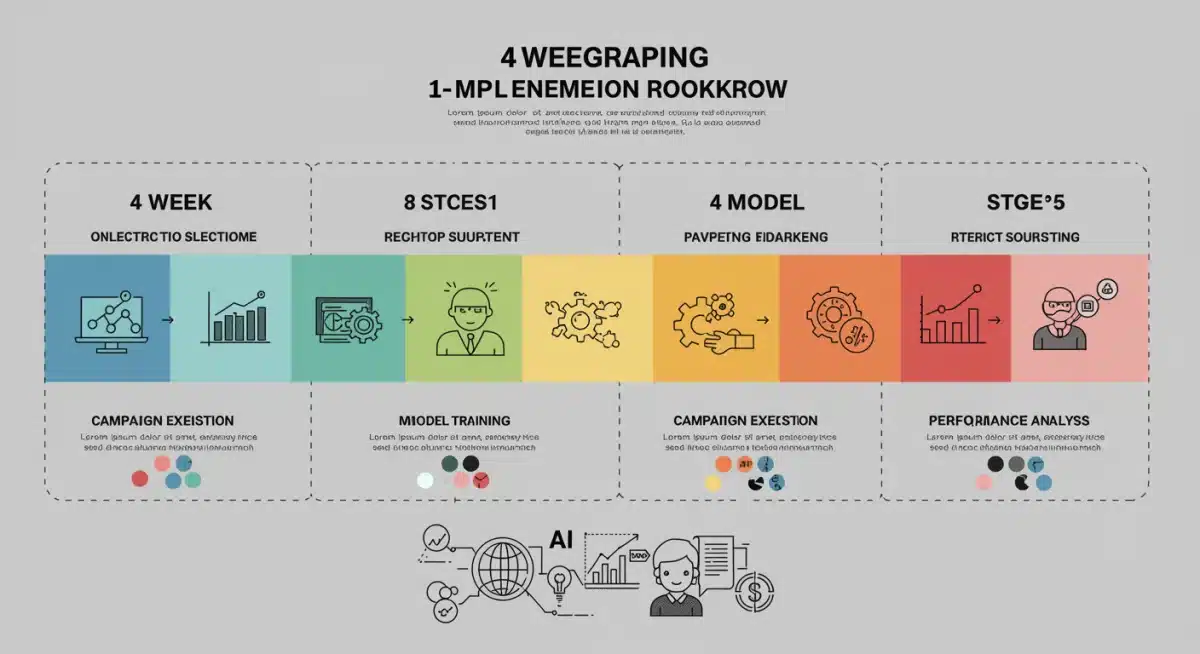
Implementing AI for Personalized Marketing: A 4-Week Roadmap
This article outlines a practical 4-week roadmap for US brands to successfully implement AI in personalized marketing, offering actionable solutions to enhance customer engagement and optimize marketing ROI.
By: Eduarda Moura on July 24, 2025
Last updated on: November 28, 2025
Implementing AI for personalized marketing offers US brands a significant competitive edge by optimizing customer engagement and maximizing return on investment through data-driven strategies.
In today’s hyper-connected digital landscape, consumers expect experiences tailored specifically to their needs and preferences. Generic marketing messages often fall flat, leading to missed opportunities and wasted resources. This is where artificial intelligence (AI) steps in, offering a transformative approach to understanding and engaging with your audience. For US brands, the journey to successfully implementing AI for personalized marketing might seem daunting, but with a structured approach, it’s entirely achievable. This article provides a practical 4-week roadmap, breaking down the complex process into manageable steps, ensuring you can harness the power of AI to create truly impactful and personalized customer journeys.
Week 1: foundational data assessment and goal setting
The initial week of your AI implementation journey is crucial for laying a solid groundwork. Without a clear understanding of your current data landscape and well-defined objectives, even the most sophisticated AI tools will struggle to deliver meaningful results. This phase focuses on auditing your existing data sources, identifying gaps, and establishing measurable goals that align with your overall business strategy.
understanding your data ecosystem
Before any AI model can learn and predict, it needs quality data. This involves identifying all potential data sources within your organization, from CRM systems to website analytics and social media interactions. A comprehensive audit helps pinpoint inconsistencies and redundancies.
Website analytics: User behavior, page views, conversion paths.
Social media insights: Engagement metrics, sentiment analysis, demographic data.
Email marketing platforms: Open rates, click-through rates, subscription preferences.
defining measurable objectives
Setting clear, quantifiable goals is paramount. Are you aiming to increase customer lifetime value, reduce churn, improve conversion rates, or boost brand loyalty? Specific objectives will guide your AI strategy and allow for effective measurement of success.
For instance, a brand might aim to increase repeat purchases by 15% within six months through personalized product recommendations. Another might focus on reducing customer service inquiries by 10% by providing proactive, AI-driven support based on past interactions. These objectives must be SMART: Specific, Measurable, Achievable, Relevant, and Time-bound.
By the end of Week 1, you should have a detailed inventory of your data sources and a precise set of marketing objectives that AI will help you achieve. This initial assessment provides the necessary clarity to move forward with confidence, ensuring that your AI efforts are directed towards tangible business outcomes.
Week 2: AI tool selection and data preparation
With your data ecosystem mapped and objectives set, Week 2 shifts focus to selecting the right AI tools and preparing your data for analysis. This involves evaluating various AI platforms, ensuring data quality, and structuring it in a way that AI models can readily consume and learn from. The success of your personalized marketing efforts heavily relies on clean, organized, and relevant data.
choosing the right AI platform
The market offers a wide array of AI tools, each with its strengths. Consider platforms that specialize in customer segmentation, predictive analytics, recommendation engines, or natural language processing (NLP), depending on your specific goals. Factors like scalability, ease of integration, and vendor support are critical.
Customer data platforms (CDPs): Consolidate customer data from various sources into a single, unified profile.
Marketing automation platforms with AI: Offer built-in AI features for personalization, segmentation, and campaign optimization.
Dedicated AI/ML platforms: Provide advanced capabilities for custom model development and deployment.
Cloud-based AI services: Leverage scalable infrastructure for data processing and model training.
data cleansing and transformation
Raw data is rarely ready for AI. This stage involves identifying and correcting errors, removing duplicates, and handling missing values. Data transformation converts raw data into a format suitable for machine learning algorithms, often involving normalization, standardization, and feature engineering.
For example, inconsistent customer names, outdated contact information, or varying date formats can hinder AI’s ability to draw accurate insights. Tools for data quality management and ETL (Extract, Transform, Load) processes become invaluable here. Investing time in data preparation now will save significant effort and improve accuracy later in the process.
By the conclusion of Week 2, your chosen AI platform should be in place, and your data should be cleaned, transformed, and ready for ingestion. This meticulous preparation is the backbone of effective AI-driven personalization, ensuring that the insights generated are reliable and actionable.
Week 3: model training and initial campaign setup
Week 3 is where your AI truly begins to learn and where the rubber meets the road in terms of practical application. This phase involves training your selected AI models with the prepared data and setting up your first personalized marketing campaigns. It’s an iterative process of feeding data, refining models, and deploying initial strategies to test the waters.
training your AI models
Using your cleaned data, you’ll train AI models to perform specific tasks, such as predicting customer churn, recommending products, or segmenting your audience. This often involves selecting appropriate algorithms, defining training parameters, and monitoring model performance.
For instance, if your goal is personalized product recommendations, you might train a collaborative filtering model using past purchase data and browsing behavior. For customer segmentation, a clustering algorithm could group customers with similar characteristics, allowing for targeted messaging. The iterative nature of model training means continuous feedback and adjustments are essential.
designing personalized campaigns
With your AI models trained, you can begin designing marketing campaigns that leverage these insights. This includes crafting personalized email content, dynamic website experiences, targeted ad campaigns, and customized product recommendations. The key is to match the right message to the right customer at the right time.
Email personalization: Dynamic content based on user preferences and behavior.
Website personalization: Tailored landing pages, product displays, and CTAs.
Ad targeting: Highly segmented audiences for social media and display ads.
Recommendation engines: Suggesting relevant products or content based on past interactions.
At the end of Week 3, you will have operational AI models and your first set of personalized marketing campaigns launched. This pivotal stage marks the transition from theoretical planning to active implementation, allowing you to start gathering real-world performance data.
Week 4: campaign launch, monitoring, and optimization
The final week of this roadmap focuses on the live deployment of your personalized marketing campaigns, rigorous monitoring of their performance, and continuous optimization based on the insights gained. This phase emphasizes agility, data-driven decision-making, and the ongoing refinement of your AI strategies.
launching personalized campaigns
With models trained and campaigns designed, it’s time to go live. Ensure all integrations between your AI platform, marketing automation tools, and customer touchpoints are seamless. A phased rollout can help identify and address any unforeseen issues before a full-scale launch.
Before launching, conduct thorough A/B testing on various elements of your personalized campaigns, such as subject lines, calls to action, and content variations. This pre-launch optimization can significantly improve initial performance and provide valuable data for future refinements. Always have a contingency plan in place for any technical glitches or unexpected outcomes.
continuous monitoring and analysis
Once campaigns are live, continuous monitoring is critical. Track key performance indicators (KPIs) such as conversion rates, click-through rates, engagement levels, and customer satisfaction. AI tools often come with dashboards that provide real-time insights, allowing for immediate adjustments.
Performance dashboards: Visualize key metrics and identify trends.
A/B testing results: Understand which personalization strategies resonate most.
Customer feedback: Gather direct input on personalized experiences.
Attribution modeling: Determine the impact of personalized efforts on overall revenue.
iterative optimization
Personalized marketing with AI is not a one-time setup; it’s an ongoing process of learning and adaptation. Use the insights from monitoring to refine your AI models, tweak campaign parameters, and explore new personalization opportunities. This iterative approach ensures your strategies remain effective and responsive to evolving customer behavior.
Based on performance data, you might discover that certain customer segments respond better to specific types of personalized content or that a particular recommendation algorithm outperforms others. Use these learnings to update your AI models and adjust your campaign creatives, ensuring continuous improvement.
By the end of Week 4, your US brand will have successfully launched its initial AI-powered personalized marketing campaigns, established a robust monitoring framework, and initiated a cycle of continuous optimization. This foundational work sets the stage for sustained growth and deeper customer relationships.
Measuring ROI and demonstrating value
Beyond the initial 4-week implementation, it’s vital for US brands to consistently measure the return on investment (ROI) of their AI personalized marketing efforts. Demonstrating tangible value ensures continued stakeholder buy-in and justifies further investment in AI technologies. This involves linking personalized marketing outcomes directly to business metrics.
quantifying the impact of personalization
Measuring ROI goes beyond simple vanity metrics. It requires carefully tracking how personalized campaigns influence revenue, customer retention, and operational efficiency. Establish clear benchmarks before implementation to accurately assess the uplift provided by AI.
Increased conversion rates: Direct impact on sales from personalized product recommendations or offers.
Higher customer lifetime value (CLTV): Improved retention and repeat purchases due to tailored experiences.
Reduced customer acquisition cost (CAC): More efficient targeting leading to lower spend per new customer.
Enhanced brand loyalty: Qualitative and quantitative measures of customer satisfaction and advocacy.
attribution modeling and dashboards
Advanced attribution models can help pinpoint which personalized touchpoints contribute most to conversions. Integrated dashboards should provide a holistic view of performance, allowing marketing teams to quickly identify successful strategies and areas needing improvement.
Utilize multi-touch attribution models to understand the entire customer journey and the role personalization plays at each stage. This moves beyond last-click attribution, offering a more nuanced view of AI’s influence. Regularly review these dashboards with key stakeholders to communicate progress and demonstrate the value generated.
Successfully measuring ROI and demonstrating the value of AI in personalized marketing transforms it from a technological experiment into a core strategic advantage. It provides the data-driven evidence needed to scale efforts and continuously refine your personalized customer experiences.
Overcoming common challenges and best practices
Implementing AI for personalized marketing, while transformative, comes with its own set of challenges. US brands must be prepared to address issues ranging from data privacy to integration complexities. Adopting best practices can mitigate these hurdles and ensure a smoother, more effective deployment.
addressing data privacy and ethics
With increased personalization comes greater responsibility regarding customer data. Compliance with regulations like CCPA and responsible data handling are paramount. Transparency with customers about data usage builds trust and fosters stronger relationships.
GDPR/CCPA compliance: Ensure all data collection and usage practices adhere to relevant privacy laws.
Data anonymization: Protect sensitive customer information where possible.
Consent management: Clearly obtain and manage customer consent for data usage.
Ethical AI guidelines: Develop internal policies for fair and unbiased AI model development.
integration and scalability challenges
Integrating new AI platforms with existing marketing technologies can be complex. Ensuring scalability as your customer base and data volume grow is also a critical consideration. Plan for robust APIs and flexible architectures from the outset.
Many brands face challenges connecting disparate systems, leading to data silos. Prioritize AI solutions that offer strong integration capabilities or consider a unified customer data platform (CDP) to centralize your data. As your brand grows, your AI infrastructure must be able to scale without compromising performance or accuracy.
By proactively addressing these common challenges and adhering to best practices, US brands can navigate the complexities of AI implementation more effectively. This strategic foresight ensures that personalization efforts are not only powerful but also responsible and sustainable in the long term.
Key Stage
Brief Description
Week 1: Foundations
Data assessment, goal setting, and data source identification.
Week 2: Tools & Prep
AI platform selection, data cleansing, and transformation.
Week 3: Training & Setup
AI model training and initial personalized campaign design.
Week 4: Launch & Optimize
Campaign launch, continuous monitoring, and iterative optimization.
Frequently asked questions about AI personalized marketing
What is personalized marketing with AI?▼
Personalized marketing with AI involves using artificial intelligence technologies to deliver tailored content, product recommendations, and experiences to individual customers. AI analyzes vast amounts of data to predict preferences and behaviors, enabling brands to create highly relevant and timely interactions that resonate deeply with their audience.
How long does it take to implement AI personalized marketing?▼
While a foundational implementation can be achieved within a structured 4-week roadmap, the full realization of AI’s potential in personalized marketing is an ongoing process. The initial four weeks establish data collection, tool integration, and initial campaign launches, with continuous optimization and expansion occurring over subsequent months.
What are the key benefits for US brands?▼
US brands implementing AI for personalized marketing can experience significant benefits, including increased customer engagement, higher conversion rates, improved customer retention, and a stronger return on marketing investment. It also fosters deeper brand loyalty by making customers feel understood and valued through relevant communications.
Is data privacy a concern with AI personalization?▼
Yes, data privacy is a significant concern that must be addressed. Brands must ensure full compliance with regulations like CCPA and GDPR, prioritize data security, and maintain transparency with customers about how their data is used. Ethical AI practices are crucial for building and maintaining customer trust in personalized marketing efforts.
What initial investment is required for AI tools?▼
The initial investment for AI tools can vary widely depending on the complexity and scale of the solution. Options range from integrated AI features within existing marketing platforms to dedicated enterprise-level AI/ML platforms. Brands should assess their needs, budget, and desired outcomes to select the most appropriate and cost-effective tools for their specific personalized marketing goals.
Conclusion
Implementing AI for personalized marketing is no longer a futuristic concept but a present-day imperative for US brands seeking to thrive in a competitive landscape. This 4-week roadmap provides a clear, actionable framework to transition from generic messaging to highly individualized customer experiences. By focusing on data foundations, strategic tool selection, continuous optimization, and responsible data practices, brands can unlock unparalleled opportunities for engagement, loyalty, and significant ROI. The journey demands commitment and adaptability, but the rewards of deeply understanding and connecting with your customer base are immeasurable, setting the stage for sustained growth and market leadership.
Eduarda Moura has a degree in Journalism and a postgraduate degree in Digital Media. With experience as a copywriter, Eduarda strives to research and produce informative content, bringing clear and precise information to the reader.