Automating Customer Service: US Companies Save 25% with AI by 2025
US companies are rapidly adopting AI for customer service automation, projected to save up to 25% on operational costs by 2025, driven by enhanced efficiency, reduced labor expenses, and improved customer experience.
By: Eduarda Moura on June 26, 2025
Last updated on: November 28, 2025
US companies are rapidly adopting AI for customer service automation, projected to save up to 25% on operational costs by 2025, driven by enhanced efficiency, reduced labor expenses, and improved customer experience.
In an increasingly competitive landscape, US companies are turning to artificial intelligence to revolutionize their customer service operations. The move towards AI customer service automation isn’t just about technological advancement; it’s a strategic imperative promising substantial financial gains. Projections indicate that by 2025, businesses could see operational cost savings of up to 25% through smart AI integration.
The strategic imperative of AI in customer service
The role of customer service has evolved from a cost center to a critical differentiator for businesses. As customer expectations escalate, companies face the challenge of delivering consistent, high-quality support while managing operational expenses. This is where AI steps in, offering a transformative solution that addresses both efficiency and effectiveness.
AI-powered tools can handle routine inquiries, provide instant support, and personalize interactions at scale, freeing human agents to focus on complex issues requiring empathy and nuanced problem-solving. This strategic shift not only optimizes resource allocation but also significantly enhances the overall customer experience, building stronger brand loyalty.
Beyond chatbots: comprehensive AI solutions
While chatbots are often the first thing that comes to mind when discussing AI in customer service, the scope of AI’s application is far broader. Modern AI solutions encompass a range of capabilities that integrate seamlessly into existing customer service ecosystems.
Intelligent virtual assistants: These advanced bots can understand complex queries, process natural language, and even learn from past interactions to provide more accurate and helpful responses.
Predictive analytics: AI algorithms analyze customer data to anticipate needs and potential issues, enabling proactive support that prevents problems before they arise.
Sentiment analysis: By interpreting the emotional tone of customer interactions, AI helps companies identify dissatisfied customers and intervene appropriately, often turning a negative experience into a positive one.
Automated routing: AI can efficiently direct customer inquiries to the most suitable human agent or department, reducing wait times and ensuring faster resolution.
The integration of these diverse AI components creates a robust and intelligent customer service infrastructure. This comprehensive approach allows US companies to not only streamline their operations but also to elevate the quality of their customer interactions, making every touchpoint more meaningful and effective.
Unpacking the 25% operational cost savings by 2025
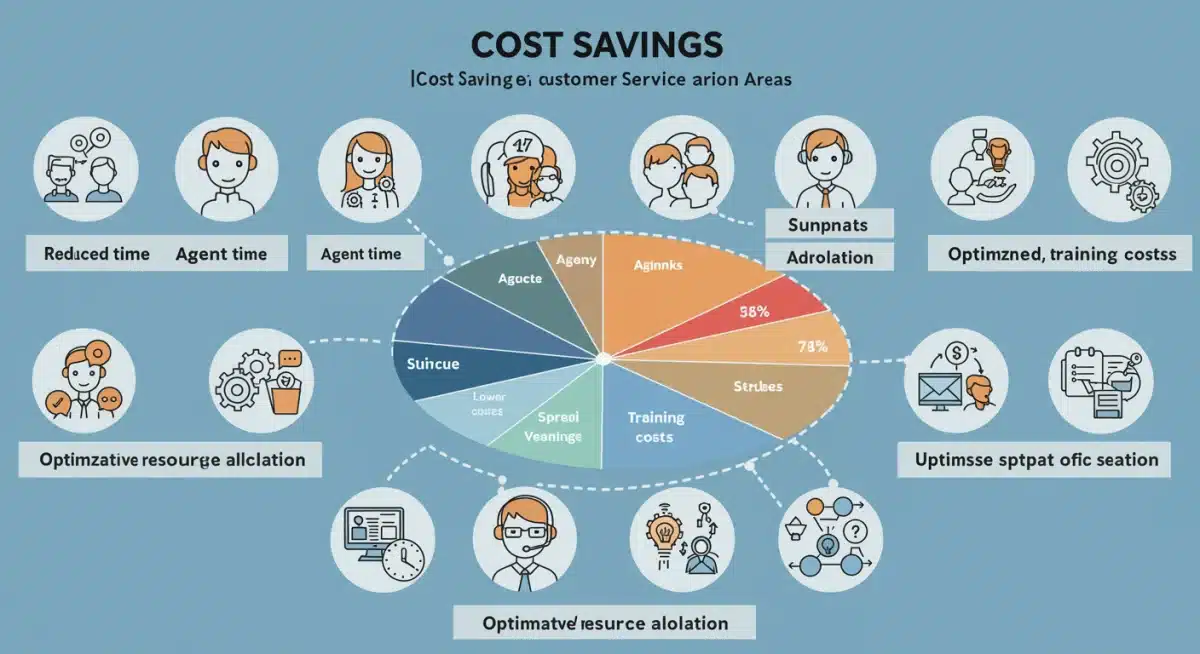
The projection of a 25% operational cost saving by 2025 through AI customer service automation is a significant figure that demands closer examination. This reduction isn’t a single silver bullet but rather a cumulative effect of improvements across various operational areas. Understanding where these savings come from is crucial for businesses looking to implement AI strategically.
One of the primary drivers of cost reduction is the decreased reliance on human agents for repetitive tasks. AI can handle a vast volume of inquiries, particularly those that are frequently asked and have standardized answers. This allows companies to optimize their staffing levels, reducing recruitment, training, and salary expenses associated with large customer service teams.
Reduced labor and infrastructure costs
The most direct impact on operational costs comes from the optimization of labor resources. AI tools can operate 24/7 without breaks, holidays, or shift differentials, providing continuous support without the associated human resource overheads. This leads to substantial savings in salaries, benefits, and overtime pay.
Furthermore, the need for extensive physical infrastructure, such as large call centers, can be reduced as a significant portion of customer interactions moves to digital AI platforms. This translates to lower expenditures on office space, utilities, and IT equipment. The scalability of AI also means that companies can handle spikes in demand without proportional increases in staffing or infrastructure, offering greater flexibility and cost control.
Lower staffing requirements: Automating routine tasks reduces the number of agents needed.
24/7 availability: AI provides continuous support without additional labor costs.
Reduced training expenses: AI systems require less recurring training compared to human agents.
Optimized resource utilization: Better allocation of human agents to complex issues.
These combined factors contribute to a significant reduction in the overall operational footprint of customer service departments. The efficiency gains are not just about doing more with less, but about doing it smarter, allowing businesses to reallocate resources to higher-value activities and strategic initiatives.
Enhanced efficiency and productivity gains
Beyond direct cost savings, AI customer service automation brings about substantial improvements in efficiency and productivity. These enhancements translate into indirect financial benefits and a more robust customer service ecosystem. Faster response times, consistent service quality, and improved agent performance are all hallmarks of an AI-driven approach.
AI systems can process information and respond to queries almost instantaneously, eliminating customer wait times. This immediate gratification is a key factor in customer satisfaction and can prevent frustration that often leads to churn. For complex issues, AI can quickly retrieve relevant information and present it to human agents, significantly reducing handling times.
Streamlined workflows and faster resolution
AI streamlines customer service workflows by automating repetitive tasks and providing agents with intelligent tools. For instance, AI can automatically populate customer information, suggest responses, and even complete post-interaction summaries. This reduces the administrative burden on agents, allowing them to focus on active problem-solving.
Faster resolution times are a direct consequence of these streamlined processes. When customers get their issues resolved quickly and efficiently, they are more satisfied and less likely to require follow-up contacts. This reduces the overall volume of interactions and the workload on the customer service team, further contributing to operational efficiency.
The productivity gains extend to human agents as well. With AI handling the simpler tasks, agents can dedicate their skills to more challenging and rewarding interactions. This not only improves their job satisfaction but also leverages their expertise more effectively, leading to better outcomes for both the customer and the company.
Improving customer experience and retention
While financial savings are a powerful motivator, the impact of AI on customer experience and retention is equally, if not more, critical for long-term business success. A superior customer experience translates directly into higher satisfaction, increased loyalty, and ultimately, greater revenue. AI customer service automation plays a pivotal role in achieving these outcomes.
Personalization is a key aspect of modern customer service, and AI excels at delivering it. By analyzing past interactions, purchase history, and preferences, AI can tailor responses and recommendations, making customers feel understood and valued. This level of personalized engagement fosters a deeper connection between the customer and the brand.
Consistent, personalized, and always-on support
AI ensures a consistent quality of service across all interactions, a challenge often faced by human-only teams due to variations in agent skill, mood, or training. AI systems provide uniform, accurate information every time, building trust and reliability. Furthermore, the 24/7 availability of AI means customers can get support whenever they need it, regardless of time zones or business hours.
Personalized interactions: AI customizes responses based on customer data.
24/7 availability: Customers receive support anytime, enhancing convenience.
Consistent service quality: AI ensures uniform and accurate information delivery.
Proactive engagement: AI can anticipate needs and offer solutions before problems arise.
This always-on, personalized, and consistent support significantly elevates the customer experience. Satisfied customers are more likely to become repeat buyers and brand advocates, driving organic growth and reducing marketing costs. The positive word-of-mouth generated by excellent service is invaluable, reinforcing the financial benefits of AI automation.
Challenges and considerations for AI adoption
While the benefits of AI customer service automation are compelling, its successful implementation is not without challenges. US companies must navigate several considerations to ensure a smooth transition and maximize their return on investment. These include data privacy, integration complexities, and the need for ongoing human oversight.
Data privacy and security are paramount. AI systems rely heavily on customer data, and companies must ensure robust measures are in place to protect sensitive information and comply with regulations like GDPR and CCPA. Breaches can lead to severe financial penalties and irreparable damage to brand reputation.
Ethical AI and data privacy
The ethical implications of AI use also require careful consideration. Companies must ensure their AI systems are fair, unbiased, and transparent in their operations. Algorithmic bias, if not addressed, can lead to discriminatory outcomes and erode customer trust. Regular audits and ethical guidelines are essential for responsible AI deployment.
Integration with existing systems can be another hurdle. Many companies operate with legacy systems that may not seamlessly connect with new AI platforms. This can require significant investment in infrastructure upgrades or custom development, adding to the initial cost of adoption. However, the long-term benefits typically outweigh these upfront expenses.
Finally, the role of human agents needs to be redefined, not eliminated. AI should augment, not replace, human capabilities. Training employees to work alongside AI, handling escalated issues, and focusing on complex problem-solving is crucial for a balanced and effective customer service strategy. This human-in-the-loop approach ensures that the customer experience remains empathetic and nuanced.
Future trends: beyond 2025 in AI customer service
As US companies move towards and beyond 2025, the evolution of AI in customer service is expected to accelerate further, introducing more sophisticated capabilities and deeper integration across business functions. The initial focus on cost savings will mature into a broader strategy centered on hyper-personalization, predictive service, and seamless omnichannel experiences.
One prominent trend will be the rise of truly conversational AI, capable of understanding context, nuance, and even emotional states with greater accuracy. This will enable more natural and empathetic interactions, blurring the lines between human and AI support and further enhancing customer satisfaction. AI will learn dynamically from every interaction, continuously improving its performance.
Hyper-personalization and predictive service
Beyond current personalization, future AI will anticipate individual customer needs with unprecedented precision. By leveraging vast amounts of data—from browsing history and social media activity to IoT device usage—AI will offer proactive solutions and highly tailored recommendations before the customer even articulates a need. This predictive service will redefine customer engagement.
Proactive problem solving: AI will identify and resolve issues before customers are even aware of them.
Emotional intelligence: AI will better understand and respond to customer emotions, improving interaction quality.
Seamless omnichannel integration: Consistent experience across all touchpoints, from voice to text to VR.
AI-powered agent assistance: Human agents will be equipped with advanced AI tools for real-time support and knowledge access.
The integration of AI with other emerging technologies, such as virtual and augmented reality (VR/AR), will also create immersive customer service experiences. Imagine an AI-powered virtual assistant guiding a customer through troubleshooting a product in a 3D environment. These advancements promise not just efficiency but entirely new forms of customer interaction that will set new industry benchmarks.
Measuring the financial impact and ROI
For US companies investing in AI customer service automation, rigorously measuring the financial impact and return on investment (ROI) is paramount. It’s not enough to simply implement AI; businesses must demonstrate tangible benefits to justify the initial outlay and continued investment. This involves tracking key performance indicators (KPIs) and conducting thorough cost-benefit analyses.
The 25% operational cost savings projected by 2025 will be realized through a combination of reduced labor costs, improved efficiency, and enhanced customer retention. Companies need to establish clear metrics before deployment, such as average handling time (AHT), first contact resolution (FCR) rates, customer satisfaction scores (CSAT), and churn rates.
Key metrics for success
Tracking AHT and FCR will directly illustrate efficiency gains. Shorter handling times and higher resolution rates mean fewer resources are expended per interaction. CSAT and Net Promoter Score (NPS) will provide insights into the quality of the customer experience, which indirectly impacts revenue through loyalty and advocacy. Reduced churn rates are a direct indicator of improved retention and a significant financial benefit.
Companies should also consider the opportunity costs of not adopting AI. The competitive disadvantage of slower service, higher operational costs, and declining customer satisfaction can be substantial. By contrast, the strategic advantage gained through AI can lead to market leadership and accelerated growth.
A comprehensive ROI calculation should factor in the initial investment in AI software and hardware, implementation costs, training expenses, and ongoing maintenance. These costs should then be weighed against quantifiable savings and revenue gains. Regular reviews and adjustments to the AI strategy based on these metrics will ensure continuous optimization and maximize the financial returns.
Key Benefit
Description
Operational Cost Savings
Projected 25% reduction by 2025 through labor optimization and infrastructure efficiency.
Enhanced Efficiency
Faster response times, streamlined workflows, and quicker issue resolution.
Improved Customer Experience
Personalized, consistent, and 24/7 support leading to higher satisfaction and retention.
Strategic Advantage
Market leadership and growth through innovative, cost-effective service delivery.
Frequently asked questions about AI customer service automation
How does AI automation lead to 25% cost savings in customer service?▼
AI automation reduces costs primarily by handling routine inquiries, decreasing the need for large human agent teams. This leads to savings in salaries, training, and infrastructure. AI also boosts efficiency, reducing average handling times and improving first contact resolution, which further lowers operational expenses.
What types of AI are most effective for customer service?▼
Intelligent virtual assistants, chatbots, natural language processing (NLP), sentiment analysis, and predictive analytics are highly effective. These tools automate responses, understand complex queries, gauge customer emotions, and anticipate needs, collectively enhancing service quality and operational efficiency.
Will AI replace human customer service agents entirely?▼
No, AI is more likely to augment human agents rather than replace them. AI handles repetitive tasks, freeing human agents to focus on complex, empathetic, and high-value interactions. This creates a hybrid model where AI and humans collaborate for optimal customer support.
What are the main challenges when implementing AI in customer service?▼
Key challenges include ensuring data privacy and security, integrating AI with existing legacy systems, addressing potential algorithmic bias, and effectively training human agents to work alongside AI. Overcoming these requires strategic planning and investment.
How does AI improve customer satisfaction and retention?▼
AI improves satisfaction by offering 24/7 availability, consistent service quality, and personalized interactions based on customer data. Faster resolution times and proactive support contribute to a more positive experience, fostering loyalty and increasing customer retention rates.
Conclusion
The shift towards AI customer service automation is not merely a technological upgrade but a fundamental transformation of how US companies engage with their clientele. The projected 25% operational cost savings by 2025 highlight the significant financial advantages, driven by optimized labor, enhanced efficiency, and streamlined infrastructure. Beyond the numbers, AI empowers businesses to deliver a consistently superior, personalized customer experience, fostering loyalty and driving long-term growth. While challenges exist, strategic implementation and a focus on ethical considerations will ensure that AI becomes an indispensable asset, redefining customer service excellence for the years to come.
Eduarda Moura has a degree in Journalism and a postgraduate degree in Digital Media. With experience as a copywriter, Eduarda strives to research and produce informative content, bringing clear and precise information to the reader.