Microservices Adoption: Accelerating US Tech in 2025
This playbook outlines strategic microservices adoption for US tech companies in 2025, targeting a 15% acceleration in software development cycles through modularity, scalability, and enhanced agility.
By: Eduarda Moura on November 12, 2025
Last updated on: November 28, 2025
Microservices adoption in 2025 for US tech aims to accelerate software development cycles by 15% through enhanced agility, scalability, and modular system design, driving significant competitive advantages.
The landscape of software development is in constant flux, demanding ever-increasing speed and adaptability. For US tech companies looking to gain a significant edge, microservices adoption 2025 stands out as a critical strategy. This approach promises not just incremental improvements but a fundamental shift towards 15% faster software development cycles, fostering innovation and resilience.
Understanding the Microservices Imperative for 2025
As we approach 2025, the pressure on US tech firms to deliver software faster, more reliably, and at scale has never been higher. Monolithic architectures, once the standard, increasingly struggle to keep pace with these demands. This is where microservices enter the picture, offering a paradigm shift that allows for independent development, deployment, and scaling of distinct application components.
The imperative for microservices in 2025 stems from several factors, including the need for continuous delivery, rapid experimentation, and the ability to leverage diverse technology stacks. Companies that embrace this architectural style are better positioned to respond to market changes, integrate new technologies, and ultimately, outperform competitors.
The Shift from Monoliths to Modular Systems
Historically, many applications were built as single, tightly coupled units, known as monoliths. While simpler to start, these often become cumbersome as they grow, leading to:
Slow development cycles due to complex dependencies.
Difficulty in scaling individual components without scaling the entire application.
Increased risk with every deployment, as a bug in one part could bring down the whole system.
Limited technology choices, forcing teams to stick with initial decisions.
Microservices break down these large applications into smaller, independent services, each running in its own process and communicating through lightweight mechanisms. This modularity is key to achieving the desired speed and agility in modern software development.
In conclusion, the decision to move towards microservices is not merely a technical one; it’s a strategic business imperative for US tech companies aiming for sustained growth and innovation in 2025. It addresses core challenges of scalability, resilience, and speed that traditional architectures often impede.
Strategic Planning for Microservices Implementation
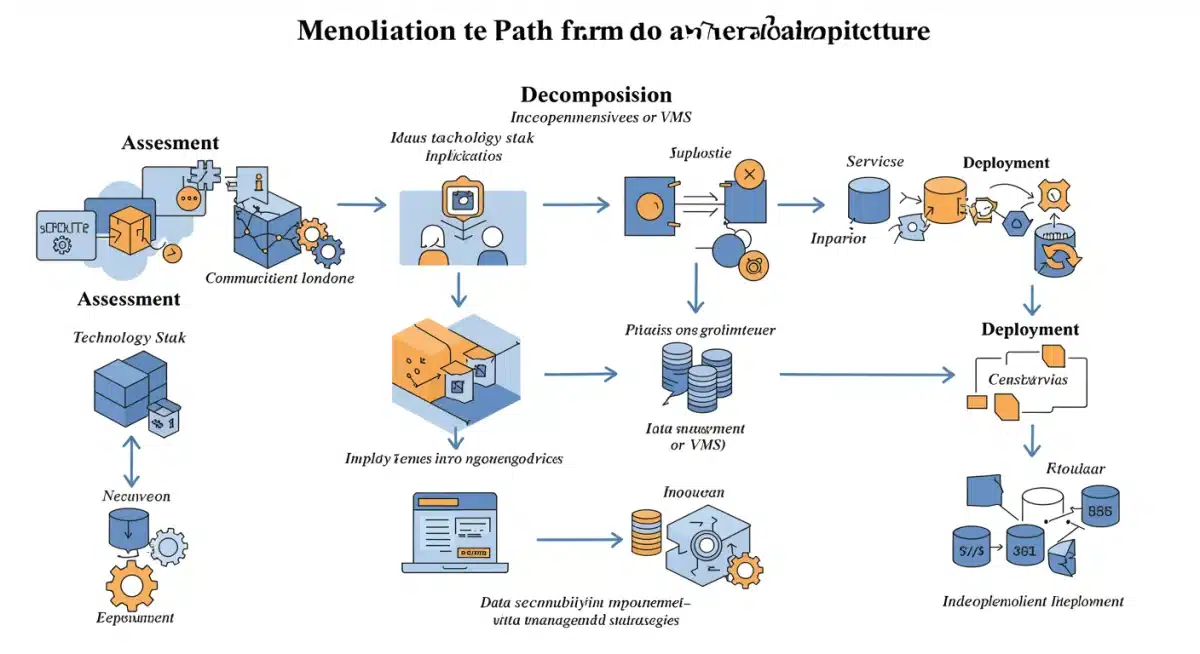
Successful microservices adoption doesn’t happen by accident; it requires meticulous planning and a clear strategy. For 2025, US tech leaders must prioritize a phased approach, starting with a thorough assessment of existing systems and organizational capabilities. This initial phase helps identify suitable candidates for migration and potential roadblocks.
A well-defined roadmap should outline the architectural vision, technology choices, and the sequence of service decomposition. It’s crucial to align technical decisions with business objectives, ensuring that each microservice contributes directly to value creation and faster development cycles.
Key Considerations for a 2025 Playbook
Developing a robust strategy involves looking at multiple angles:
Business Value Alignment: Identify core business domains that can benefit most from microservices, focusing on areas requiring rapid iteration or high scalability.
Technical Readiness: Assess current infrastructure, tooling, and team skills. Gaps in areas like containerization, orchestration, and CI/CD pipelines need to be addressed.
Organizational Structure: Microservices thrive in environments with autonomous, cross-functional teams. Organizations may need to restructure to support this model.
Data Management Strategy: Decide on data ownership and consistency models for distributed data, which is a common challenge in microservices architectures.
The planning phase also involves setting clear metrics for success, not just in terms of technical performance but also in business outcomes, such as reduced time-to-market and increased developer productivity. Without these benchmarks, it’s challenging to justify the investment and track progress effectively.
Ultimately, strategic planning for microservices in 2025 is about building a scalable and resilient foundation. It’s an iterative process that demands continuous evaluation and adaptation to ensure the architecture evolves with business needs.
Decomposition Strategies and Best Practices
Decomposing a monolithic application into microservices is often the most challenging aspect of the transition. There isn’t a one-size-fits-all approach, and the choice of strategy significantly impacts the success of microservices adoption 2025. Effective decomposition focuses on creating services that are loosely coupled and highly cohesive, minimizing dependencies between them.
Common strategies include decomposition by business capability, where services are aligned with specific business functions, or by subdomain, using Domain-Driven Design principles. Another method is the ‘Strangler Fig’ pattern, where new microservices gradually replace parts of the monolith, allowing for a safer, incremental migration.
Practical Approaches to Service Decomposition
When embarking on decomposition, consider these best practices:
Identify Bounded Contexts: Use Domain-Driven Design to define clear boundaries for services, ensuring each service owns its data and logic.
Start Small and Iterate: Begin with a less critical or easily isolatable part of the monolith to gain experience and refine the process before tackling more complex areas.
Avoid Distributed Monoliths: Ensure services are truly independent. Over-communication between services or shared databases can lead to a ‘distributed monolith’ which carries the complexity of microservices without their benefits.
Automate Everything: From testing to deployment, automation is crucial for managing the increased complexity of a microservice ecosystem.
The goal is to create services that can be developed, tested, and deployed independently. This autonomy is what ultimately drives faster development cycles and allows teams to innovate without stepping on each other’s toes. Careful consideration of data consistency across services is also paramount, often leading to event-driven architectures.
In essence, successful decomposition is an art as much as a science. It requires deep understanding of the business domain, technical foresight, and a willingness to refactor and refine service boundaries over time. This iterative refinement is a hallmark of effective microservices adoption.
Enabling Technologies and Tooling for 2025
The success of microservices adoption 2025 heavily relies on the right set of enabling technologies and tooling. These tools streamline development, deployment, and operational management, allowing US tech teams to fully leverage the benefits of a distributed architecture. Key areas include containerization, orchestration, API gateways, and robust monitoring solutions.
Containerization, primarily through Docker, has become almost synonymous with microservices, providing lightweight, portable, and consistent environments for each service. Orchestration platforms like Kubernetes then manage these containers at scale, automating deployment, scaling, and operational aspects, freeing developers to focus on code.
Essential Technology Stack Components
A modern microservices ecosystem typically includes:
Containerization (e.g., Docker): Encapsulates services with their dependencies, ensuring consistent execution across environments.
Container Orchestration (e.g., Kubernetes): Automates the deployment, scaling, and management of containerized applications.
API Gateway: Acts as a single entry point for clients, routing requests to appropriate services, handling authentication, and rate limiting.
Service Mesh (e.g., Istio, Linkerd): Provides traffic management, observability, and security features for inter-service communication.
Distributed Tracing (e.g., Jaeger, Zipkin): Essential for understanding request flows across multiple services and debugging issues.
Centralized Logging: Aggregates logs from all services into a single location for easier analysis and troubleshooting.
Monitoring and Alerting: Tools like Prometheus and Grafana provide real-time insights into service health and performance.
Beyond these, embracing cloud-native platforms from providers like AWS, Azure, or Google Cloud can further accelerate microservices deployment and management, offering managed services for databases, message queues, and serverless functions. These platforms reduce operational overhead and allow teams to focus on building business logic.
In summary, selecting and implementing the correct technology stack is foundational for achieving the speed and efficiency promised by microservices. It’s an ongoing process of evaluation and adoption as new tools and practices emerge.
Organizational Transformation and Team Empowerment
The shift to microservices is not just a technological change; it demands a significant organizational transformation. For US tech companies in 2025, empowering teams and fostering a culture of ownership are paramount for successful microservices adoption 2025. Traditional hierarchical structures and centralized teams often hinder the agility that microservices aim to provide.
Microservices thrive in environments where small, autonomous, cross-functional teams own specific services end-to-end, from development to deployment and operations. This ‘you build it, you run it’ philosophy reduces handoffs, increases accountability, and accelerates problem-solving, directly contributing to faster development cycles.
Cultivating a Microservices-Ready Culture
Empowering Autonomous Teams: Grant teams the authority to make decisions regarding their services, including technology choices and deployment schedules.
Fostering a DevOps Culture: Break down silos between development and operations, promoting shared responsibility for service reliability and performance.
Investing in Training and Skill Development: Equip teams with the necessary skills in distributed systems, cloud-native technologies, and operational best practices.
Promoting Communication and Collaboration: While services are independent, teams must still communicate effectively, especially regarding API contracts and shared infrastructure.
Leadership plays a crucial role in championing this cultural shift, providing the vision, resources, and psychological safety for teams to experiment and learn from failures. It’s about shifting from a command-and-control approach to one of enablement and trust.
Ultimately, a successful microservices implementation is as much about people and processes as it is about technology. By empowering teams and fostering a culture of ownership, organizations can unlock the full potential of microservices and achieve significant gains in development speed and innovation.
Measuring Success and Continuous Improvement
Achieving a 15% faster software development cycle through microservices adoption 2025 requires a robust framework for measuring success and a commitment to continuous improvement. Without clear metrics, it’s impossible to gauge the effectiveness of the microservices strategy and identify areas for optimization. US tech companies must define key performance indicators (KPIs) that reflect both technical health and business value.
Metrics should extend beyond traditional uptime and response times to include indicators like deployment frequency, lead time for changes, mean time to recovery (MTTR), and change failure rate. These DORA metrics (DevOps Research and Assessment) are particularly valuable for understanding the true velocity and stability of a microservices environment.
Key Metrics for Microservices Success
To effectively measure progress, consider these vital metrics:
Deployment Frequency: How often code is deployed to production. Higher frequency often indicates greater agility.
Lead Time for Changes: The time it takes for a commit to get into production. Shorter lead times mean faster delivery.
Mean Time to Recovery (MTTR): How quickly a service can be restored after a failure. Essential for system resilience.
Change Failure Rate: The percentage of deployments that result in a degradation of service. A low rate indicates high quality.
Developer Productivity: Measured by factors like time spent on new features versus maintenance, or developer satisfaction.
Resource Utilization: Efficiency of infrastructure usage, especially important for cloud costs.
Beyond these operational metrics, it’s crucial to connect microservices adoption back to business outcomes. Has it reduced time-to-market for new features? Improved customer satisfaction? Enabled entry into new markets? These questions provide the ultimate validation of the strategy.
Continuous improvement is an ongoing journey. Regular reviews, retrospectives, and feedback loops are essential to identify bottlenecks, refine service boundaries, optimize infrastructure, and adapt the microservices architecture to evolving business needs. This iterative process ensures that the benefits of microservices are sustained and amplified over time.
Navigating Challenges and Future Trends
While the benefits of microservices are substantial, the journey is not without its challenges. US tech companies embarking on microservices adoption 2025 must be prepared to navigate complexities such as distributed data management, inter-service communication overhead, and increased operational complexity. Addressing these proactively is key to realizing the promised 15% faster development cycles.
Future trends also play a significant role. The increasing adoption of serverless functions, event-driven architectures, and AI/ML integration within microservices will further shape development practices. Staying abreast of these advancements and strategically incorporating them will be crucial for maintaining a competitive edge.
Overcoming Common Microservices Hurdles
Anticipating and mitigating challenges is vital:
Distributed Data Management: Implement robust strategies for data consistency across services, often involving event sourcing or sagas.
Observability: Invest in comprehensive logging, monitoring, and tracing to understand system behavior in a distributed environment.
Security: Implement strong authentication and authorization mechanisms for inter-service communication and external APIs.
Testing Complexity: Develop strategies for integration and end-to-end testing in a distributed system.
Cost Management: Optimize cloud resource usage and monitor costs closely, as unmanaged microservices can lead to higher infrastructure expenses.
Looking ahead, the evolution of service mesh technologies will simplify inter-service communication and security, while serverless computing will push the boundaries of granularity and operational abstraction. AI and machine learning will increasingly be integrated into microservices, enabling smarter, more adaptive applications.
In conclusion, while microservices offer immense potential, their successful adoption requires a holistic approach that includes strategic planning, technical excellence, organizational change, and a continuous focus on improvement and adaptation to future trends. This comprehensive playbook will guide US tech companies towards achieving their ambitious goals in 2025.
Key Aspect
Brief Description
Strategic Planning
Define clear objectives, assess current systems, and map out a phased migration roadmap aligned with business goals for 2025.
Decomposition
Break down monoliths into independent services using business capabilities or domain-driven design, avoiding distributed monoliths.
Enabling Tech
Leverage containerization, orchestration, API gateways, and robust monitoring for efficient development and operations.
Team Empowerment
Foster autonomous, cross-functional teams with a ‘you build it, you run it’ mindset to enhance agility and ownership.
Frequently Asked Questions About Microservices Adoption
What is the primary benefit of microservices adoption for US tech in 2025?▼
The primary benefit is achieving significantly faster software development cycles, estimated at 15% or more. This speed comes from increased agility, independent deployments, and the ability for teams to work on distinct services concurrently without bottlenecks, driving quicker innovation and market responsiveness.
How does microservices impact team structure?▼
Microservices encourage small, autonomous, cross-functional teams, often adopting a ‘you build it, you run it’ philosophy. Each team typically owns one or more services end-to-end, fostering greater accountability, faster decision-making, and reduced inter-team dependencies, which is crucial for 2025’s agile demands.
What are the biggest challenges in migrating to microservices?▼
Key challenges include managing distributed data consistency, ensuring robust inter-service communication, and handling increased operational complexity. Proper observability with centralized logging, monitoring, and tracing is essential to navigate these hurdles effectively in a distributed environment.
Which technologies are crucial for microservices in 2025?▼
Essential technologies include containerization (e.g., Docker) for packaging services, orchestration (e.g., Kubernetes) for managing them at scale, API gateways for request routing, and service meshes for inter-service communication. Cloud-native platforms also play a vital role in accelerating deployment and reducing operational overhead.
How can US tech companies measure the success of microservices adoption?▼
Success can be measured through DORA metrics like deployment frequency, lead time for changes, mean time to recovery, and change failure rate. Additionally, tracking business outcomes such as reduced time-to-market for new features and improved developer productivity provides a holistic view of the strategy’s effectiveness.
Conclusion
The journey towards comprehensive microservices adoption 2025 represents a strategic imperative for US tech companies aiming to achieve and sustain a competitive edge. By embracing modular architectures, empowering autonomous teams, leveraging cutting-edge technologies, and rigorously measuring outcomes, organizations can realistically target a 15% acceleration in software development cycles. This transformation is not merely about technology; it’s about fostering a culture of continuous innovation, adaptability, and resilience that will define success in the rapidly evolving digital landscape.
Eduarda Moura has a degree in Journalism and a postgraduate degree in Digital Media. With experience as a copywriter, Eduarda strives to research and produce informative content, bringing clear and precise information to the reader.