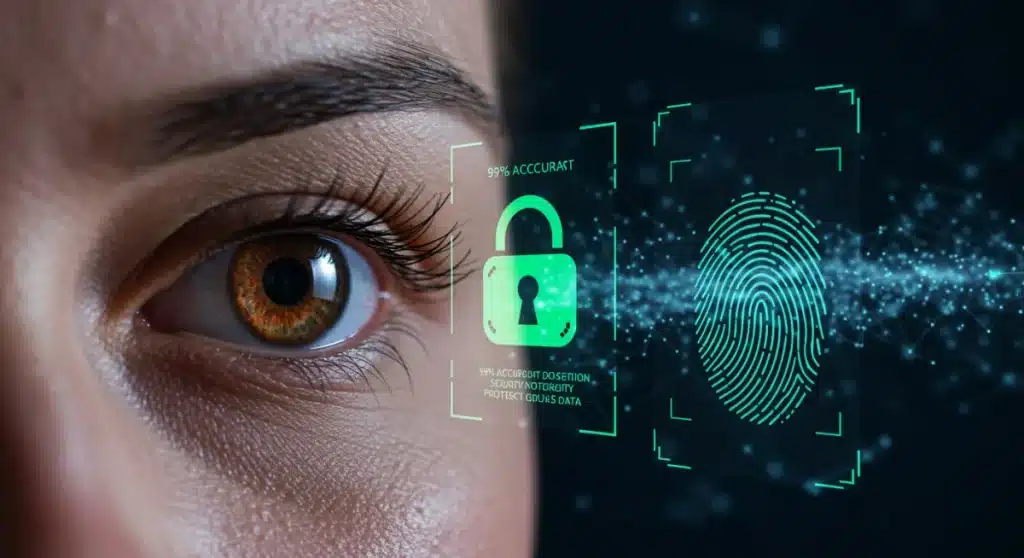
Biometric Security 2025: 99% Accuracy Protecting US Data
By 2025, biometric security is projected to reach 99% accuracy in protecting US data, leveraging advanced technologies like multimodal biometrics and AI-driven authentication to fortify digital defenses against evolving threats.
By: Eduarda Moura on November 4, 2025
Last updated on: November 28, 2025
By 2025, biometric security is projected to reach 99% accuracy in protecting US data, leveraging advanced technologies like multimodal biometrics and AI-driven authentication to fortify digital defenses against evolving threats.
The digital landscape is constantly evolving, and with it, the methods we use to protect our most sensitive information. As we look towards 2025, one area stands out for its rapid advancements and profound potential: the latest in biometric security: protecting US data with 99% accuracy in 2025. This isn’t just about convenience; it’s about building an impenetrable fortress around personal and national data, ensuring that access is granted only to those who truly are who they claim to be. How will these innovations redefine our understanding of security?
the evolution of biometric technology
Biometric technology has come a long way from simple fingerprint scanners. What was once considered science fiction is now a tangible reality, with systems capable of identifying individuals based on unique physiological and behavioral characteristics. This evolution is driven by an increasing need for more robust and user-friendly authentication methods, especially in an era of sophisticated cyber threats.
The journey of biometrics began with rudimentary physical identifiers, but today, it encompasses a diverse range of technologies. These advancements are not just about making systems more secure; they are also about improving user experience, reducing friction in daily interactions, and ensuring privacy in an increasingly interconnected world.
from single-factor to multimodal biometrics
Early biometric systems relied on a single identifier, such as a fingerprint or a facial scan. While effective to a degree, these systems could sometimes be vulnerable to spoofing or limitations in certain environments. The shift towards multimodal biometrics marks a significant leap forward in security.
Enhanced Accuracy: Combining multiple biometric modalities, like fingerprint and iris scans, significantly reduces the likelihood of false positives or negatives.
Increased Robustness: If one modality is compromised or unavailable (e.g., a hand injury affecting fingerprint), the system can rely on other factors for authentication.
Improved User Experience: Users can often choose their preferred method, or the system can seamlessly combine multiple methods for a quick and secure login.
Multimodal systems create a more complex and resilient authentication barrier, making it exponentially harder for unauthorized individuals to gain access. This layered approach is critical for achieving the high accuracy targets set for 2025.
behavioral biometrics on the rise
Beyond physical traits, behavioral biometrics are gaining prominence. These systems analyze patterns in how individuals interact with devices, providing continuous authentication without explicit user action.
Typing Cadence: Unique rhythm and pressure applied when typing.
Mouse Movement: Distinctive ways a user moves and clicks their mouse.
Gait Analysis: The particular way an individual walks.
Behavioral biometrics add an invisible, always-on layer of security, constantly verifying identity in the background. This passive authentication significantly enhances protection against account takeover and other forms of digital fraud, contributing to the overall 99% accuracy goal for US data protection.
The evolution of biometric technology underscores a proactive approach to security. By integrating multiple layers of identification, from physical to behavioral, systems are becoming more intelligent and adaptable, paving the way for unprecedented levels of data protection by 2025.
ai and machine learning: the backbone of 99% accuracy
The ambitious target of 99% accuracy in biometric security by 2025 is largely attributable to the sophisticated integration of artificial intelligence (AI) and machine learning (ML). These technologies are not merely enhancing existing systems; they are fundamentally transforming how biometric data is captured, processed, and validated.
AI algorithms excel at pattern recognition, a core component of biometric authentication. They can analyze vast datasets of biometric information, identifying subtle nuances that human observation or simpler algorithms might miss. This capability is crucial for distinguishing between legitimate users and sophisticated spoofing attempts.
deep learning for enhanced recognition
Deep learning, a subset of machine learning, utilizes neural networks with multiple layers to learn from data with increasing levels of abstraction. In biometrics, this translates to unparalleled accuracy in recognition.
Facial Recognition: Deep learning models can identify faces from various angles, lighting conditions, and even with partial obstructions, far surpassing previous capabilities.
Voice Recognition: AI can differentiate between genuine voices and synthesized or recorded audio, recognizing subtle inflections and speech patterns unique to an individual.
Iris and Retina Scans: Deep learning enhances the precision of matching complex patterns in the eye, making these methods even more secure.
The continuous learning aspect of deep learning allows biometric systems to improve over time, adapting to new data and evolving threats. This iterative refinement is key to maintaining high accuracy rates in dynamic environments.
anomaly detection and fraud prevention
Beyond simple identification, AI and ML are critical for detecting anomalies and preventing fraud. These systems can analyze real-time biometric inputs against established user profiles and identify deviations that might indicate a security breach.
For instance, if a user’s typical login behavior suddenly changes—different typing speed, unusual mouse movements, or an unfamiliar geographic location—AI can flag this as suspicious, prompting additional verification steps. This proactive anomaly detection is a powerful tool in protecting US data, moving beyond reactive security measures to predictive defense.
The synergy between biometrics and AI creates a formidable barrier against unauthorized access. By automating complex analysis and continuous learning, AI empowers biometric systems to achieve and sustain the 99% accuracy vital for safeguarding sensitive US data in the coming years.
key biometric modalities for us data protection
As we advance towards 2025, several biometric modalities are proving particularly effective in protecting US data, each offering unique strengths and applications. The selection of the most appropriate modality often depends on the specific security requirements and the environment in which it will be deployed.
These diverse technologies are being refined and integrated, contributing to a comprehensive security posture. Their individual strengths, when combined, create a robust defense against various types of cyber threats and unauthorized access attempts.
iris and retinal scanning: unparalleled precision
Iris and retinal scans are widely regarded as among the most secure biometric methods due to the unique and stable patterns within the human eye. The complexity of these patterns makes them incredibly difficult to replicate or spoof.
High Uniqueness: Each iris and retinal pattern is distinct, even between identical twins.
Stability Over Time: These patterns remain largely unchanged throughout a person’s life, ensuring long-term reliability.
Non-invasive Options: Modern iris scanners can capture images from a distance, improving user convenience.
These modalities are especially critical for high-security applications, such as government facilities, financial institutions, and critical infrastructure, where the integrity of US data is paramount.
facial recognition advancements
While often associated with consumer devices, facial recognition technology has undergone significant advancements, making it a powerful tool for enterprise-level security. 3D facial mapping and liveness detection are key to its enhanced security.
Liveness detection algorithms can distinguish between a live person and a photograph or video, preventing spoofing attacks. Furthermore, advancements in 3D facial mapping capture the unique contours of a face, adding another layer of security that 2D images cannot provide. This makes facial recognition increasingly viable for securing sensitive data.
fingerprint and palm vein recognition
Fingerprint scanning remains a staple due to its widespread adoption and continuous improvements in sensor technology. Palm vein recognition, though less common, offers an even higher degree of security.
Subdermal Patterns: Palm vein scanners detect the unique network of veins beneath the skin, which are nearly impossible to forge.
Hygienic and Reliable: Being internal, vein patterns are less susceptible to surface damage or environmental factors that might affect fingerprints.
These physical biometric methods continue to evolve, offering reliable and accurate identification for a broad range of applications, from securing personal devices to controlling access to restricted areas where US data is stored.
The strategic deployment of these advanced biometric modalities, often in combination, forms the bedrock of achieving 99% accuracy in protecting US data by 2025. Each technology contributes to a multi-layered defense strategy, addressing different vulnerabilities and enhancing overall security.
challenges and ethical considerations in biometric security
While the promise of 99% accuracy in biometric security by 2025 is exciting, the path forward is not without its challenges and crucial ethical considerations. Addressing these issues is vital for the successful and responsible deployment of these powerful technologies.
The rapid advancement of biometrics necessitates a careful balance between security, privacy, and societal impact. Ignoring these challenges could undermine public trust and lead to unintended consequences, despite the significant security benefits.
data privacy and consent
Biometric data is inherently sensitive and unique to an individual. Its collection, storage, and use raise significant privacy concerns. Ensuring explicit consent and transparent data handling practices are paramount.
Data Storage: Where and how is biometric data stored? Is it encrypted and protected from breaches?
Data Sharing: Under what circumstances can biometric data be shared with third parties, and what are the legal frameworks governing such sharing?
Anonymization: Can biometric data be effectively anonymized or pseudonymized to protect individual identities when used for research or analysis?
Robust legal frameworks and clear organizational policies are essential to safeguard this highly personal information, building public confidence in biometric systems.
bias and discrimination risks
AI-driven biometric systems, while highly accurate, can sometimes perpetuate or even amplify existing societal biases if not carefully designed and trained. This can lead to discriminatory outcomes.
For example, some facial recognition systems have historically shown lower accuracy rates for individuals with darker skin tones or certain ethnic backgrounds. Addressing these biases requires diverse training datasets, rigorous testing, and continuous monitoring to ensure equitable performance across all demographics. Failure to do so could lead to unfair access denial or misidentification, compromising the integrity of security systems.
spoofing and circumvention techniques
As biometric technology advances, so do attempts to circumvent it. Sophisticated spoofing techniques, such as realistic masks, deepfake audio, or even synthetic fingerprints, pose ongoing threats.
Developers are continuously working on liveness detection, anti-spoofing measures, and advanced anomaly detection to counter these threats. However, the cat-and-mouse game between security measures and circumvention tactics will remain a persistent challenge, requiring constant innovation and vigilance to maintain high accuracy levels.
Navigating these challenges and ethical considerations responsibly is crucial for the widespread adoption and long-term success of biometric security solutions. A technology’s effectiveness is not solely measured by its accuracy, but also by its ethical application and public trust.
regulatory landscape and compliance for us data
The deployment of advanced biometric security systems for US data protection is not solely a technological endeavor; it is also heavily influenced by a complex and evolving regulatory landscape. Compliance with various federal and state laws is critical to ensure both security and privacy.
These regulations aim to establish clear guidelines for the collection, storage, and use of biometric data, reflecting a growing awareness of its sensitive nature. Businesses and government agencies must navigate this regulatory environment carefully to avoid legal repercussions and maintain public trust.
federal regulations impacting biometrics
While there isn’t a single comprehensive federal law solely dedicated to biometrics, several existing regulations touch upon its use, particularly when it involves personally identifiable information (PII).
HIPAA (Health Insurance Portability and Accountability Act): Protects health information, which can include biometric data used in healthcare settings.
NIST Guidelines (National Institute of Standards and Technology): Provides best practices and standards for federal agencies using biometric technologies, influencing broader industry practices.
FTC Act (Federal Trade Commission Act): Empowers the FTC to take action against unfair or deceptive practices, including the mishandling of consumer data, which can extend to biometrics.
These federal guidelines provide a baseline for responsible biometric data management, emphasizing security, transparency, and consumer protection.
state-specific biometric privacy laws
Several US states have taken the lead in enacting specific biometric privacy laws, creating a patchwork of regulations that organizations must adhere to. These state laws often impose stricter requirements than federal guidelines.
The Illinois Biometric Information Privacy Act (BIPA) is a prominent example, requiring private entities to obtain written consent before collecting or disclosing an individual’s biometric identifier or information. Other states, like Texas and Washington, have similar, though often less stringent, laws. This fragmented regulatory environment necessitates a careful, state-by-state approach to compliance for any entity handling US data with biometrics.
the role of industry standards and certifications
Beyond government regulations, industry standards and certifications play a crucial role in promoting best practices and ensuring the security and interoperability of biometric systems. Organizations like the FIDO Alliance are developing open standards for strong, passwordless authentication, often leveraging biometrics.
Adhering to these standards can help organizations demonstrate their commitment to security and privacy, providing an additional layer of assurance for both regulators and users. These voluntary frameworks often complement mandatory regulations, contributing to a more secure and trustworthy biometric ecosystem.
The regulatory landscape for biometric security is dynamic and complex. Achieving 99% accuracy in protecting US data by 2025 will require not only technological prowess but also a deep understanding of, and strict adherence to, these evolving legal and ethical frameworks.
real-world applications and future outlook
The advancements in biometric security are not confined to theoretical discussions; they are actively being deployed across various sectors, transforming how individuals and organizations protect US data. The practical applications are vast, ranging from everyday convenience to critical national security measures.
As we approach 2025, the integration of 99% accurate biometric systems is set to become even more pervasive, fundamentally altering our interactions with technology and our expectations for data security.
securing financial transactions and personal devices
The financial sector has been an early adopter of biometric technology, using it to secure transactions, authorize payments, and prevent fraud. From fingerprint logins for banking apps to facial recognition for high-value transfers, biometrics are making financial interactions safer and more convenient.
Similarly, personal devices like smartphones and laptops now routinely use biometrics for unlocking and app access. This widespread consumer adoption has normalized the technology, paving the way for more sophisticated integrations. The goal is to eliminate passwords, which are often weak and susceptible to phishing, replacing them with immutable personal identifiers.
government and critical infrastructure protection
For government agencies and critical infrastructure, the stakes are even higher. Biometric security is essential for controlling access to sensitive facilities, securing classified information, and verifying the identity of personnel.
Border Control: Streamlined and secure immigration processes using facial and iris recognition.
Military and Defense: Access control to highly restricted areas and authentication for secure communications.
Healthcare: Protecting patient records and ensuring authorized access to medical systems.
The 99% accuracy target is particularly crucial in these sectors, where a single security breach could have catastrophic consequences for national security and public safety. Biometrics offer a robust solution to these complex challenges.
the smart city and iot integration
Looking further into the future, biometric security will play a pivotal role in the development of smart cities and the Internet of Things (IoT). Imagine a city where access to public transport, buildings, and even personal services is seamlessly and securely managed through biometric identification.
IoT devices, often vulnerable to hacking, can be secured with biometric authentication, ensuring that only authorized users can interact with them. This ubiquitous integration promises a future where security is both invisible and omnipresent, providing unparalleled protection for US data in an interconnected world.
The real-world applications of advanced biometric security are already tangible and will only expand, making digital interactions safer and more efficient. The drive towards 99% accuracy by 2025 signifies a commitment to a future where US data is protected by the most advanced and reliable authentication methods available.
future trends and emerging technologies
The journey towards 99% accurate biometric security by 2025 is continuous, with new trends and emerging technologies constantly pushing the boundaries of what’s possible. Researchers and developers are exploring innovative approaches to make authentication even more secure, seamless, and resilient against future threats.
These forward-looking developments promise to further solidify the protective measures around US data, ensuring that security systems remain one step ahead of malicious actors. The focus is on integrating biometrics more deeply and intelligently into our digital infrastructure.
vein pattern recognition and cardiac biometrics
Beyond traditional fingerprints and iris scans, more advanced physiological biometrics are gaining traction. Vein pattern recognition, which maps the unique network of blood vessels beneath the skin, offers a highly secure and difficult-to-spoof method.
Internal and Stable: Vein patterns are internal, making them impervious to surface damage and highly stable over time.
Cardiac biometrics, which analyze an individual’s unique heart rhythm (ECG or EKG patterns), represent another frontier. These patterns are incredibly precise and can offer continuous authentication, verifying identity passively as a person interacts with a device.
biometric fusion and adaptive authentication
The future of biometric security lies in sophisticated fusion techniques and adaptive authentication systems. Biometric fusion combines data from multiple modalities (e.g., face, voice, and gait) to create an even more robust and accurate identity profile.
Adaptive authentication takes this a step further by dynamically adjusting the level of security required based on context. For example, a low-risk transaction might only require a fingerprint, while a high-value transfer from an unusual location might trigger a request for multiple biometric verifications and a behavioral analysis. This intelligent, risk-based approach optimizes both security and user experience.
quantum-resistant cryptography for biometric data
As quantum computing advances, the security of current cryptographic methods, including those protecting biometric data, could be jeopardized. Anticipating this, researchers are developing quantum-resistant cryptography.
Integrating these new cryptographic techniques with biometric storage and transmission protocols will be crucial to ensure that the 99% accuracy achieved by 2025 remains robust against future computational threats. This proactive measure ensures the long-term integrity of US data secured by biometrics.
These emerging trends and technologies paint a picture of a future where biometric security is not only highly accurate but also incredibly intelligent, adaptable, and resilient. The continuous innovation in this field is critical to maintaining a strong defense against the ever-evolving landscape of cyber threats.
implementing robust biometric security for enterprises
For enterprises, particularly those handling sensitive US data, implementing robust biometric security is no longer an option but a necessity. The goal of 99% accuracy by 2025 requires a strategic and comprehensive approach, moving beyond simple authentication to a holistic security framework.
This involves not just selecting the right technology but also establishing secure protocols, ensuring compliance, and fostering a culture of security awareness among employees. A well-planned implementation minimizes vulnerabilities and maximizes the protective capabilities of biometric systems.
strategic technology selection and integration
Choosing the appropriate biometric technologies is the first critical step. Enterprises must assess their specific needs, risk profiles, and regulatory obligations to select modalities that offer the best balance of security, usability, and cost-effectiveness.
Multimodal Systems: Prioritize solutions that combine multiple biometric types for enhanced accuracy and redundancy.
AI-Powered Analytics: Opt for systems that leverage AI and machine learning for continuous monitoring, anomaly detection, and fraud prevention.
Scalability and Interoperability: Ensure that chosen solutions can scale with organizational growth and integrate seamlessly with existing IT infrastructure.
Careful planning during the selection and integration phases is paramount to building a resilient biometric security ecosystem.
data governance and privacy by design
Given the sensitive nature of biometric data, enterprises must adopt a “privacy by design” approach. This means integrating privacy considerations into every stage of system development and deployment.
Establishing clear data governance policies is essential, outlining how biometric data will be collected, stored, processed, and ultimately, retired. This includes robust encryption protocols, access controls, and regular audits to ensure compliance with privacy regulations like BIPA and other relevant laws. Transparency with users about data handling practices also builds trust and reduces potential liabilities.
employee training and security awareness
Even the most advanced biometric systems can be compromised by human error. Comprehensive employee training and ongoing security awareness programs are vital to reinforce the effectiveness of these technologies.
Educating employees on the importance of biometric security, how to use systems correctly, and how to identify and report potential threats (e.g., social engineering attempts to bypass biometrics) is crucial. A well-informed workforce acts as an additional layer of defense, contributing significantly to the overall security posture and helping achieve the 99% accuracy target for US data protection.
Implementing robust biometric security in enterprises is a multifaceted endeavor that combines cutting-edge technology with stringent policies and human vigilance. This integrated approach is essential for safeguarding US data in an increasingly complex digital world, ensuring high accuracy and reliability by 2025.
Key Aspect
Brief Description
99% Accuracy Goal
Biometric security aims for near-perfect identification by 2025, significantly reducing unauthorized access risks.
AI & Machine Learning
These technologies are fundamental, powering advanced recognition, anomaly detection, and continuous system improvement.
Multimodal Biometrics
Combining multiple identification methods (e.g., face + iris) creates a more robust and resilient security layer.
Ethical Considerations
Addressing privacy, consent, and potential biases is crucial for responsible and trusted biometric deployment.
frequently asked questions about biometric security in 2025
what does 99% accuracy in biometric security mean for US data?▼
Achieving 99% accuracy means biometric systems will have an extremely low error rate in identifying individuals, significantly reducing false positives and negatives. This enhanced precision ensures that US data is protected by highly reliable authentication, minimizing unauthorized access and bolstering overall cybersecurity defenses.
how will ai contribute to biometric accuracy by 2025?▼
AI, particularly deep learning, will be crucial. It enables systems to analyze complex biometric patterns with unprecedented detail, differentiate between genuine and spoofed inputs, and continuously learn from new data to improve performance. This makes biometric identification more robust, adaptive, and resistant to circumvention attempts.
what are the primary types of biometric data used for security?▼
Primary types include physiological biometrics like fingerprints, facial recognition, iris scans, and palm vein patterns. Behavioral biometrics, such as typing cadence and gait analysis, are also gaining prominence. Multimodal systems often combine several of these for enhanced security and reliability in protecting US data.
what are the main challenges for biometric security adoption?▼
Key challenges include ensuring data privacy and obtaining explicit consent, addressing potential biases in AI algorithms, and continuously combating sophisticated spoofing techniques. Overcoming these requires robust regulatory frameworks, ethical design, and ongoing technological innovation to build public trust and system integrity.
how will biometric security impact everyday life in the us by 2025?▼
Biometric security will become even more integrated into daily life, simplifying access to devices, financial services, and even physical locations. It will contribute to a more secure digital environment, reducing reliance on passwords and enhancing convenience while providing stronger protection for personal and national data across various sectors.
conclusion
The trajectory of biometric security towards 99% accuracy in protecting US data by 2025 represents a significant milestone in our collective defense against digital threats. Driven by the relentless innovation in AI, machine learning, and multimodal biometrics, these systems are poised to deliver unprecedented levels of authentication reliability. While challenges related to privacy, ethical considerations, and evolving spoofing techniques remain, the ongoing commitment to research, robust regulation, and strategic implementation ensures that the future of data protection is both highly secure and increasingly seamless. As we move forward, the integration of these advanced technologies will not only safeguard our most sensitive information but also redefine our expectations for security in an interconnected world, making digital interactions safer and more trustworthy for all.
Eduarda Moura has a degree in Journalism and a postgraduate degree in Digital Media. With experience as a copywriter, Eduarda strives to research and produce informative content, bringing clear and precise information to the reader.