US Data Privacy Regulations: Analytics Changes & 2025 Adaptation
New data privacy regulations in the US have significantly altered how businesses collect, process, and utilize consumer data for analytics, necessitating strategic adjustments and robust compliance frameworks by mid-2025.
The landscape of digital analytics in the United States is undergoing a profound transformation. With the continuous emergence of new legislation, understanding the impact of new data privacy regulations in the US on analytics practices: what changed in the last 3 months and how to adapt by mid-2025 is not just crucial, but imperative for any organization leveraging consumer data.
Understanding the Evolving US Data Privacy Landscape
The United States, unlike the European Union with its unified GDPR, has seen a patchwork of state-level data privacy laws emerge, creating a complex compliance environment for businesses. In the last three months, several states have either enacted new comprehensive privacy laws or significantly updated existing ones, further complicating data collection and analytics strategies. These regulations aim to grant consumers greater control over their personal information, imposing stringent requirements on how businesses handle data.
This evolving legal framework means that what was permissible just a few months ago might now be subject to strict limitations or outright prohibitions. Businesses operating nationally or even internationally must navigate these varied requirements, which often have different definitions of personal data, consent mechanisms, and consumer rights. The sheer volume and granularity of these changes necessitate a proactive and informed approach to analytics.
Key Regulatory Updates in the Last Quarter
- New State Laws Taking Effect: Several states have seen their comprehensive privacy laws become effective or enter critical enforcement phases. These laws often mirror aspects of California’s CCPA/CPRA, but with unique provisions that demand specific attention.
- Expanded Definitions of Personal Data: Many new regulations are broadening the scope of what constitutes ‘personal data,’ now including identifiers such as IP addresses, device IDs, and even browsing history, directly impacting how analytics platforms track user behavior.
- Enhanced Consumer Rights: Consumers are gaining more robust rights, including the right to access, delete, and correct their data, as well as the right to opt-out of the sale or sharing of their personal information, particularly for targeted advertising.
These updates collectively reshape the foundational principles of data collection and usage in analytics. Organizations can no longer assume a one-size-fits-all approach to data privacy; instead, they must implement dynamic strategies that account for regional specificities and ongoing legislative developments. The challenge lies not only in understanding the letter of the law but also in anticipating future trends and integrating privacy-by-design principles into all data-related operations.
Direct Impact on Analytics Practices: From Collection to Reporting
The immediate and tangible impact of these new regulations on analytics practices is multifaceted, affecting every stage of the data lifecycle. From how data is initially collected to how insights are derived and reported, businesses are being forced to re-evaluate their entire analytical infrastructure.
One of the most significant shifts is the increased emphasis on explicit consumer consent. Where implicit consent or legitimate interest might have sufficed in the past, many new laws now demand clear, affirmative consent for specific data uses, especially for personalized advertising and cross-context behavioral tracking. This directly influences the volume and quality of data available for analysis, as users may opt out of certain tracking mechanisms.
Adjustments in Data Collection and Consent Management
Analytics teams must now work closely with legal and marketing departments to overhaul their data collection methodologies. This includes implementing robust Consent Management Platforms (CMPs) that are granular enough to capture user preferences across various data processing activities. The absence of proper consent can lead to significant fines and reputational damage.
- Granular Consent Mechanisms: Implementing CMPs that allow users to select preferences for different types of data processing, rather than a blanket accept or decline.
- First-Party Data Emphasis: A growing reliance on first-party data, collected directly from customer interactions, as third-party data collection becomes more restricted and scrutinized.
- Transparent Data Use Policies: Clear, concise, and easily accessible privacy policies explaining how data will be used for analytics purposes, fostering trust with consumers.
Furthermore, the ability to track users across different websites and applications is diminishing. The deprecation of third-party cookies and the rise of privacy-enhancing technologies are pushing analytics towards more privacy-centric measurement approaches, such as aggregated data analysis, differential privacy, and synthetic data generation. This necessitates a re-skilling of analytics professionals and an investment in new tools.
Adapting Data Governance and Storage Strategies
Beyond collection, the new data privacy regulations profoundly influence data governance and storage. Businesses are now tasked with not only collecting data responsibly but also managing, securing, and retaining it in a compliant manner. This involves establishing clear data retention policies, implementing robust security measures, and ensuring data minimization principles are adhered to.
The right to deletion, a cornerstone of many new privacy laws, presents a significant operational challenge for analytics teams. When a consumer requests their data to be deleted, it must be removed from all systems, including analytical databases, backups, and archives, within specified timeframes. This requires sophisticated data mapping and deletion capabilities that many organizations currently lack.
Enhancing Data Security and Minimization
Data security is paramount, with regulations often mandating specific technical and organizational measures to protect personal data from unauthorized access, loss, or disclosure. This includes encryption, access controls, and regular security audits. Data minimization, the principle of collecting only the data necessary for a specific purpose, also becomes a critical practice, reducing the risk exposure.
- Robust Data Mapping: Comprehensive understanding of where all personal data resides, how it flows through the organization, and who has access to it.
- Secure Data Storage: Implementing advanced encryption at rest and in transit, alongside strict access controls and regular vulnerability assessments.
- Automated Deletion Processes: Developing automated or semi-automated systems to efficiently handle data deletion requests across all relevant data stores.
Moreover, the concept of data residency, where certain types of data cannot leave specific geographic boundaries, is gaining traction. For businesses operating across state lines, this can complicate cloud-based analytics solutions and require careful consideration of data center locations and data transfer mechanisms. Adapting these governance and storage strategies is crucial for long-term compliance and risk mitigation.
Re-evaluating Analytics Models and Reporting by Mid-2025
The changes in data collection and governance inevitably force a re-evaluation of analytics models and reporting methodologies. Traditional models heavily reliant on granular individual-level data may no longer be viable or compliant. Analytics teams must innovate and adopt new approaches that prioritize privacy while still delivering valuable business insights.
By mid-2025, organizations need to have fully transitioned to analytics frameworks that are inherently privacy-preserving. This means moving away from solely individual-centric metrics towards more aggregated, cohort-based, or synthetic data analyses. The focus shifts from ‘who’ is doing ‘what’ to ‘how many’ are doing ‘what,’ and ‘what trends’ are emerging.
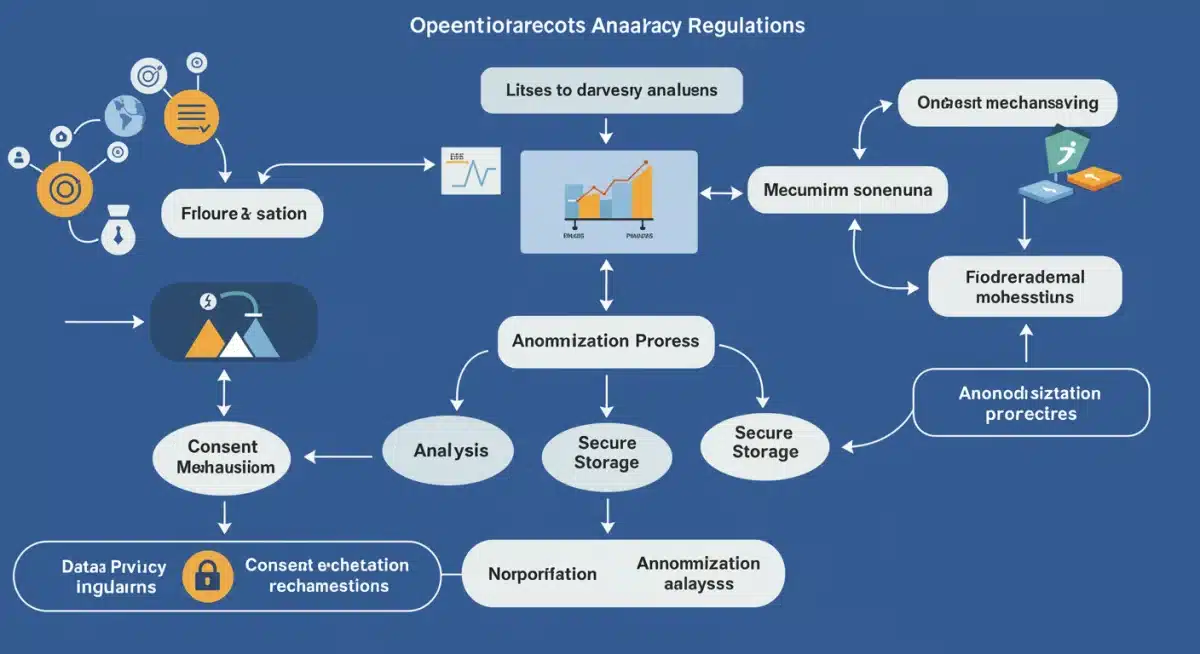
Privacy-Preserving Analytics Techniques
New techniques like differential privacy, which adds statistical noise to datasets to protect individual identities while retaining aggregate patterns, are becoming essential. Similarly, synthetic data generation, creating artificial datasets that mimic the statistical properties of real data without containing any actual personal information, offers a promising avenue for robust analysis.
- Shift to Aggregated Insights: Prioritizing reporting based on large groups or segments rather than individual user behavior.
- Adopting Privacy-Enhancing Technologies (PETs): Investing in tools and methodologies like differential privacy, homomorphic encryption, and secure multi-party computation.
- Ethical AI and Machine Learning: Ensuring that AI models used for analytics are trained on compliant data and do not inadvertently perpetuate biases or privacy violations.
The reporting aspect also requires careful consideration. Analytics dashboards and reports must clearly indicate the privacy-preserving measures taken and any limitations these might impose on data granularity. Transparency in reporting builds trust, both internally and with external stakeholders. By mid-2025, these advanced analytical capabilities should be fully integrated into daily operations.
The Role of Technology and Automation in Compliance
Meeting the demands of new data privacy regulations without overwhelming internal resources requires a significant reliance on technology and automation. Manual processes for consent management, data mapping, deletion requests, and compliance auditing are simply not scalable or sustainable in the face of increasingly complex legal requirements.
Investing in specialized privacy technology solutions, often referred to as Privacy-Enhancing Technologies (PETs) or Governance, Risk, and Compliance (GRC) tools, is no longer optional. These platforms can automate many of the tedious and error-prone tasks associated with privacy compliance, freeing up analytics and legal teams to focus on strategic initiatives.
Leveraging Automation for Efficiency and Accuracy
Automation plays a critical role in ensuring consistency and accuracy across all data privacy processes. From automatically updating consent preferences across integrated systems to scheduling regular data deletion routines, technology can significantly reduce the risk of human error and ensure timely compliance. This proactive approach helps organizations stay ahead of potential regulatory challenges.
- Automated Consent Management Platforms (CMPs): Streamlining the process of obtaining, managing, and enforcing user consent across all digital touchpoints.
- Data Discovery and Classification Tools: Automatically identifying and categorizing personal data across various systems, crucial for data mapping and deletion requests.
- Automated Compliance Auditing: Implementing tools that continuously monitor data processing activities against regulatory requirements, providing real-time alerts for potential non-compliance.
Furthermore, the integration of privacy controls directly into core analytics platforms and data warehouses is essential. This ‘privacy by design’ approach ensures that data protection is not an afterthought but an integral component of the entire data infrastructure. By mid-2025, these technological integrations should be mature and fully operational across the enterprise.
Strategic Planning for Mid-2025: A Proactive Approach
The approaching deadline of mid-2025 emphasizes the urgency for businesses to adopt a proactive and strategic approach to data privacy compliance. Waiting for enforcement actions or further legislative changes is a risky strategy that can lead to significant financial penalties, reputational damage, and loss of consumer trust. A comprehensive strategy involves cross-functional collaboration and continuous adaptation.
Developing a robust roadmap for compliance requires input from legal, IT, marketing, and analytics teams. This collaborative effort ensures that all aspects of data handling, from initial collection to final reporting, are aligned with regulatory requirements and best practices. It’s about embedding privacy into the organizational culture, not just treating it as a checklist item.
Key Steps for a Successful Adaptation Strategy
Organizations should prioritize a phased implementation plan, starting with a thorough audit of current data practices and identifying areas of non-compliance. This baseline assessment is critical for understanding the scope of work required. Following this, clear objectives, timelines, and resource allocation should be established to guide the adaptation process.
- Comprehensive Data Privacy Audit: A thorough review of all data collection, processing, storage, and sharing practices against current and anticipated regulations.
- Cross-Functional Privacy Task Force: Establishing a dedicated team with representatives from legal, IT, marketing, and analytics to drive compliance initiatives.
- Continuous Employee Training: Regular training sessions for all employees who handle personal data, ensuring they understand their roles and responsibilities in maintaining privacy.
Moreover, staying informed about new legislative developments is an ongoing process. Subscribing to regulatory updates, participating in industry forums, and engaging with legal counsel specializing in data privacy are crucial for maintaining compliance in a dynamic environment. By mid-2025, organizations need to demonstrate not just compliance, but a culture of privacy.
| Key Point | Brief Description |
|---|---|
| Evolving Regulations | New US state privacy laws and expanded data definitions demand constant vigilance and adaptation. |
| Analytics Impact | Direct effects on data collection (consent), storage (deletion rights), and reporting (privacy-preserving models). |
| Adaptation by Mid-2025 | Urgent need for strategic planning, technology adoption, and cultural shifts towards privacy-by-design. |
| Technological Solutions | Automation, CMPs, and PETs are crucial for efficient and accurate compliance management. |
Frequently Asked Questions About US Data Privacy and Analytics
The most significant changes include new state-level comprehensive privacy laws taking effect, expanded definitions of personal data, and enhanced consumer rights like data deletion and opt-out options, all directly impacting how analytics teams collect and process user information.
Explicit consent mandates users actively agree to data collection for specific purposes. This reduces the volume of trackable data, especially for third-party advertising, pushing analytics teams to rely more on first-party data and privacy-preserving techniques like aggregated insights.
PETs, such as differential privacy and synthetic data, enable organizations to extract valuable insights from data while protecting individual privacy. They are crucial for maintaining analytical capabilities in a regulatory environment that restricts direct use of personal identifiers.
By mid-2025, businesses should conduct comprehensive data audits, implement robust consent management platforms, invest in automated compliance tools, re-evaluate analytics models for privacy-by-design, and foster a culture of continuous privacy training across all departments.
To ensure compliance, businesses should implement a unified privacy framework that meets the strictest requirements across all operating states, utilize geo-fencing for data collection, conduct regular legal reviews, and employ flexible consent management platforms that adapt to regional regulations.
Conclusion
The evolving landscape of US data privacy regulations presents both challenges and opportunities for analytics practices. The last three months have underscored the accelerating pace of legislative change, demanding immediate attention and strategic planning. By mid-2025, organizations must have fully integrated privacy-by-design principles, leveraged advanced technologies for compliance, and cultivated an organizational culture that prioritizes data protection. This proactive approach will not only ensure regulatory adherence but also build a stronger foundation of trust with consumers, ultimately enhancing long-term business value in an increasingly privacy-conscious world.