Optimize Marketing Spend with Data Analytics: 3:1 ROI in 90 Days

Achieving a 3:1 ROI within 90 days for US companies requires a strategic shift towards data-driven marketing, leveraging advanced analytics to precisely allocate resources and continuously refine campaign performance.
In today’s competitive landscape, US companies face increasing pressure to demonstrate tangible returns on their marketing investments. The goal of optimizing marketing spend with data analytics to achieve a 3:1 ROI within 90 days is not merely ambitious; it’s an achievable necessity. This guide will explore how leveraging robust data strategies can transform your marketing efforts from guesswork into a precise, predictive science, ensuring every dollar spent works harder for your business.
The imperative of data-driven marketing in 2025
The marketing world in 2025 is fundamentally shaped by data. Companies that fail to embrace data analytics risk falling behind competitors who are already using insights to gain a significant edge. The imperative isn’t just about collecting data; it’s about transforming raw information into actionable strategies that directly impact the bottom line.
Understanding customer behavior, market trends, and campaign performance through data allows for unparalleled precision in marketing. This precision is what drives the efficiency needed to hit aggressive ROI targets. Without a solid data foundation, marketing decisions are often based on intuition, which is rarely sufficient for sustained, high-level performance.
Shifting from intuition to insight
Historically, marketing relied heavily on creative intuition and broad demographic targeting. While creativity remains vital, its effectiveness is amplified when guided by data. Data analytics provides a clear picture of what works, for whom, and why, enabling marketers to refine their approach continuously.
- Identify high-performing channels and campaigns.
- Understand customer journeys and touchpoints.
- Personalize messaging for higher engagement.
- Allocate budget more effectively to maximize impact.
The transition to a data-driven model requires commitment from leadership and investment in the right tools and talent. It’s a cultural shift that prioritizes evidence over assumption, leading to more predictable and robust marketing outcomes.
Ultimately, the ability to analyze and react to data quickly will define market leaders in 2025. This proactive approach ensures that marketing spend is not just optimized, but also agile enough to adapt to rapidly changing market conditions and consumer preferences.
Establishing your data foundation: collection and integration
Before any meaningful analysis can occur, a robust data foundation must be in place. This involves systematically collecting data from all relevant sources and integrating it into a cohesive, accessible system. Fragmented data leads to incomplete insights, hindering optimization efforts.
Key data sources typically include website analytics, CRM systems, social media platforms, email marketing tools, advertising platforms, and offline sales data. The challenge lies in bringing all these disparate datasets together in a way that allows for a holistic view of the customer and campaign performance.
Key data points for marketing optimization
Focusing on the right data points is crucial. Not all data is equally valuable. Prioritize metrics that directly correlate with your marketing objectives and ROI goals. This often includes conversion rates, customer acquisition cost (CAC), customer lifetime value (CLTV), engagement rates, and return on ad spend (ROAS).
- Website traffic and user behavior (e.g., bounce rate, time on page).
- Lead generation and conversion metrics.
- Campaign-specific performance data (e.g., click-through rates, impressions).
- Customer demographics and psychographics.
Data integration is best achieved through a centralized data warehouse or a customer data platform (CDP). These systems allow for the consolidation, cleaning, and standardization of data, making it ready for analysis. Without proper integration, data silos prevent a unified understanding of your marketing ecosystem.
Investing in the right data collection and integration infrastructure is foundational to any successful marketing optimization strategy. It ensures that the insights generated are accurate, comprehensive, and ultimately, actionable for achieving a 3:1 ROI.
Leveraging advanced analytics for actionable insights
Once data is collected and integrated, the real work of generating insights begins. Advanced analytics goes beyond simple reporting, employing sophisticated techniques to uncover patterns, predict future outcomes, and prescribe optimal actions. This is where the magic happens for optimizing marketing spend.
Techniques like predictive modeling, machine learning, and attribution modeling are becoming indispensable. Predictive analytics can forecast customer churn or future purchase behavior, allowing for proactive marketing interventions. Machine learning can identify subtle correlations in vast datasets that human analysts might miss.
Attribution modeling for precise ROI measurement
Understanding which marketing touchpoints contribute to conversions is critical for accurate ROI calculation. Traditional last-click attribution often undervalues earlier interactions. Advanced attribution models, such as multi-touch or algorithmic models, provide a more accurate picture of each channel’s contribution.
- Linear attribution: Assigns equal credit to all touchpoints.
- Time decay attribution: Gives more credit to recent interactions.
- Positional attribution: Credits first and last touchpoints more heavily.
- Algorithmic attribution: Uses data science to determine custom weights.
By implementing sophisticated attribution modeling, companies can precisely understand the true ROI of each marketing channel and campaign. This allows for intelligent budget reallocation, moving spend from underperforming areas to those that deliver the highest returns, directly contributing to the 3:1 ROI goal.
The insights derived from advanced analytics empower marketers to make data-backed decisions with confidence. This shifts the focus from simply spending money to strategically investing it where it will yield the greatest impact, making the 90-day ROI target a realistic objective.
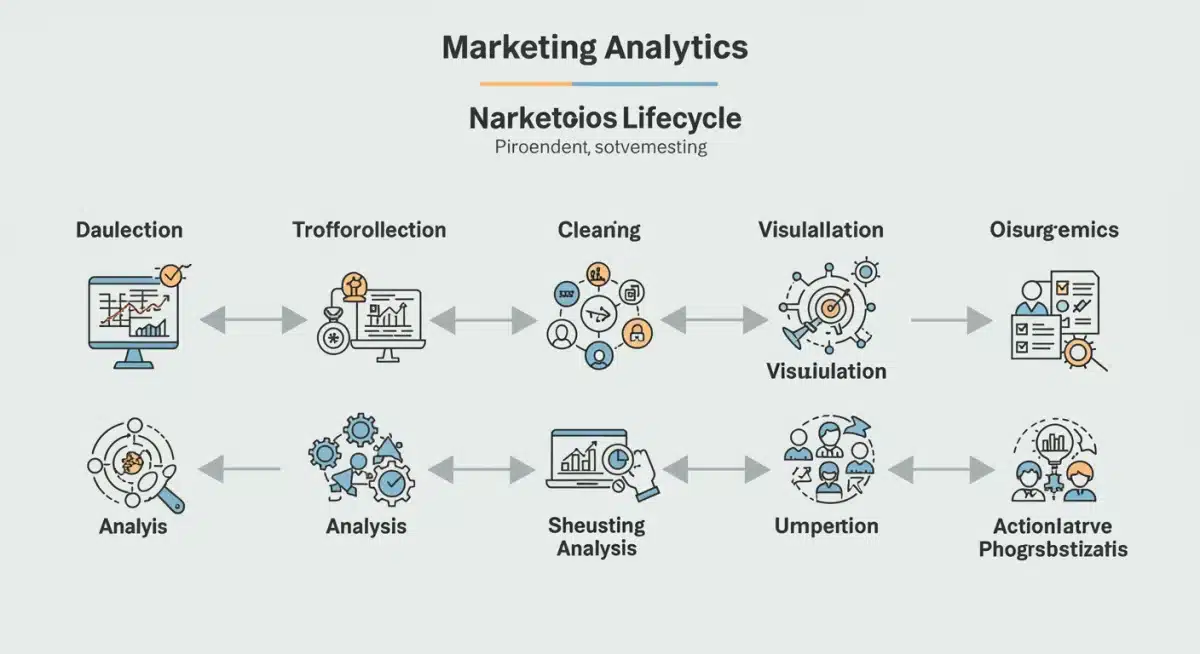
Strategic budget allocation and continuous optimization
With actionable insights in hand, the next step is to strategically allocate your marketing budget and establish a framework for continuous optimization. This iterative process is key to not only reaching but sustaining a 3:1 ROI.
Budget allocation should be dynamic, not static. Based on real-time performance data and predictive analytics, funds should be shifted to channels and campaigns that demonstrate the highest potential for return. This agility allows companies to capitalize on emerging opportunities and mitigate underperforming efforts quickly.
A/B testing and experimentation
Continuous optimization relies heavily on methodical experimentation. A/B testing various elements of your campaigns – from ad copy and visuals to landing page designs and call-to-actions – provides empirical evidence of what resonates best with your target audience. Every test is an opportunity to learn and improve.
- Test different ad creatives and messaging.
- Experiment with various bidding strategies.
- Optimize landing page layouts for conversions.
- Refine audience targeting parameters.
Beyond A/B testing, consider multivariate testing for more complex interactions between variables. The goal is to create a culture of continuous learning and improvement, where every campaign launch is a hypothesis to be tested, and every result provides valuable data for the next iteration.
This systematic approach to budget allocation and optimization ensures that your marketing spend is always working at its peak efficiency. It’s the engine that drives consistent improvement and makes achieving a 3:1 ROI within a tight 90-day window a tangible reality.
Measuring and reporting ROI: beyond the basics
Accurately measuring and reporting ROI is fundamental to proving the value of marketing efforts and securing continued investment. In 2025, this goes far beyond simple revenue-to-spend ratios, incorporating a more nuanced view of marketing’s impact.
While a 3:1 ROI is a clear quantitative goal, it’s essential to understand the qualitative factors that contribute to it. This includes brand lift, customer sentiment, and long-term customer value, all of which can be influenced by marketing activities even if they don’t immediately manifest as direct revenue.
Key metrics for comprehensive ROI reporting
To provide a complete picture of marketing effectiveness, reporting should include a mix of financial and operational metrics. This allows stakeholders to understand both the direct monetary returns and the broader impact on business growth and customer relationships.
- Return on Ad Spend (ROAS): Direct revenue generated per dollar spent on advertising.
- Customer Lifetime Value (CLTV): Total revenue expected from a customer over their relationship with your company.
- Customer Acquisition Cost (CAC): The cost to acquire a new customer.
- Marketing Originated Revenue: Percentage of new revenue generated by marketing efforts.
- Marketing Influenced Revenue: Percentage of total revenue that marketing touched at any point.
Effective reporting also involves clear visualization of data, making complex insights accessible to all stakeholders. Dashboards customized for different audiences – from marketing teams to executive leadership – ensure that everyone has the information they need to understand performance and make informed decisions.
By moving beyond basic ROI calculations to a more comprehensive measurement framework, US companies can fully articulate the value of their optimized marketing spend. This transparency builds trust and reinforces the strategic importance of data-driven marketing.
Implementing technology and fostering a data culture
Achieving and sustaining a 3:1 ROI through data analytics requires not only strategic processes but also the right technological infrastructure and a strong data-driven culture within the organization. Technology acts as the enabler, while culture ensures its effective utilization.
Investing in marketing technology (MarTech) stacks that include advanced analytics platforms, CDPs, automation tools, and business intelligence (BI) dashboards is crucial. These tools automate data collection, streamline analysis, and facilitate the dissemination of insights across teams.
Building a data-literate team
Even the most sophisticated technology is only as good as the people using it. Fostering a data culture means empowering every member of the marketing team to understand, interpret, and act upon data. This often involves ongoing training and development programs.
- Provide training on analytics tools and methodologies.
- Encourage cross-functional collaboration around data insights.
- Establish clear data governance policies.
- Promote a mindset of continuous learning and experimentation.
A data-first culture ensures that data analytics is not just an isolated function but an integrated part of every marketing decision. When teams are comfortable with data, they are more likely to identify opportunities for optimization, experiment with new approaches, and ultimately drive better results.
The combination of cutting-edge technology and a deeply ingrained data culture creates a powerful synergy. This enables US companies to not only achieve their 3:1 ROI target within 90 days but also to maintain a competitive edge in the long run by continually optimizing their marketing spend.
| Key Focus Area | Action for 3:1 ROI |
|---|---|
| Data Foundation | Integrate all marketing data sources for a unified view. |
| Advanced Analytics | Implement attribution modeling to pinpoint effective channels. |
| Budget Optimization | Continuously reallocate spend based on real-time campaign performance. |
| Data Culture | Train teams to interpret and act on data for informed decisions. |
Frequently asked questions about marketing spend optimization
A 3:1 ROI means for every dollar spent on marketing, three dollars are generated in return. This benchmark is crucial as it indicates a healthy, profitable marketing operation, allowing for sustainable growth and reinvestment, particularly vital for competitive US markets.
While comprehensive transformation takes time, significant improvements in marketing spend efficiency and initial ROI gains can often be observed within 90 days. This accelerated timeline is achievable through focused data integration, rapid A/B testing, and agile budget reallocation strategies.
Key challenges include data silos, lack of skilled analysts, resistance to change within the organization, and choosing the right technology stack. Overcoming these requires strategic planning, investment in training, and fostering a culture that values data-backed decisions.
Essential tools include web analytics platforms (e.g., Google Analytics 4), customer relationship management (CRM) systems, customer data platforms (CDPs), advertising platform analytics, and business intelligence (BI) dashboards. The specific combination depends on a company’s size and complexity.
Attribution modeling provides a clearer understanding of which marketing touchpoints contribute to conversions, allowing for more accurate ROI measurement and strategic budget allocation. By moving beyond last-click, companies can credit channels more fairly and optimize spend effectively.
Conclusion
Achieving a 3:1 ROI within 90 days for US companies by optimizing marketing spend with data analytics is a demanding yet entirely attainable objective. It requires a commitment to building a robust data foundation, leveraging advanced analytics for deep insights, embracing a dynamic approach to budget allocation, and fostering a pervasive data-driven culture. By meticulously implementing these strategies, businesses can transform their marketing investments into powerful engines of growth, ensuring every dollar spent contributes meaningfully to their success in 2025 and beyond.
Related Posts: