US Data Governance Best Practices for Compliance & Value by Q3 2025

Implementing robust US data governance practices is paramount for enterprises seeking to meet regulatory compliance and significantly enhance data value by Q3 2025, requiring a proactive and integrated approach to data management.
As the digital landscape evolves at an unprecedented pace, enterprises in the United States face increasing pressure to manage their data effectively. The imperative to adopt robust US data governance practices for ensuring compliance and maximizing data value by Q3 2025 has never been more critical. This isn’t merely about avoiding penalties; it’s about transforming data into a strategic asset that drives innovation and competitive advantage.
Understanding the Evolving Data Governance Landscape
The regulatory environment surrounding data in the US is dynamic, with new laws and amendments constantly emerging. Enterprises must not only understand these changes but also anticipate future shifts to build a resilient data governance framework.
This proactive stance ensures that data practices remain compliant and adaptable, safeguarding against potential legal and financial repercussions while fostering trust with customers and stakeholders.
Key Regulatory Drivers in the US
Several regulations significantly influence how US enterprises manage data. Understanding these specific mandates is the first step towards achieving compliance and establishing a strong governance foundation. These frameworks often dictate how data is collected, stored, processed, and shared.
- CCPA/CPRA: The California Consumer Privacy Act (CCPA) and its amendment, the California Privacy Rights Act (CPRA), set stringent requirements for personal data handling, granting consumers significant rights over their information.
- HIPAA: The Health Insurance Portability and Accountability Act dictates standards for protecting sensitive patient health information, crucial for healthcare providers and related entities.
- GDPR (Extraterritorial Impact): While a European regulation, the General Data Protection Regulation impacts US enterprises that process personal data of EU citizens, necessitating a global approach to data privacy.
- State-Specific Privacy Laws: Beyond California, states like Virginia (VCDPA), Colorado (CPA), and Utah (UCPA) have enacted their own comprehensive data privacy laws, creating a complex web of compliance requirements.
The evolving nature of these regulations demands continuous monitoring and adjustment of data governance policies. Enterprises must establish mechanisms to track legislative changes and assess their impact on current data practices.
In conclusion, a thorough understanding of the US regulatory landscape is foundational for any effective data governance strategy. It provides the necessary context for developing policies that protect data, ensure compliance, and build consumer confidence.
Establishing a Robust Data Governance Framework
Building a strong data governance framework is essential for any US enterprise aiming to manage its data assets effectively. This involves defining clear roles, responsibilities, and processes that guide all data-related activities from creation to disposition.
A well-structured framework provides the necessary backbone for data quality, security, and compliance, enabling the organization to leverage its data for strategic decisions.
Defining Data Ownership and Stewardship
One of the initial steps in establishing a framework is to clearly define who owns the data and who is responsible for its stewardship. This often involves assigning specific individuals or departments to oversee particular data sets.
Data owners are typically senior business leaders who make strategic decisions about data, while data stewards are responsible for the day-to-day management, quality, and access controls for specific data elements.
- Clear Accountability: Establishes who is responsible for data quality, security, and compliance within specific domains.
- Improved Data Quality: Stewards actively monitor and improve the accuracy, completeness, and consistency of data.
- Enhanced Trust: Clear ownership fosters confidence in data reliability, supporting better decision-making across the enterprise.
- Regulatory Adherence: Ensures that data handling practices align with legal and industry standards.
Without clear definitions of ownership and stewardship, data management can become fragmented, leading to inconsistencies, quality issues, and increased compliance risks. This foundational element underpins all other aspects of data governance.
Ultimately, a robust data governance framework is not a one-time project but an ongoing commitment. It requires continuous review, adaptation, and improvement to meet the evolving needs of the enterprise and the regulatory environment.
Implementing Data Quality and Master Data Management
High-quality data is the lifeblood of any successful enterprise, enabling accurate analytics and informed decision-making. Implementing strong data quality initiatives and master data management (MDM) are critical components of effective data governance.
These practices ensure that data is accurate, consistent, and reliable across all systems, maximizing its value and reducing operational inefficiencies.
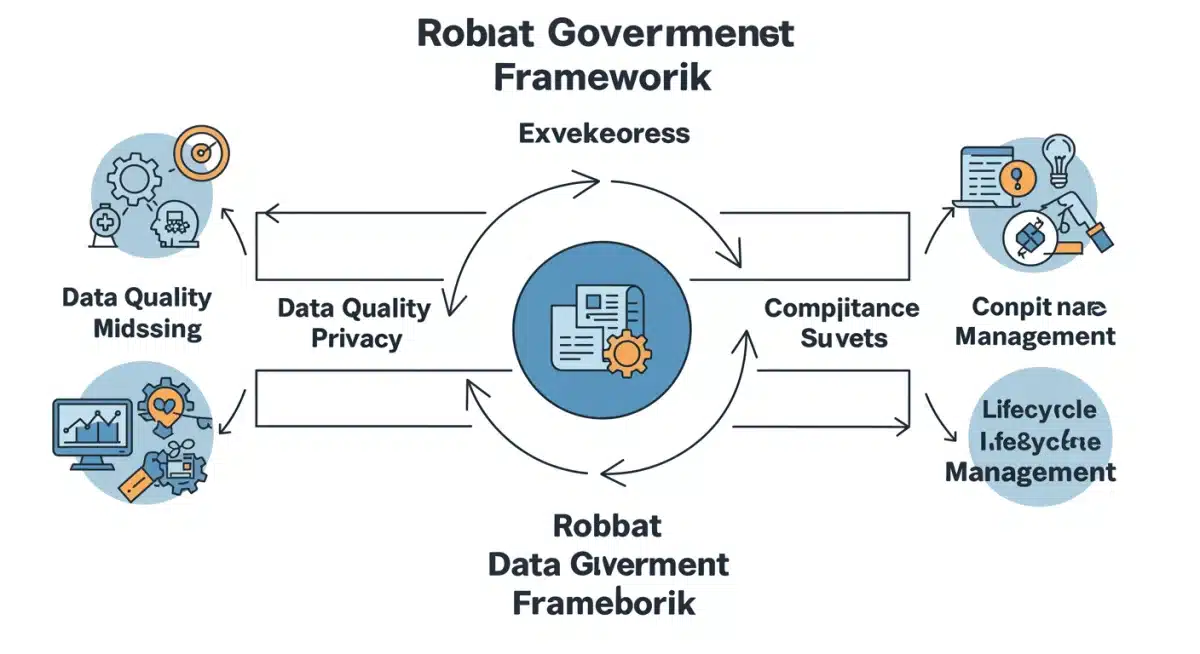
Strategies for Data Quality Improvement
Improving data quality involves a systematic approach to identifying, correcting, and preventing errors. This process is continuous and requires dedicated resources and clear methodologies. Data profiling, data cleansing, and data validation are key activities.
Establishing data quality rules and metrics allows enterprises to measure progress and ensure ongoing adherence to defined standards. Automated tools can significantly aid in this process by proactively identifying anomalies.
- Profiling Data: Regularly analyze data to discover its structure, content, and quality issues.
- Cleansing Data: Correct or remove incorrect, corrupted, or duplicate data from datasets.
- Standardizing Data: Ensure data conforms to a unified format and set of definitions across the organization.
- Monitoring Data: Continuously track data quality metrics to identify and address new issues promptly.
Master Data Management (MDM) focuses on creating a single, authoritative source of master data for key business entities like customers, products, and locations. This eliminates redundancy and ensures consistency across various applications and departments.
By effectively managing master data, enterprises can improve operational efficiency, enhance customer experience, and reduce compliance risks associated with inconsistent information. MDM is a strategic investment that pays dividends in data integrity and business intelligence.
In summary, prioritizing data quality and implementing MDM are non-negotiable for US enterprises seeking to leverage their data assets fully. These practices lay the groundwork for reliable analytics and robust compliance.
Ensuring Data Privacy and Security Compliance
In an era of increasing cyber threats and stringent privacy regulations, ensuring data privacy and security is paramount for US enterprises. A breach can lead to significant financial penalties, reputational damage, and loss of customer trust.
Effective data governance integrates robust privacy and security measures into every aspect of data handling, from collection to deletion.
Implementing Data Security Measures
Data security encompasses a range of technical and organizational measures designed to protect data from unauthorized access, use, disclosure, disruption, modification, or destruction. This involves a multi-layered approach.
Encryption, access controls, intrusion detection systems, and regular security audits are foundational elements. Employee training on security best practices is equally vital to mitigate human error.
Data privacy, distinct from security, focuses on the proper handling and protection of personal information according to legal and ethical guidelines. It involves respecting individuals’ rights regarding their data.
This includes obtaining consent, providing transparency about data usage, and enabling individuals to access, correct, or delete their personal information as mandated by regulations like CCPA/CPRA.
- Data Minimization: Collect only the necessary data for a specific purpose, reducing the risk exposure.
- Purpose Limitation: Use collected data only for the purpose for which it was originally gathered.
- Consent Management: Implement clear processes for obtaining, recording, and managing user consent for data processing.
- Breach Response Plan: Develop and regularly test a comprehensive plan for responding to data breaches, including notification procedures.
Regular assessments and updates to security and privacy protocols are crucial to keep pace with evolving threats and regulatory changes. This proactive stance is a cornerstone of responsible data governance.
Ultimately, a strong commitment to data privacy and security compliance not only protects the enterprise but also builds invaluable trust with its customer base, fostering long-term relationships.
Leveraging Data for Business Value and Innovation
Beyond compliance and risk mitigation, a primary objective of robust data governance is to unlock and maximize the inherent business value of data. Data, when properly managed and analyzed, becomes a powerful engine for innovation and competitive advantage.
US enterprises must shift their perspective from viewing data as merely a liability to recognizing its potential as a strategic asset that drives growth and efficiency.
Enabling Advanced Analytics and AI
High-quality, well-governed data is the foundation for effective advanced analytics and artificial intelligence (AI) initiatives. Without reliable data, the insights generated by these technologies can be flawed or misleading.
Data governance ensures that data used for analytics is accurate, complete, and consistent, leading to more trustworthy models and predictions. This enables enterprises to make more informed decisions.
By establishing clear data lineage and metadata management, data scientists and analysts can easily discover, understand, and trust the data they are using. This accelerates the development and deployment of AI models.
- Improved Decision-Making: Access to reliable data leads to more accurate insights and better strategic choices.
- Enhanced Customer Experience: Personalized products and services driven by data analysis can significantly improve customer satisfaction.
- Operational Efficiency: Data insights can optimize processes, reduce waste, and improve resource allocation.
- New Revenue Streams: Identifying market trends and customer needs through data can lead to the creation of innovative products or services.
Furthermore, data governance fosters a culture of data literacy across the organization, empowering employees at all levels to understand and utilize data effectively in their roles. This broadens the impact of data-driven initiatives.
Therefore, by prioritizing data governance, US enterprises are not just meeting regulatory mandates but are actively investing in their future growth and capacity for innovation in a data-driven economy.
Preparing for Future Data Governance Challenges by Q3 2025
The landscape of data governance is constantly evolving, driven by technological advancements, shifting regulatory priorities, and changing consumer expectations. US enterprises must adopt a forward-looking approach to stay ahead of future challenges and opportunities by Q3 2025.
This involves anticipating emerging trends and building agile data governance structures that can adapt quickly to new demands.
Anticipating Emerging Technologies and Regulations
New technologies such as quantum computing, advanced AI, and blockchain present both opportunities and governance challenges. Enterprises need to assess how these technologies will impact data handling and privacy.
Similarly, the trend towards more granular state-level privacy laws and potential federal privacy legislation requires continuous vigilance and preparation for compliance with diverse requirements.
Building a flexible data architecture that can integrate new data sources and technologies while maintaining governance controls is crucial. This agility allows enterprises to innovate without compromising compliance or data integrity.
- Proactive Regulatory Scanning: Regularly monitor legislative bodies for upcoming data privacy and security laws.
- Technology Impact Assessments: Evaluate new technologies for their potential data governance implications before adoption.
- Upskilling Data Professionals: Invest in training for data teams to handle new data types and governance complexities.
- Cross-Functional Collaboration: Foster cooperation between legal, IT, and business units to address future challenges holistically.
Moreover, establishing a culture of ethical data use will become increasingly important. As AI systems become more autonomous, the ethical implications of data collection and algorithmic decision-making will require careful governance.
In conclusion, preparing for future data governance challenges is not about predicting the exact future but about building an adaptive, resilient, and ethically sound framework that can navigate uncertainty and ensure sustained compliance and value.
| Key Point | Brief Description |
|---|---|
| Regulatory Awareness | Continuously monitor and adapt to evolving US data privacy laws like CCPA/CPRA and state-specific regulations. |
| Framework Implementation | Establish clear roles, data ownership, and stewardship to ensure consistent data quality and accountability. |
| Data Quality & MDM | Implement strategies for data cleansing, standardization, and Master Data Management to maximize data reliability and value. |
| Future Readiness | Prepare for emerging technologies and regulatory shifts by building an agile and ethically sound governance framework. |
Frequently Asked Questions About Data Governance
▼
Data governance is the overall management of the availability, usability, integrity, and security of data used in an enterprise. It’s crucial for US enterprises to ensure compliance with diverse regulations, reduce risks, improve data quality, and unlock data’s full potential for strategic decision-making and innovation.
▼
Regulations such as CCPA/CPRA significantly impact data governance by imposing strict requirements on how personal data is collected, processed, and stored. They grant consumers greater rights over their data, necessitating robust policies for consent management, data access requests, and clear data privacy notices to ensure compliance.
▼
An effective data governance framework includes defining data ownership and stewardship, establishing data quality standards, implementing robust data security and privacy measures, maintaining comprehensive metadata, and developing clear policies for data lifecycle management. These components work together to ensure data integrity and compliance.
▼
By ensuring data quality, consistency, and accessibility, data governance provides a reliable foundation for advanced analytics and AI. This leads to more accurate insights, better decision-making, enhanced customer experiences through personalization, and the identification of new opportunities, ultimately driving innovation and competitive advantage.
▼
Enterprises should proactively monitor emerging regulations, assess the data governance implications of new technologies like AI and blockchain, invest in continuous training for data professionals, and foster cross-functional collaboration. Building an agile and ethically-driven governance framework is key to adapting to future demands and maintaining trust.
Conclusion
The journey towards optimal data governance for US enterprises is continuous, demanding strategic foresight and unwavering commitment. By Q3 2025, organizations that have proactively implemented robust data governance practices will not only meet compliance requirements but will also transform their data into a powerful asset. This transformation fosters innovation, enhances decision-making, and builds crucial trust with customers and stakeholders, positioning them for sustained success in an increasingly data-driven world.