Leveraging 5G for Business Growth: 2025 US Opportunities
5G technology is set to revolutionize US businesses by 2025, offering critical opportunities for enhanced connectivity, advanced IoT deployments, and seamless AI integration to drive unprecedented growth and competitive advantage.
By: Eduarda Moura on September 17, 2025
Last updated on: November 28, 2025
5G technology is set to revolutionize US businesses by 2025, offering critical opportunities for enhanced connectivity, advanced IoT deployments, and seamless AI integration to drive unprecedented growth and competitive advantage.
In the rapidly evolving digital landscape, understanding and harnessing the power of 5G is no longer an option but a strategic imperative for US companies. Leveraging 5G for business growth in 2025 presents a transformative pathway, unlocking unprecedented opportunities for innovation, efficiency, and market expansion. This guide will delve into the critical areas where 5G is poised to make the most significant impact, helping businesses navigate this new era of hyper-connectivity and secure a competitive edge.
Understanding the 5G Landscape in 2025 for US Businesses
By 2025, 5G will have moved beyond early adoption and become a foundational technology for many industries across the United States. Its unique capabilities, such as ultra-low latency, massive connectivity, and significantly higher bandwidth, are creating a new paradigm for how businesses operate and interact with their customers. This widespread availability and maturity mean that companies can now reliably plan and implement 5G-driven strategies, moving from pilot programs to full-scale deployment.
The infrastructure build-out, while still ongoing, will have reached a critical mass, ensuring that a significant portion of urban and suburban areas, along with key industrial zones, have robust 5G coverage. This improved accessibility will democratize advanced technological applications, allowing businesses of all sizes to tap into capabilities previously reserved for large enterprises. Understanding this foundational shift is the first step towards effectively integrating 5G into core business functions.
The Evolution of 5G Connectivity
The journey of 5G has been marked by continuous advancements, with 2025 representing a crucial inflection point. Networks are becoming more stable and optimized, offering a blend of speed and reliability that previous generations of wireless technology could not match. This evolution directly translates into tangible benefits for businesses seeking to enhance their digital operations.
Enhanced Mobile Broadband (eMBB): Delivering significantly faster speeds and greater capacity for mobile devices, enabling richer content experiences and more efficient remote work.
Ultra-Reliable Low-Latency Communications (URLLC): Crucial for real-time applications, such as autonomous vehicles, remote surgery, and industrial automation, where even milliseconds of delay can have critical consequences.
Massive Machine-Type Communications (mMTC): Supporting the connection of millions of IoT devices per square kilometer, vital for smart cities, agriculture, and large-scale sensor networks.
These core capabilities are not just technical specifications; they are the building blocks for new business models and operational efficiencies. Companies that grasp the nuances of each will be better positioned to select and implement the most appropriate 5G solutions for their specific needs, ensuring that their investments yield maximum returns.
In conclusion, the 2025 5G landscape in the US is characterized by widespread availability, mature technology, and a clear understanding of its diverse capabilities. Businesses must recognize 5G as more than just faster internet; it is a catalyst for fundamental change across various operational and strategic domains.
Opportunity 1: Transforming Operations with Enhanced Connectivity
One of the most immediate and impactful opportunities for US companies leveraging 5G in 2025 lies in transforming their operational infrastructure through enhanced connectivity. The sheer speed and reliability of 5G networks enable a level of real-time data processing and communication that can redefine supply chain management, logistics, and internal workflows. This isn’t merely about faster internet; it’s about creating an always-on, highly responsive operational environment.
Businesses can re-imagine their physical spaces, from manufacturing floors to retail stores, as interconnected ecosystems. The ability to seamlessly transfer vast amounts of data without lag allows for immediate decision-making, predictive maintenance, and dynamic resource allocation. This operational overhaul can lead to significant cost reductions, increased productivity, and a more agile business response to market demands.
Revolutionizing Supply Chain and Logistics
5G’s low latency and high bandwidth are game-changers for supply chain optimization. Real-time tracking of goods, from raw materials to final delivery, becomes highly precise and efficient. This allows companies to identify bottlenecks instantly, reroute shipments, and manage inventory with unprecedented accuracy, minimizing waste and improving delivery times.
Real-time Asset Tracking: Utilizing 5G-enabled IoT sensors for precise location and condition monitoring of goods during transit.
Automated Warehousing: Deploying 5G-connected autonomous robots and drones for inventory management, picking, and packing, significantly speeding up operations.
Predictive Logistics: Leveraging AI and machine learning, powered by 5G data, to forecast demand, optimize routes, and anticipate potential disruptions.
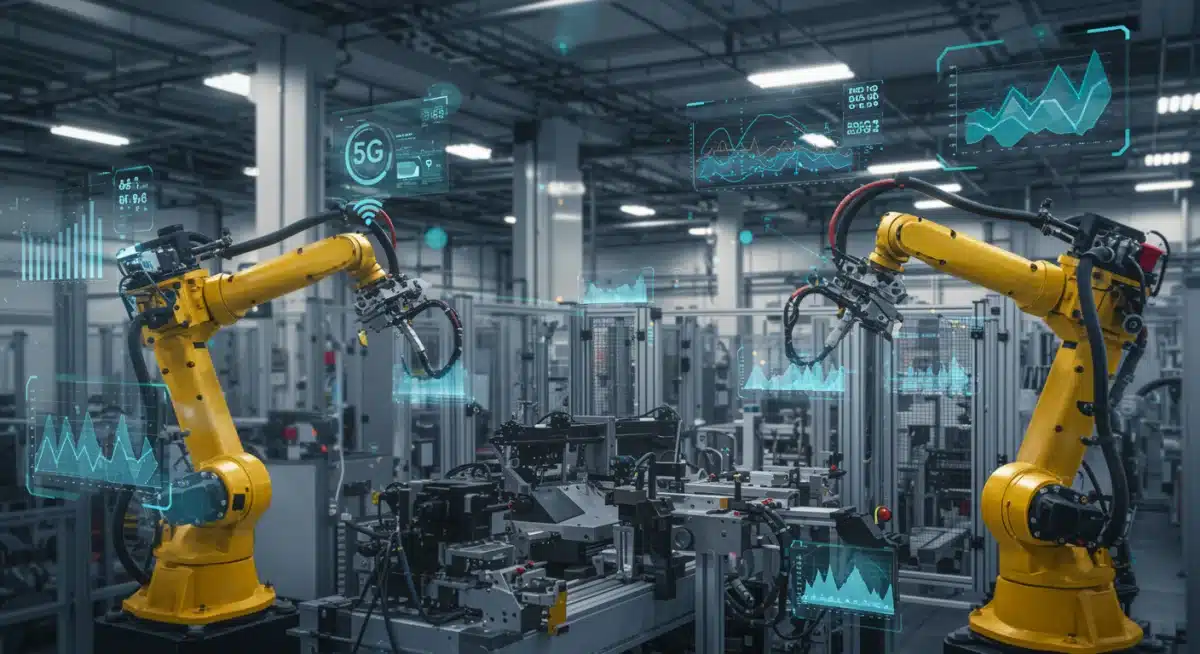
Beyond tracking, 5G facilitates the creation of ‘smart ports’ and ‘smart factories’ where every component, vehicle, and piece of machinery communicates seamlessly. This integrated approach reduces human error, enhances safety, and drives a new era of operational excellence.
Streamlining Internal Workflows and Collaboration
Within the corporate environment, 5G enables a more fluid and efficient approach to internal operations. High-definition video conferencing without buffering, instant file transfers, and reliable access to cloud-based applications from anywhere transform how teams collaborate. For businesses with distributed teams or a significant remote workforce, 5G ensures a consistent and high-quality digital experience.
This enhanced connectivity also supports the deployment of advanced collaboration tools, such as augmented reality (AR) for remote assistance or virtual reality (VR) for immersive training. The ability to share complex 3D models or conduct detailed virtual inspections in real-time empowers employees and accelerates project timelines. The elimination of connectivity bottlenecks allows creativity and productivity to flourish, regardless of physical location.
In essence, 5G’s enhanced connectivity provides the backbone for a truly interconnected and intelligent operational framework. US companies that embrace this opportunity will see not just incremental improvements, but a fundamental shift in their efficiency and responsiveness, paving the way for sustainable growth.
Opportunity 2: Unleashing the Power of IoT and Edge Computing
The second major opportunity for US businesses with 5G in 2025 is directly linked to its synergy with the Internet of Things (IoT) and edge computing. While IoT has been growing for years, 5G provides the crucial network infrastructure needed to unlock its full potential, enabling massive deployments of connected devices and processing data closer to its source. This combination allows for unprecedented levels of automation, real-time insights, and personalized experiences across various sectors.
Edge computing, powered by 5G, means that data no longer needs to travel all the way to a centralized cloud for processing. Instead, it can be analyzed and acted upon at the network’s edge, significantly reducing latency and improving response times. This is vital for applications where immediate action is required, such as in autonomous systems, critical infrastructure monitoring, and advanced robotics.
Accelerating Smart City and Infrastructure Development
5G and IoT are foundational to the development of smart cities, offering solutions for urban challenges and improving quality of life. US companies involved in urban planning, utilities, and public services can leverage these technologies to create more efficient and responsive environments.
Smart Traffic Management: Real-time data from 5G-connected sensors and cameras to optimize traffic flow, reduce congestion, and improve public safety.
Utility Monitoring: Smart grids and water systems that use IoT sensors and 5G to detect anomalies, predict maintenance needs, and manage resources more efficiently.
Public Safety and Emergency Response: Enhanced communication for first responders, real-time video feeds from public spaces, and drone-based surveillance for rapid incident management.
These applications not only improve civic services but also open new markets for technology providers, system integrators, and data analytics firms. The sheer volume of data generated by these smart city initiatives creates opportunities for innovation in data monetization and urban problem-solving.
Driving Innovation in Manufacturing and Healthcare
In manufacturing, the combination of 5G, IoT, and edge computing facilitates the rise of Industry 4.0. Smart factories become truly intelligent, with every machine, robot, and product communicating in real-time. This enables hyper-customization, predictive maintenance, and entirely new levels of automation and efficiency. For healthcare, 5G and IoT are revolutionizing patient care, from remote monitoring to sophisticated surgical procedures.
Remote patient monitoring devices, powered by 5G, can transmit vital health data instantly and reliably, allowing healthcare providers to intervene proactively. Telemedicine becomes more robust, supporting high-definition video consultations and even remote diagnostics. In hospitals, 5G enables the deployment of robotic assistants for logistics and sanitation, freeing up human staff for direct patient care.
The synergy between 5G, IoT, and edge computing is not just about connecting more devices; it’s about creating intelligent systems that can learn, adapt, and act autonomously. For US businesses, this translates into unprecedented opportunities for innovation, cost savings, and the creation of entirely new products and services.
Opportunity 3: Integrating AI and Machine Learning for Competitive Advantage
The third pivotal opportunity for US companies in 2025 involves the seamless integration of Artificial Intelligence (AI) and Machine Learning (ML) capabilities, significantly amplified by the underlying power of 5G networks. While AI and ML have been transformative on their own, 5G acts as an accelerator, providing the necessary bandwidth and low latency for real-time AI processing, distributed AI models, and the efficient handling of massive datasets crucial for advanced analytics. This combination gives businesses an unparalleled competitive advantage, enabling smarter decision-making, hyper-personalization, and predictive insights.
The ability to collect, transmit, and process vast quantities of data from diverse sources at high speeds unlocks the full potential of AI. Whether it’s for customer behavior analysis, operational optimization, or developing innovative new products, 5G ensures that AI models have the fresh, comprehensive data they need to perform at their best. This integration moves AI from a theoretical advantage to a practical, deployable solution across the enterprise.
Enhancing Customer Experience and Personalization
5G-powered AI can revolutionize how businesses interact with their customers, leading to highly personalized experiences and improved satisfaction. By rapidly analyzing customer data streams, AI can offer real-time recommendations, provide intelligent support, and anticipate needs, creating a more engaging and responsive customer journey.
AI-driven Customer Service: 5G enables sophisticated AI chatbots and virtual assistants that can process complex queries and provide instant, accurate responses, reducing wait times and improving efficiency.
Hyper-personalized Marketing: Leveraging AI to analyze real-time customer behavior transmitted over 5G, businesses can deliver highly targeted ads, product recommendations, and content.
Immersive Retail Experiences: 5G supports AR/VR applications in retail, allowing customers to virtually try on clothes or visualize products in their homes, enhancing the shopping experience.
The speed of 5G means that these AI applications can operate without perceptible delay, making the customer experience feel seamless and intuitive. This level of personalization fosters stronger brand loyalty and drives repeat business, offering a significant differentiator in competitive markets.
Optimizing Data Analytics and Predictive Maintenance
For operational efficiency, the synergy between 5G and AI is equally profound. Businesses can deploy AI models that continuously monitor equipment, processes, and network performance, predicting potential failures before they occur. This predictive capability minimizes downtime, reduces maintenance costs, and extends the lifespan of critical assets.
In industries like manufacturing, energy, and transportation, 5G provides the conduit for massive sensor data to be fed into AI algorithms in real-time. This allows for dynamic adjustments to production lines, optimization of energy consumption, and proactive identification of safety hazards. The insights gained from 5G-enabled AI are not just descriptive but prescriptive, guiding businesses toward optimal outcomes.
The combination of 5G’s robust network and AI’s analytical prowess offers US companies an unprecedented opportunity to gain deep insights from their data, automate complex tasks, and deliver superior customer experiences. Those who successfully integrate these technologies will be well-positioned to innovate faster and maintain a significant competitive edge in the dynamic market of 2025 and beyond.
Navigating Security and Privacy in a 5G World
As US companies increasingly embrace 5G for business growth, it becomes paramount to address the inherent challenges related to security and privacy. The expanded attack surface created by massive IoT deployments and increased reliance on edge computing demands a proactive and robust cybersecurity strategy. While 5G inherently offers some enhanced security features over previous generations, the sheer volume of connected devices and the speed of data transfer also introduce new vulnerabilities that must be meticulously managed.
Protecting sensitive data, ensuring network integrity, and maintaining customer trust are critical for successful 5G adoption. Businesses must move beyond traditional perimeter-based security models and adopt a more comprehensive, ‘zero-trust’ approach that assumes no user or device can be implicitly trusted, regardless of its location within or outside the network.
Implementing Robust Cybersecurity Frameworks
A multi-layered cybersecurity framework is essential for safeguarding 5G environments. This involves a combination of advanced technologies, stringent policies, and continuous monitoring to detect and respond to threats effectively. The distributed nature of 5G networks, with edge computing pushing processing closer to the data source, necessitates a decentralized security approach as well.
Endpoint Security: Ensuring every 5G-connected device, from sensors to smartphones, has robust security measures, including strong authentication and encryption.
Network Slicing Security: Leveraging 5G’s network slicing capability to isolate critical applications and data, creating dedicated, secure virtual networks.
AI-driven Threat Detection: Employing AI and machine learning to analyze network traffic patterns in real-time, identifying unusual behavior that could indicate a cyber attack.
Regular security audits, penetration testing, and employee training on best security practices are also non-negotiable components of a resilient 5G security posture. The dynamic threat landscape requires constant vigilance and adaptation.
Ensuring Data Privacy and Compliance
With the proliferation of data collected via 5G-enabled IoT devices and AI applications, ensuring data privacy and compliance with regulations like CCPA and future standards is crucial. Companies must implement clear data governance policies, obtain proper consent, and anonymize data where possible to protect individual privacy.
Transparency with customers about how their data is collected, used, and protected will build trust and foster loyalty. Businesses should invest in privacy-enhancing technologies (PETs) and implement data minimization principles, collecting only the data that is absolutely necessary for their operations. Proactive compliance efforts not only mitigate legal risks but also enhance a company’s reputation as a responsible data steward.
Ultimately, successfully leveraging 5G for business growth hinges on a strong foundation of security and privacy. US companies that prioritize these aspects will not only protect their assets and customers but also build a trusted environment for innovation and digital transformation.
Strategic Planning for 5G Implementation by 2025
For US companies aiming to capitalize on the opportunities presented by 5G by 2025, a well-defined strategic implementation plan is indispensable. Simply adopting 5G technology without a clear roadmap can lead to fragmented efforts and suboptimal returns on investment. A strategic approach involves assessing current infrastructure, identifying key business use cases, fostering internal talent, and establishing partnerships to ensure a smooth and effective transition.
This planning phase should not be limited to IT departments but should involve cross-functional teams, including leadership, operations, marketing, and product development. The transformative potential of 5G touches every aspect of a business, and a holistic strategy is required to fully leverage its capabilities and integrate it into the core business model.
Assessing Current Infrastructure and Readiness
The first step in strategic planning is a thorough assessment of existing IT and network infrastructure. Understanding current capabilities and identifying gaps is crucial before embarking on 5G integration. This includes evaluating existing wireless networks, cloud infrastructure, and the readiness of endpoints to support 5G connectivity.
Network Audit: Analyze current network performance, coverage, and capacity to identify areas that will benefit most from 5G upgrades.
Device Compatibility: Inventory existing devices and systems to determine which are 5G-ready and which require upgrades or replacement.
Cloud Integration: Assess current cloud strategies and how they can be optimized to work seamlessly with 5G’s edge computing capabilities.
This assessment provides a baseline for investment decisions and helps prioritize implementation efforts, ensuring that resources are allocated to areas that will yield the most significant business impact.
Developing Use Cases and Pilot Programs
Rather than a blanket adoption, businesses should identify specific 5G use cases that align with their strategic objectives and offer tangible benefits. Starting with pilot programs allows companies to test the technology, gather data, and refine their approach before a broader rollout. This iterative process minimizes risk and ensures that 5G solutions are tailored to real-world business needs.
For example, a manufacturing company might pilot 5G-enabled predictive maintenance on a single production line, while a retail business might test AR-powered shopping experiences in a few select stores. These pilots provide valuable insights into performance, ROI, and potential challenges, informing subsequent phases of implementation. Engaging employees in these pilot programs can also foster early adoption and build internal expertise.
Effective strategic planning for 5G implementation is about more than just technology; it’s about envisioning the future of the business. By carefully assessing readiness, identifying impactful use cases, and fostering a culture of innovation, US companies can confidently navigate the 5G landscape and unlock its full potential for sustained growth in 2025 and beyond.
Future Trends and Long-Term Impact of 5G
Looking beyond 2025, the long-term impact of 5G on US businesses is set to be even more profound, driving continuous innovation and reshaping economic landscapes. As the technology matures and new applications emerge, 5G will become an invisible but indispensable layer, enabling advancements that are currently only conceptual. Understanding these future trends is crucial for companies seeking to maintain a competitive edge and make forward-looking strategic investments.
The evolution of 5G, often referred to as 5G-Advanced or 6G, will push the boundaries of connectivity even further, supporting truly immersive digital experiences, advanced holographic communications, and a fully autonomous world. Businesses that position themselves early to leverage these nascent capabilities will be at the forefront of the next wave of technological disruption.
The Rise of Immersive Technologies
5G’s ultra-high bandwidth and low latency are foundational for the widespread adoption of immersive technologies like Virtual Reality (VR), Augmented Reality (AR), and Mixed Reality (MR). In the long term, these technologies will move beyond niche applications to become integral components of work, education, and entertainment.
Virtual Workspaces: Employees collaborating in highly realistic virtual environments, transcending geographical barriers with seamless interaction.
Advanced Training and Simulation: Industries like healthcare, aerospace, and manufacturing using VR/AR for highly realistic and interactive training simulations.
Enhanced Consumer Experiences: Retail, entertainment, and tourism sectors offering deeply immersive experiences, from virtual try-ons to interactive historical tours.
These immersive trends will create new markets for content creators, hardware manufacturers, and platform developers. US companies that invest in developing or integrating these technologies will find new ways to engage customers and enhance employee capabilities.
Paving the Way for a Fully Autonomous Ecosystem
The long-term vision of 5G is to enable a fully autonomous ecosystem, where vehicles, drones, and industrial machinery operate independently and communicate with each other in real-time. This level of automation will redefine transportation, logistics, and manufacturing, leading to unprecedented efficiencies and safety improvements.
Autonomous vehicles, powered by 5G for vehicle-to-everything (V2X) communication, will become a common sight, transforming urban mobility and freight transport. Smart factories will evolve to become self-optimizing, with AI-driven robots coordinating complex tasks with minimal human intervention. The reliability and speed of 5G are critical for the safety and effectiveness of these autonomous systems, where split-second decisions are paramount.
The long-term impact of 5G extends far beyond current applications, acting as a catalyst for a future where digital and physical worlds are seamlessly integrated. US companies that embrace strategic foresight and continuous innovation will be best equipped to harness these evolving capabilities and maintain their leadership in the global economy.
Key Opportunity
Brief Description
Enhanced Connectivity
5G’s speed and reliability transform operations, supply chains, and internal workflows, enabling real-time data processing and decision-making for greater efficiency.
IoT & Edge Computing
Massive IoT deployments and local data processing at the edge drive automation, smart cities, and innovation in manufacturing and healthcare.
AI & Machine Learning
5G accelerates AI/ML integration for real-time analytics, hyper-personalization, predictive maintenance, and superior customer experiences.
Security & Privacy
Addressing new vulnerabilities with robust cybersecurity frameworks and data privacy compliance is crucial for trusted 5G adoption.
Frequently Asked Questions About 5G Business Growth
What are the primary benefits of 5G for US businesses by 2025?▼
By 2025, 5G offers ultra-low latency, massive connectivity, and significantly higher bandwidth, leading to transformed operations, enhanced IoT deployments, and accelerated AI integration. These benefits drive efficiency, innovation, and a strong competitive advantage for companies across various sectors.
How does 5G enable advanced IoT and edge computing?▼
5G provides the necessary network capabilities for massive IoT device connections and allows data processing at the network’s edge. This reduces latency, improves real-time analytics, and supports critical applications in smart cities, manufacturing, and healthcare where immediate action is vital.
Can 5G truly enhance AI and Machine Learning applications?▼
Absolutely. 5G’s high bandwidth and low latency are crucial for AI/ML. It enables real-time data collection and processing for advanced analytics, distributed AI models, and hyper-personalized customer experiences, making AI applications more responsive and effective across business functions.
What security challenges should US businesses consider with 5G?▼
The expanded attack surface from massive IoT and edge computing introduces new vulnerabilities. Businesses need robust cybersecurity frameworks, endpoint security, network slicing security, and AI-driven threat detection, alongside strict data privacy compliance, to mitigate risks.
What is the long-term outlook for 5G’s impact on business?▼
Beyond 2025, 5G will continue to evolve, enabling immersive technologies like VR/AR for work and entertainment, and paving the way for fully autonomous ecosystems in transportation and manufacturing. It will foster continuous innovation and reshape economic landscapes globally.
Conclusion
The advent of 5G marks a significant paradigm shift for US businesses, presenting unparalleled opportunities for growth, efficiency, and innovation by 2025. By strategically embracing enhanced connectivity, leveraging the full potential of IoT and edge computing, and seamlessly integrating AI and machine learning, companies can redefine their operations, elevate customer experiences, and secure a formidable competitive edge. While navigating the complexities of security and privacy remains crucial, proactive planning and a clear vision for implementation will enable businesses to not only adapt to but thrive in the hyper-connected future that 5G promises.
Eduarda Moura has a degree in Journalism and a postgraduate degree in Digital Media. With experience as a copywriter, Eduarda strives to research and produce informative content, bringing clear and precise information to the reader.